
Intel's Strategic Bet on AI: Is It Enough to Close the GPU Gap?
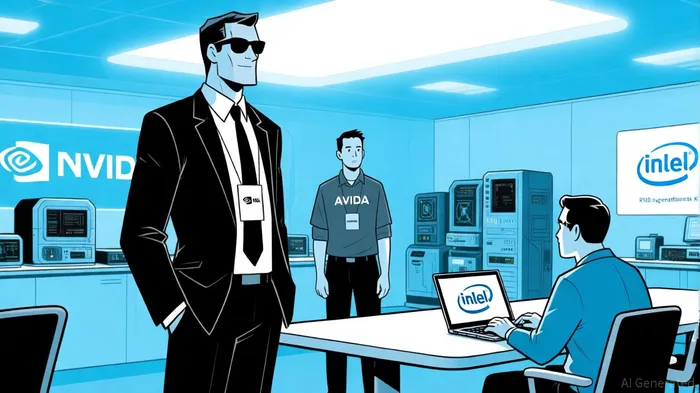
The AI semiconductor race in 2025 is defined by stark contrasts. NVIDIANVDA-- has cemented its dominance, with its data center segment generating $115.2 billion in fiscal year 2025 revenue—88% of its total—and capturing 94% of discrete GPU shipments[1]. AMDAMD--, while trailing, is gaining traction in inference workloads and open-source ecosystems, reporting $6.7 billion in data center revenue from its Instinct MI products[2]. IntelINTC--, meanwhile, faces an uphill battle, with its GPU market share declining by 2.1 points in 2025 as NVIDIA's share rose by 3.6 points[3]. Yet, Intel's recent $5 billion partnership with NVIDIA and a $8.9 billion U.S. government stake under the CHIPS Act[4] have reignited debates about its potential to close the GPU gap.
The NVIDIA Moat: Software, Ecosystem, and Scale
NVIDIA's leadership stems from its dual dominance in hardware and software. Its CUDA ecosystem, used by over 2 million developers[5], has become the de facto standard for AI development, creating a self-reinforcing cycle of innovation and adoption. The company's FY2025 R&D spend of $12.9 billion—a 50% increase from 2024—underscores its commitment to maintaining this edge[6]. Products like the H100 and Blackwell GPUs, optimized for large language model training, are entrenched in hyperscalers' infrastructures, with AWS, Azure, and Google Cloud collectively spending $325 billion on AI compute in 2025[7].
NVIDIA's strategic bets extend beyond R&D. Its $5 billion investment in Intel to co-develop custom CPUs integrating NVIDIA interconnect and GPU technology[8] is less a sign of altruism than a calculated move to secure Intel's foundry capabilities and reduce reliance on TSMC. This partnership also indirectly counters AMD, which has gained CPU and GPU market share with its integrated solutions[9].
AMD's Niche Play: Inference and Open Source
AMD's strategy hinges on differentiation. Its MI300X GPUs, with 192 GB of HBM3 memory, are carving out a role in cost-optimized inference clusters, particularly in academic and cloud environments[10]. The company's ROCm open-source software ecosystem appeals to institutions wary of vendor lock-in, though adoption lags behind CUDA due to backward compatibility issues[11]. AMD's Q2 2025 revenue surged 32% year-over-year[12], reflecting its ability to capture incremental market share in inference—a segment projected to grow at 28.3% CAGR through 2030[13]. However, its absence in high-end training workloads and weaker developer tools leave it vulnerable to NVIDIA's scale.
Intel's Reckoning: Capital, Restructuring, and Risks
Intel's 2025 challenges are multifaceted. Its data center and AI segment reported $3.9 billion in Q2 revenue—a 4% YoY increase[14]—but this pales against NVIDIA's $115.2 billion. The company's R&D expenses for Q2 2025 fell 13% YoY to $3.684 billion[15], signaling a shift toward financial discipline amid broader restructuring, including 21,000 layoffs[16]. While Intel plans to allocate $18 billion in 2025 capital expenditures[17], its AI roadmap is marked by delays and pivots. The Falcon Shores GPU project was repurposed as an internal test chip[18], and its focus has shifted to rack-scale solutions like Jaguar Shores—a full-stack AI infrastructure platform slated for 2026[19].
The NVIDIA partnership and government funding offer lifelines. The $5 billion investment provides Intel access to NVIDIA's AI technologies and could bolster its foundry operations[20], while the U.S. government's stake ensures political and financial support. However, these moves come with risks. Intel's Panther Lake and Clearwater Forest chips, built on the 18A process, face production uncertainties, and its decision to outsource Nova Lake to TSMC raises questions about long-term manufacturing independence[21].
Capital Allocation and Long-Term Viability
The AI semiconductor industry is witnessing a $1 trillion investment surge by 2028[22], but capital allocation will determine winners and losers. NVIDIA's $12.9 billion R&D spend in FY2025[6] reflects its confidence in sustaining its lead, while AMD's growth in inference workloads is backed by improving ROCm tools and strategic cloud partnerships. Intel's $17 billion R&D target for 2025[17] is ambitious but must contend with declining internal resources and reliance on external funding.
Intel's pivot to system-level AI solutions—such as Jaguar Shores—mirrors industry trends toward integrated hardware-software stacks[23]. Yet, success hinges on execution. The company's historical struggles with GPU performance and developer ecosystems, coupled with NVIDIA's entrenched dominance, suggest that closing the GPU gap will require more than capital—it demands a sustained innovation surge and ecosystem-building akin to CUDA.
Conclusion: A Long Shot, But Not a Lost Cause
Intel's AI bet is a high-stakes gamble. While its partnerships and government backing provide critical resources, the company remains a distant third in a market where NVIDIA's software moat and AMD's niche focus define the landscape. For Intel to close the GPU gap, it must leverage its foundry capabilities to secure design wins, accelerate its 18A roadmap, and foster developer adoption of its Arc GPUs and oneAPI tools. The path is fraught, but in an industry where capital and collaboration drive outcomes, Intel's resilience—and the $5 billion NVIDIA bet—suggest the race is not yet over.





Comentarios
Aún no hay comentarios