
Is Intel's Sizzling Stock Run a Lasting Turnaround or a Politically Driven Bubble?
The 80.3% surge in Intel's stock price in 2025 has ignited fierce debate among investors: Is this a genuine turnaround driven by operational progress, or a politically fueled bubble riding on government largesse? The answer lies in dissecting the interplay between Washington's unprecedented support and the company's ability to execute its ambitious manufacturing and AI strategies.
Political Tailwinds: A Government-Backed Bet on National Security
Intel's stock has benefited immensely from the Trump Administration's $8.9 billion equity investment, which secured a 9.9% stake in the company under the CHIPS and Science Act. This historic move, funded by unused grants and the Secure Enclave program, was framed as a strategic imperative to bolster U.S. semiconductor leadership and national security. The passive nature of the investment-no board seats, but a five-year warrant for additional shares-signals both confidence and caution. As stated by Intel CEO Lip-Bu Tan, the partnership aligns with "ensuring U.S. leadership in semiconductor manufacturing," a goal critical to countering global supply chain vulnerabilities.
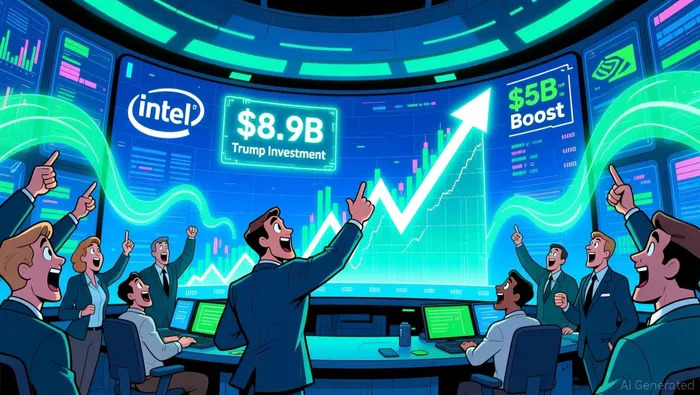 This political tailwind has also amplified Intel's visibility. A $5 billion investment from NVIDIA in IntelINTC-- stock, part of a collaboration to integrate NVLink connectivity into custom x86 processors, underscores the company's growing relevance in AI and high-performance computing (HPC) ecosystems. Meanwhile, strategic partnerships with Amazon and Microsoft, coupled with bipartisan praise from tech leaders like Satya Nadella and Michael Dell, have reinforced Intel's narrative as a cornerstone of American technological resilience.
Operational Execution Risks: Can Intel Deliver on Its Promises?
Yet, political momentum alone cannot sustain a stock's ascent. Intel's operational challenges remain daunting. The company's "IDM 2.0" strategy-blending internal manufacturing, external foundry services, and partnerships- hinges on flawless execution of advanced process nodes like Intel 18A. While RibbonFET and PowerVia technologies have shown promise, ramping up production to compete with TSMC and Samsung requires overcoming years of delays and technical hurdles.
Financial metrics offer mixed signals. Q3 2025 revenue hit $13.7 billion, surpassing guidance, and non-GAAP gross margins rose to 40.0%-a stark improvement from 15.0% in Q3 2024. However, analysts warn that profitability remains fragile until Intel's foundry strategy generates consistent returns. The company's AI ambitions, including the Panther Lake processor and full-stack AI solutions, are critical to capturing market share in a sector dominated by NVIDIANVDA--, which retains 92% of the discrete GPU market. While Intel's Gaudi series offers a cost-effective alternative, it still lags in high-performance applications.
Balancing the Equation: A Hybrid Outlook
The key to Intel's long-term success lies in balancing political tailwinds with operational execution. The government's investment provides a lifeline, but it also ties the company to ambitious domestic manufacturing goals, such as the Arizona fab's high-volume production. As data from HyperFrame Research notes, "cost-cutting alone can't spark a turnaround-Intel must secure external foundry business and deliver on its AI roadmap."
Moreover, the collaboration with NVIDIA, while strategic, highlights Intel's reliance on third-party innovation. NVIDIA's RTX GPU chiplets integrated into Intel's x86 SoCs may help bridge the gap in AI performance, but they also underscore the company's need for external validation. Meanwhile, environmental commitments-such as achieving 98% renewable electricity usage in 2024 and net-zero emissions by 2040-add another layer of complexity to capital allocation.
Conclusion: A Bubble with Legs?
Intel's stock run reflects a unique confluence of political will and operational progress. The government's stake and strategic partnerships have injected confidence, but the company's ability to sustain this momentum depends on its execution. With 2026 looming, investors must weigh whether Intel can transform its $100+ billion in U.S. investments into consistent returns while navigating fierce competition and technical risks.
For now, the stock's trajectory appears less like a speculative bubble and more like a high-stakes gamble: one where political tailwinds have created a runway, but operational execution will determine whether Intel soars or stalls.





Comentarios
Aún no hay comentarios