
Intel's Panther Lake and 18A Process: A Strategic Inflection Point for AI-Driven PC Revival and Foundry Credibility
The semiconductor industry is at a pivotal juncture, with AI-driven computing and advanced manufacturing processes reshaping competitive dynamics. Intel's Panther Lake and 18A process represent a critical test of the company's ability to reclaim relevance in both AI-powered PC markets and the foundry sector. As the company navigates a strategic shift under CEO Lip-Bu Tan, investors must assess whether IntelINTC-- can transform its manufacturing challenges into a sustainable competitive advantage.
The 18A Process: A Double-Edged Sword
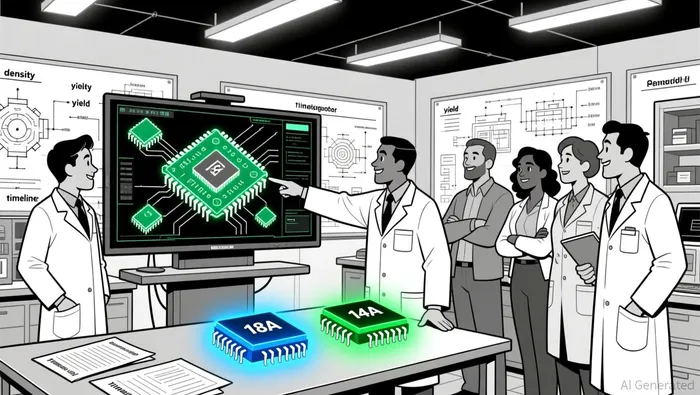
Intel's 18A process, featuring RibbonFET gate-all-around transistors and PowerVia backside power delivery, has achieved volume production ahead of TSMC's N2 node. This milestone positions Intel to deliver Panther Lake, its next-generation AI-enabled laptop chips, at scale. However, early yield issues and customer dissatisfaction in 2024 have cast doubt on the process's readiness. The company's recent pivot to prioritize the 14A process-potentially relegating 18A to internal use-signals a strategic recalibration. While this shift could lead to a significant financial write-off, it also reflects a pragmatic focus on high-NA EUV lithography for 14A, a technology expected to debut in late 2026.
Foundry Market Credibility: TSMC's Dominance and Intel's Counterplay
TSMC's foundry dominance remains unchallenged, with a 70% market share in Q2 2025 driven by AI accelerators and advanced node production. Its N2 node offers higher transistor density (313 MTr/mm² vs. Intel's 238 MTr/mm²), giving it a cost edge for high-volume clients. Intel's foundry ambitions hinge on differentiating through advanced packaging (e.g., Foveros Direct 3D) and hybrid bonding, which could attract customers seeking integrated solutions. Strategic partnerships with AWS, Microsoft, and Apple-targeting AI fabric chips and entry-level M-series processors-signal progress. However, without major external customers for 14A, Intel risks remaining a niche player in a market dominated by TSMCTSM-- and Samsung.
AI Performance: Panther Lake vs. Competitors
In AI-driven computing, Intel faces stiff competition from AMD and NVIDIA. AMD's Instinct MI400X, with 432GB of HBM4 memory and 19.6 TB/s bandwidth, is poised to outperform Intel's offerings in memory-intensive workloads. NVIDIA's H200 and B200 accelerators, built on TSMC's 3nm and N4 nodes, leverage mature CUDA and TensorRT ecosystems to dominate inference and training benchmarks. While Panther Lake's 18A process offers performance-per-watt advantages for edge AI, its ability to compete in datacenter-scale AI will depend on software optimization and ecosystem adoption.
Financial Realities and Strategic Risks
Intel's foundry segment reported $4.2 billion in operating revenue but a $2.3 billion loss in Q3 2025, underscoring the financial toll of its manufacturing overhauls. The company's $10 billion in external investments-from the U.S. government, NVIDIA, and SoftBank-provides a lifeline but also raises expectations for rapid returns. The 14A process, while technologically ambitious, requires massive capital expenditures and customer commitments to justify its $90+ billion investment in 18A infrastructure. If Intel fails to secure major clients for 14A, its foundry ambitions could stall, exacerbating its financial strain.
Conclusion: A High-Stakes Bet on Manufacturing Leadership
Intel's 18A-to-14A pivot is a high-risk, high-reward strategy. Success hinges on three factors: (1) resolving yield issues with 18A to ensure Panther Lake's AI performance meets expectations, (2) securing external customers for 14A to challenge TSMC's foundry dominance, and (3) leveraging advanced packaging to differentiate in a crowded AI market. While the company's partnerships with AWS, Microsoft, and Apple offer hope, its ability to execute on these fronts will determine whether it becomes a credible player in AI-driven computing or remains a cautionary tale of manufacturing missteps.
For investors, the coming year will be pivotal. Intel's 2026 performance-particularly in validating 14A and delivering competitive AI chips-will either cement its revival or expose the limits of its strategic reinvention.







Comentarios
Aún no hay comentarios