
Intel-Nvidia Partnership and Its Implications for AI Hardware Markets
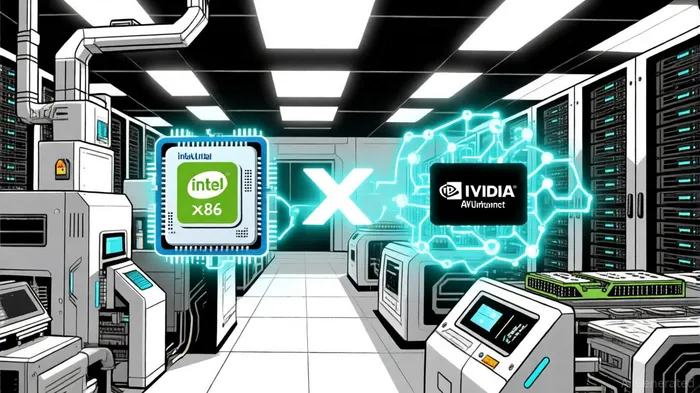
The recent landmark partnership between IntelINTC-- and NVIDIANVDA-- marks a seismic shift in the AI hardware landscape, transcending their historical rivalry to create a unified front in the race for AI-driven innovation. This collaboration, anchored by NVIDIA's $5 billion investment in Intel stock[2], is not merely a financial transaction but a strategic alignment of complementary strengths: Intel's x86 architecture and manufacturing prowess with NVIDIA's AI and accelerated computing leadership. Together, they aim to redefine AI infrastructure and personal computing, positioning themselves to dominate a market projected to grow at a 22% compound annual growth rate (CAGR) through 2030[3].
Strategic Synergy: Combining CPUs and GPUs for AI Supremacy
At the core of this partnership is the integration of NVIDIA's NVLink interconnect technology with Intel's x86 CPUs. For data centers, Intel will design custom x86 CPUs optimized for NVIDIA's AI platforms, while for consumer markets, the duo will co-develop “x86 RTX SOCs” that embed NVIDIA RTX GPU chiplets into Intel's system-on-chips[1]. This dual-pronged approach addresses a critical gap in the AI hardware ecosystem: the need for seamless integration between general-purpose CPUs and specialized AI accelerators. By leveraging Intel's 300mm wafer manufacturing capabilities and NVIDIA's cutting-edge GPU architectures, the partnership aims to deliver solutions that outperform standalone offerings from competitors like AMDAMD-- and TSMC[2].
The strategic rationale extends beyond technical integration. As U.S. policymakers push to reduce reliance on foreign chip manufacturing, this alliance bolsters domestic production capabilities. Intel's Ohio and New Mexico factories, paired with NVIDIA's AI roadmap, could position the U.S. as a leader in sovereign AI infrastructure—a critical advantage amid geopolitical tensions[2].
Long-Term Growth: Beyond Short-Term Market Hype
While Intel's stock surged over 10% following the announcement[2], the true value of this partnership lies in its long-term implications. The AI hardware market, valued at $86.79 billion in 2024, is expected to balloon to $691 billion by 2033, driven by demand for edge computing, generative AI, and industry-specific applications[1]. NVIDIA's Blackwell Ultra GPU, set for late 2025, and Intel's advanced 18A manufacturing process will be pivotal in capturing this growth.
This collaboration also mirrors broader trends in the AI era, where co-opetition—collaborating on shared challenges while competing in others—has become the norm. For instance, NVIDIA's $17.4 billion partnership with MicrosoftMSFT-- and Nebius[1] and IBM's alliances with cloud providers[2] highlight how infrastructure-driven partnerships are reshaping market dynamics. Unlike short-term vendor relationships, these alliances require joint roadmaps, shared R&D, and trust—a model that aligns with the decade-long growth trajectories of AI hardware.
Risks and Rivalries: Can the Alliance Sustain Momentum?
Despite its promise, the partnership faces hurdles. Execution risks include technical integration challenges, such as optimizing NVLink for Intel's architecture, and market competition from AMD's EPYC CPUs and TSMC's advanced packaging technologies. Additionally, geopolitical pressures, such as U.S. export controls on AI chips, could disrupt supply chains[2].
However, the scale of the investment and the complementary nature of their technologies suggest a high tolerance for risk. NVIDIA's stake in Intel ensures alignment of incentives, while Intel's access to NVIDIA's AI ecosystem (e.g., CUDA, TensorRT) strengthens its CPU roadmap. This mutual dependency is a hallmark of successful long-term alliances, as seen in historical partnerships like GoogleGOOGL-- and Mayo Clinic's AI-driven healthcare initiatives[2].
Conclusion: A Blueprint for AI-Driven Growth
The Intel-Nvidia partnership exemplifies how strategic alliances are becoming the bedrock of AI-driven growth. By prioritizing interoperability, shared innovation, and domestic manufacturing, the duo is not just competing on hardware but shaping the architecture of the AI future. For investors, this collaboration signals a shift from fragmented, short-term gains to ecosystem-based dominance—a trend that will define the next decade of technological progress.





Comentarios
Aún no hay comentarios