
Is Intel (INTC) Poised to Overtake TSMC in 2026?
The semiconductor industry is entering a pivotal year in 2026, with IntelINTC-- (INTC) and TSMCTSM-- locked in a high-stakes race to dominate next-generation chip manufacturing. As both companies vie for leadership in advanced process nodes and production capacity, investors are scrutinizing whether Intel's aggressive innovations and strategic investments can finally eclipse TSMC's long-standing dominance. This analysis examines Intel's 18A process node, its Arizona fab expansion, and key partnerships to assess the likelihood of a seismic shift in the chip manufacturing landscape.
Process Node Innovation: Intel's 18A vs. TSMC's N2
Intel's 18A process node, a 1.8nm-class technology, has entered high-volume manufacturing (HVM) for its Panther Lake client CPUs, marking a critical milestone in the company's resurgence. The node leverages RibbonFET gate-all-around (GAA) transistors and PowerVia backside power delivery, innovations that Intel claims deliver a 15-18% performance boost and 25-30% power reduction compared to TSMC's N3E node according to technical analysis. While TSMC's N2 process-also a 2nm-class node-boasts a higher transistor density of 313 million transistors per square millimeter (MTr/mm²) versus Intel's 238 MTr/mm², the PowerVia implementation in Intel's 18A may narrow this gap by optimizing backside power delivery and reducing parasitic losses.
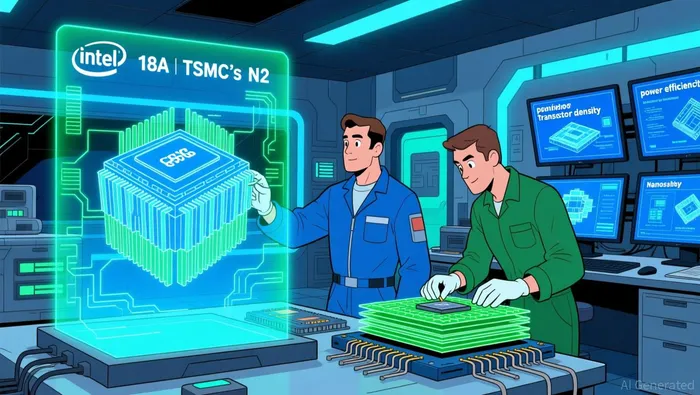
However, TSMC retains a yield advantage. As of late 2025, TSMC's N2 process has achieved 65% yield rates, with expectations of further improvements as demand from clients like Apple and NVIDIA surges. Intel's 18A yields have climbed from 50% to 55% in recent quarters, with projections of reaching 65-70% by Q4 2025. While Intel's progress is notable, TSMC's production maturity and client ecosystem remain formidable barriers.
Production Capacity: Arizona's Fab 52 and the CHIPS Act
Intel's Arizona fab expansion, particularly Fab 52 on the Ocotillo campus, is a cornerstone of its strategy to challenge TSMC. The facility, now in HVM for 18A, can produce over 40,000 wafers per month-surpassing TSMC's Arizona operations in capacity. This scale is critical for meeting demand for Intel's Panther Lake processors and attracting external foundry customers. The U.S. government's $7.86 billion CHIPS Act funding has further accelerated this expansion, enabling Intel to reduce reliance on Asian manufacturing hubs and align with geopolitical priorities.
In contrast, TSMC's N2 production is expected to ramp in late 2025 but faces bottlenecks due to its reliance on High-NA EUV lithography, which is still in development. Intel's 18A, by contrast, is already leveraging existing EUV tools, giving it a near-term edge in time-to-market. This timing advantage could allow Intel to capture early demand in high-performance computing and AI applications, where power efficiency and thermal management are paramount.
Strategic Partnerships: Nvidia and the Foundry Play
Intel's ability to overtake TSMC will also hinge on its success in the foundry market. A $5 billion investment from Nvidia-a major client for both Intel and TSMC-signals confidence in Intel's technology but stops short of a full commitment to its foundry services. While Nvidia has pledged to use some Intel technologies, such as RibbonFET, it remains a key TSMC customer for its H100 and B100 GPUs. Intel must secure additional foundry contracts to scale its 18A node beyond its own products, a challenge given TSMC's entrenched relationships with Apple, AMD, and others.
That said, Intel's focus on AI-native computing and advanced packaging technologies in Arizona positions it to target niche markets where performance-per-watt is a premium differentiator according to market analysis. If the company can replicate its success with Panther Lake in foundry offerings, it could erode TSMC's dominance in specific segments.
Investor Implications and Competitive Dynamics
For investors, the key question is whether Intel's 18A and Arizona expansion can translate into meaningful market share gains. While TSMC's N2 process and yield leadership ensure its continued dominance in the short term, Intel's production readiness and U.S.-centric strategy offer a compelling narrative. The company's ability to achieve 65-70% yields by year-end 2025 and scale 18A production to 40,000 wafers per month could attract clients seeking diversification away from TSMC.
However, overtaking TSMC entirely is unlikely in 2026. TSMC's N2 is projected to deliver a 15% performance gain and 30% power improvement over its 3nm node, while its global client base and production expertise remain unmatched. Intel's more realistic goal is to capture a significant portion of the foundry market, particularly in AI and HPC, where its PowerVia and RibbonFET innovations provide a unique value proposition.
Conclusion
Intel's 18A process and Arizona fab expansion represent a bold reentry into the vanguard of semiconductor manufacturing. While the company is not poised to fully overtake TSMC in 2026, its progress in process innovation, production capacity, and strategic partnerships positions it as a credible challenger. For investors, the focus should be on Intel's ability to scale its foundry business and maintain its yield trajectory-factors that could drive outsized returns as the industry transitions to next-generation nodes. TSMC's dominance remains secure, but the gap is narrowing, and in a sector defined by rapid technological shifts, even incremental gains could reshape the competitive landscape.







Comentarios
Aún no hay comentarios