
Intel's Government-Backed Turnaround: A Strategic Buy Opportunity Amid Policy-Driven Recovery?
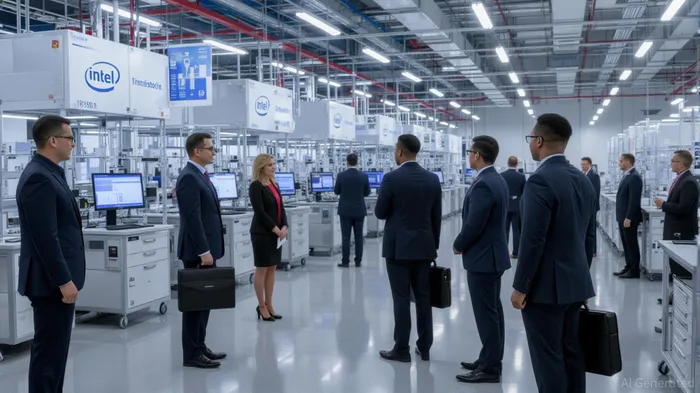
The semiconductor industry in 2025 is a battleground of geopolitical strategy, technological ambition, and financial risk. At the center of this storm stands Intel CorporationINTC--, a once-dominant chipmaker now navigating a precarious path to relevance. With the U.S. government poised to inject capital—and potentially equity—into Intel's operations under the CHIPS and Science Act, the question looms: Is this policy-driven lifeline a catalyst for long-term value creation, or a temporary fix for a fundamentally flawed business model?
The Policy-Driven Lifeline: CHIPS Act and Government Equity Stakes
The Trump administration's rumored plan to convert CHIPS Act grants into an equity stake in IntelINTC-- marks a radical shift in industrial policy. Unlike the Biden-era approach of grants and tax incentives, this strategy mirrors the administration's earlier intervention in MP Materials Corp.MP--, where a preferred equity stake secured access to critical rare-earth materials. For Intel, the stakes are higher. The proposed $7.86 billion in direct funding, coupled with up to $11 billion in loans, is not just a financial infusion—it's a strategic bet on U.S. semiconductor sovereignty.
The rationale is clear: Intel's Ohio campus, delayed until the 2030s, represents a linchpin in the administration's goal to counter Chinese dominance in advanced manufacturing. Yet, this intervention raises questions. Will government ownership dilute shareholder value? Can Intel's operational inefficiencies—exemplified by its $1.9 billion in restructuring charges and flat Q2 2025 revenue—be overcome with public funding? The answer hinges on whether the government's equity stake is paired with performance-linked incentives, ensuring that taxpayer dollars translate into tangible outcomes like production timelines and supply chain resilience.
Global Semiconductor Policies: A Zero-Sum Game
Intel's challenges are not unique to its internal struggles. The global semiconductor landscape is fracturing under the weight of competing industrial policies. The EU's push for self-sufficiency under the European Chips Act, China's state-backed push for self-reliance, and South Korea's strategic alignment with the U.S. all create a fragmented market. For Intel, this means navigating a web of export controls, supply chain bottlenecks, and geopolitical risks.
TSMC and AMDAMD--, for instance, face their own hurdles. TSMC's dominance in advanced packaging (e.g., CoWoS technology) positions it as a key enabler for AI hardware, but its reliance on Chinese manufacturing exposes it to regulatory scrutiny. AMD, while surging in AI accelerator markets, must contend with a flood of AI chip startups leveraging RISC-V and photonic ICs. Intel's pivot to AI and edge computing, while promising, requires not just capital but a coherent roadmap to differentiate itself in a crowded field.
Financial Realities: A Stock in Peril or Potential?
Intel's Q2 2025 results underscore the gravity of its situation. A GAAP loss of $0.67 per share and a non-GAAP loss of $0.10 per share, coupled with a 7% year-over-year revenue decline, paint a bleak picture. Analysts remain divided: Bernstein and MorningstarMORN-- caution against over-optimism, while UBS and Wedbush hint at cautious optimism if Intel's foundry pivot succeeds.
The stock's 19% year-to-date gain, fueled by government support rumors, masks deeper issues. With a P/E ratio in negative territory and a PEG ratio that lacks meaningful context, traditional valuation metrics fail to capture Intel's potential. However, the proposed equity stake could stabilize its balance sheet, enabling reinvestment in R&D and manufacturing. The key question is whether this stabilization will attract private capital or merely delay inevitable restructuring.
Strategic Buy or Policy-Driven Mirage?
For investors, the calculus is complex. Intel's strategic importance to U.S. national security ensures a floor for its valuation, but long-term success depends on its ability to execute. The government's equity stake could provide the liquidity needed to accelerate Ohio's completion and secure high-margin AI contracts. Yet, without a clear product roadmap and operational discipline, this support may prove insufficient.
The broader semiconductor industry's shift toward AI-driven design tools and heterogeneous chip systems (e.g., chiplets) demands agility. Intel's “IDM 2.0” strategy, which integrates advanced packaging and in-house manufacturing, is a step in the right direction. However, rivals like TSMCTSM--, with its 70,000-wafer CoWoS capacity, are already scaling faster.
Conclusion: A High-Risk, High-Reward Proposition
Intel's government-backed turnaround is a case study in the intersection of policy and market forces. While the CHIPS Act's equity stake offers a lifeline, it is not a panacea. Investors must weigh the geopolitical imperative—ensuring U.S. semiconductor leadership—against the company's operational track record. For those with a long-term horizon and a tolerance for volatility, Intel could represent a strategic buy, provided the government's involvement is paired with clear performance metrics. For others, the risks of over-reliance on public funding and a fragmented global market may outweigh the potential rewards.
In the end, Intel's story is not just about a company's survival—it's about the future of an industry that underpins the digital age. Whether it becomes a success or a cautionary tale will depend on how well it navigates the delicate balance between policy, innovation, and profitability.





Comentarios
Aún no hay comentarios