
Intel's Recent Downgrade and Strategic Vulnerabilities: Assessing Long-Term Risks Amid Fortunate Events
The recent credit rating downgrades from Fitch, S&P Global, and Moody's have cast a spotlight on Intel's deteriorating financial and operational health. While the company has leveraged strategic initiatives and external funding to stabilize its near-term liquidity, the long-term sustainability of these measures remains questionable. This analysis examines the structural risks facing IntelINTC--, the extent to which recent "fortunate" events mask deeper vulnerabilities, and the implications for investors.
Credit Downgrades and Immediate Risks
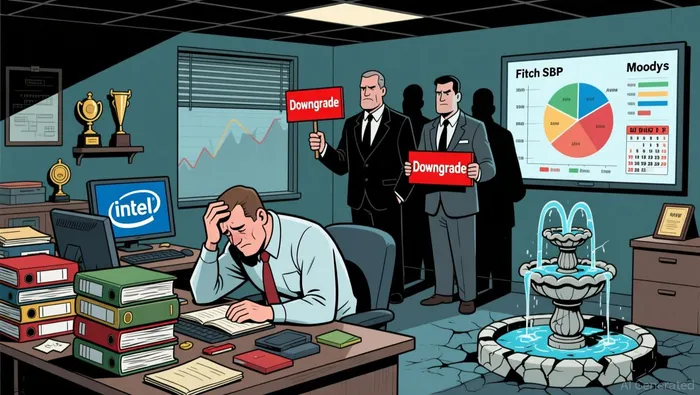
Intel's creditworthiness has eroded significantly in 2025. Fitch downgraded its long-term issuer default rating to BBB from BBB+ in August 2025, citing "heightened challenges in maintaining demand for its products" and intensifying competition from rivals like AMDAMD-- and Broadcom according to Fitch's analysis. Similarly, Moody's cut its senior unsecured rating to Baa2 from Baa1, emphasizing weak profitability and an eroding market position in core client and data center markets as reported by Moody's. These downgrades underscore a shared concern: Intel's ability to restore pricing power and halt market share losses remains uncertain.
The root causes are multifaceted. First, Intel's foundry operations have incurred high operating losses, with limited visibility on when these trends will reverse according to financial reports. Second, the company's debt burden-though offset by $21.2 billion in liquidity as of June 2025 as noted in earnings data-requires aggressive debt reduction and improved cash flow generation to regain prior credit ratings. Third, demand for traditional PC chips, a cornerstone of Intel's revenue, faces headwinds from shifting market dynamics and oversupply.
Strategic Initiatives and Fortunate Events
Intel has responded with a mix of strategic investments and operational adjustments. A $5.7 billion U.S. government funding package, converted into an equity stake, and a $2 billion investment from SoftBank Group have bolstered liquidity and supported foundry expansion according to Intel's Q3 2025 results. These funds are critical for advancing manufacturing capabilities, such as the completion of Arizona's Fab 52, which produces cutting-edge 18A wafers.
Additionally, Intel has leveraged partnerships to mitigate risks. A collaboration with NVIDIA to co-develop data center and PC products aims to combine strengths in CPU and AI technologies as detailed in the press release. On the sustainability front, the company has achieved 98% renewable electricity usage globally and reduced greenhouse gas emissions by 24% since 2019, aligning with a net-zero target by 2040 according to corporate sustainability reports.
Short-term financial results also offer optimism. Third-quarter 2025 revenue reached $13.7 billion, with losses narrowing compared to the prior year as reported in Q3 earnings. Workforce streamlining and reduced management layers are intended to enhance operational efficiency as part of strategic initiatives.
Sustainability of Strategic Measures
While these initiatives are commendable, their long-term efficacy is uncertain. Government funding and partnerships provide temporary relief but do not address structural weaknesses in Intel's core markets. For instance, the foundry business's profitability hinges on scaling production and capturing market share-a challenge given TSMC's dominance and AMD's aggressive foundry expansion.
Similarly, sustainability efforts, though laudable, are peripheral to Intel's primary financial challenges. The company's AI ambitions and environmental commitments may attract investor interest, but they cannot offset declining margins in traditional chip segments. Operational efficiency gains, such as workforce reductions, risk undermining innovation capacity if overdone.
Moreover, the reliance on "fortunate" events-such as one-time government subsidies-introduces volatility. If geopolitical or economic conditions shift, Intel's access to such funding could diminish, exacerbating liquidity pressures.
Conclusion
Intel's strategic initiatives and external funding have temporarily stabilized its financial position, but they mask deeper vulnerabilities. The company's ability to sustain growth depends on reversing market share losses, improving foundry profitability, and navigating a highly competitive semiconductor landscape. For investors, the key question is whether these efforts represent a durable turnaround or a temporary reprieve. While Intel's liquidity profile remains robust, the structural risks highlighted by rating agencies suggest that long-term recovery will require more than short-term gains-it will demand transformative execution and a redefinition of its competitive edge.





Comentarios
Aún no hay comentarios