
Intel's AI and Foundry Momentum: Can It Fuel a 100%+ Share Price Rally by 2026?
Financial Foundations and Strategic Reinvestment
Intel's Q3 2025 results underscore a dramatic turnaround. Revenue hit $13.65 billion, a 2.78% year-over-year increase, while net income surged 124% to $4.06 billion, according to an Investing.com analysis. This performance was driven by aggressive cost-cutting under CEO Lip-Bu Tan, which slashed operating expenses by nearly 20% and boosted gross margins to 40%, according to the same Investing.com analysis. The company's balance sheet has also strengthened, with cash reserves climbing to $30.94 billion and liabilities declining to $87.78 billion, according to the Investing.com analysis.
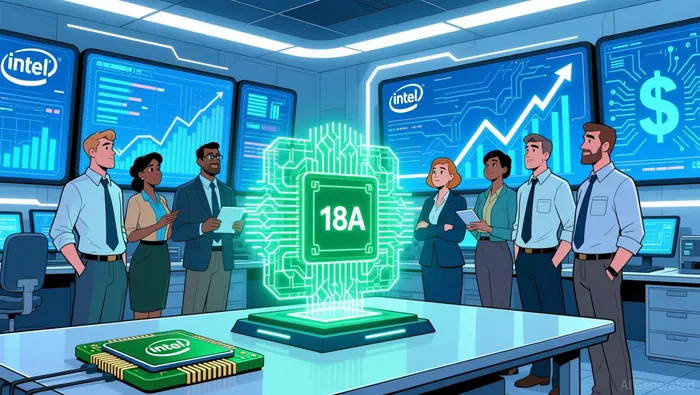
Crucially, Intel is reinvesting heavily in AI-centric initiatives. A $27 billion allocation for 18A process node scaling in 2025, according to the Investing.com analysis, signals its commitment to leading-edge manufacturing, while the Clearwater Forest data-center CPUs-optimized for AI workloads-are expected to capture cloud infrastructure demand, according to the Investing.com analysis. The Client Computing Group (CCG) and Data Center & AI (DCAI) segments are central to this strategy, with DCAI reporting a 23.4% operating margin on $4.1 billion in revenue, according to a LinkedIn post.
AI Infrastructure: Competing with NVIDIA and AMD
Intel's AI strategy is anchored in two pillars: custom accelerators and integrated CPU solutions. The Gaudi 3 AI accelerator, built on a 5nm process, claims to outperform NVIDIA's H100 by 1.5x in efficiency and speed, according to a ChronicleJournal article. Meanwhile, the Xeon 6 series integrates AI accelerators directly into the CPU, offering 5.5x higher inferencing performance than AMD's EPYC lineup, according to the same ChronicleJournal article. These advancements position Intel to challenge NVIDIA's dominance in data centers and HPC (high-performance computing) markets.
Strategic partnerships further bolster this effort. Collaborations with NVIDIA and SoftBank, according to the LinkedIn post, highlight Intel's pivot from isolation to ecosystem-building, while government support under the CHIPS Act provides a tailwind for domestic manufacturing, according to the Investing.com analysis. However, yield rates on 18A fabs remain a hurdle, lagging behind TSMC's maturity in 3nm processes, according to the Investing.com analysis.
Foundry Scalability: Closing the Gap on TSMC
Intel's foundry business, though still unprofitable (a $2.3 billion loss in Q3 2025, according to the LinkedIn post), is gaining traction. The 18A process node has attracted high-profile clients like Microsoft, which plans to use it for its next in-house AI chip, according to a Yahoo Finance article. This is critical, as demand for advanced AI manufacturing outpaces supply, with TSMC and Samsung struggling to meet capacity needs, according to the Yahoo Finance article.
The IDM 2.0 framework-combining in-house manufacturing with third-party services-positions Intel to capture a 10% global foundry market share by 2026, according to the Yahoo Finance article. Yet, skepticism persists. Potential partnerships with AMD, according to an ElNion article, and SoftBank, according to the LinkedIn post, aim to address credibility gaps, but scaling the foundry business will require sustained investment and customer diversification.
Risks and Market Realities
While Intel's momentum is undeniable, several risks could derail its trajectory. The AI infrastructure market remains volatile, as evidenced by C3.ai's 5.3% stock drop amid leadership uncertainty and declining revenue, according to a Fool article. Intel must avoid similar pitfalls by maintaining profitability in its AI and foundry segments.
Additionally, TSMC's lead in 3nm and 2nm processes, according to the Yahoo Finance article, and NVIDIA's entrenched AI software ecosystem pose long-term threats. Intel's foundry business must also prove its ability to scale without relying on government subsidies.
Conclusion: A Plausible 100%+ Rally?
For Intel to achieve a 100%+ share price rally by 2026, three conditions must align:
1. Sustained AI demand for Gaudi 3 and Clearwater Forest CPUs.
2. Foundry adoption by Microsoft, AMD, and other tech giants.
3. Execution on cost discipline and margin expansion.
The company's financial health, strategic partnerships, and government support create a strong foundation. However, execution risks-particularly in yield rates and customer acquisition-remain. If Intel can close the gap with TSMC and maintain its AI momentum, a 100%+ rally is plausible. But investors must remain cautious: the semiconductor industry is unforgiving to even minor missteps.





Comentarios
Aún no hay comentarios