
Intel's 18A Manufacturing Gambit: Can Strategic Client Testing Translate to Foundry Revival?
The semiconductor industry is at a crossroads, and Intel's 18A process node sits at the center of a high-stakes gamble. With its RibbonFET gate-all-around (GAA) transistors and PowerVia backside power delivery, the 18A node promises a 25% performance boost or 36% power reduction compared to the prior generation. But as the company races to close the gap with TSMC's 2nm process, the real question isn't just about technical prowess-it's whether IntelINTC-- can convert its internal success into a viable foundry business.
The 18A Edge: A Technological Leap, But at What Cost?
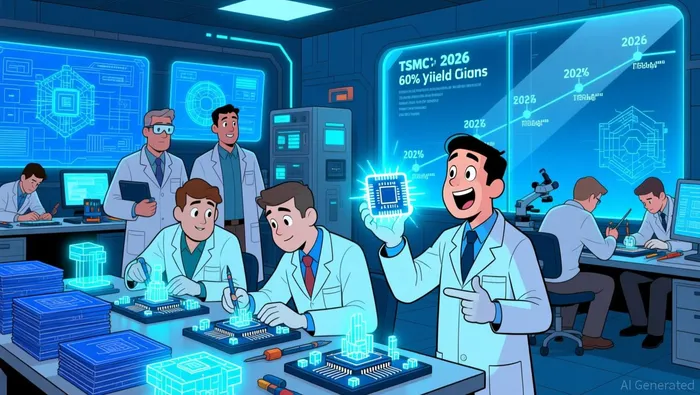
Intel's 18A process is already in production, powering the Panther Lake client CPUs and Clearwater Forest server chips. This six-month lead over TSMC's 2nm node is a tactical win, but the company's CFO, David Zinsner, has been candid: yields remain a thorn in the side. While recent improvements (7% monthly gains) suggest progress, the 18A node is still far from "commercially comfortable" levels. At 20–30% yields, Intel's costs remain elevated compared to TSMC's 60% yields on its 2nm process according to industry analysis. This isn't just a technical hurdle-it's a financial one. Without cost-competitive manufacturing, Intel's foundry business will struggle to attract external clients, even with cutting-edge tech.
Foundry Market Realities: TSMC's Dominance and Intel's Catch-Up Game
TSMC's grip on the foundry market is near unassailable. The company commands 64.9% of the global foundry market and 67% of the advanced node segment. Its ecosystem of loyal customers-Apple, AMD, NVIDIA-alongside its proven ability to scale production, creates a formidable moat. Intel's foundry services, meanwhile, are still a niche player. As of late 2025, the company has secured limited external commitments for 18A, relying heavily on internal products like Panther Lake to justify its Arizona fab investments. This raises a critical question: Can Intel's "internal foundry model" (pricing internal units like external clients) generate the economies of scale needed to compete?
The answer hinges on two factors: yield improvements and client acquisition. Intel's 18A-P variant, expected in 2026, offers an 8% performance-per-watt boost over the base node, which could entice fabless players. But TSMC's ecosystem support-tools, IP, and design flows-remains unmatched. Intel's recent partnership with Synopsys to certify EDA tools for 18A is a step forward, but it's a race against time.
Strategic Alliances: A Lifeline or a Band-Aid?
Intel's collaboration with NVIDIA is a case in point. The $5 billion equity investment and joint development of x86 + GPU tile systems for AI infrastructure signal optimism. Yet, this partnership also underscores Intel's fragility. By outsourcing Arrow Lake production to TSMCTSM--, the company is hedging its bets on its own manufacturing capabilities. This duality-leveraging TSMC while trying to outcompete it-highlights the precarious balancing act Intel must perform.
Government support, meanwhile, offers a glimmer of hope. The CHIPS Act's $8.9 billion investment in Intel's Arizona fabs provides a financial cushion, but it's not a guarantee of success. The U.S. government's stake in domestic manufacturing is a political imperative, but market forces will ultimately decide whether Intel's foundry business is viable.
Risk/Reward: A Calculated Bet for the Long Game
The risks are clear. Intel's 18A node is still a work in progress, with yield rates and client acquisition timelines uncertain. The company's history of delayed nodes and underwhelming external demand (e.g., canceled client trials) adds volatility. Yet, the rewards are equally compelling. If Intel can stabilize yields by 2026 and secure high-profile clients, its foundry business could become a $10–15 billion annual revenue stream. The 18A node's performance-per-watt edge also positions Intel to capture a slice of the AI and HPC markets, where power efficiency is paramount.
Moreover, Intel's "systems foundry" approach-integrating advanced packaging (EMIB) and design-for-yield strategies-could differentiate it from TSMC. This is particularly relevant as AI chips demand heterogeneous integration.
Conclusion: A Make-or-Break Year for Intel's Foundry Ambitions
Intel's 18A process is a technological marvel, but its commercial success depends on execution. The company must deliver on yield improvements, secure external clients, and prove that its internal foundry model can scale. While TSMC's dominance isn't easily shaken, Intel's government-backed infrastructure and strategic partnerships offer a unique edge. For investors, the key takeaway is this: Intel's foundry revival isn't a binary outcome. It's a marathon, not a sprint. Those willing to stomach short-term volatility for long-term gains might find the 18A gamble worth the risk-but only if Intel can turn its manufacturing prowess into a sustainable foundry business.







Comentarios
Aún no hay comentarios