
Intel's 18A Launch: A Tactical Pop or a Foundry Catalyst?
The catalyst was clear and immediate. On Tuesday, IntelINTC-- officially launched its new Core Ultra Series 3 chips, dubbed "Panther Lake," at CES. The market's reaction followed the next day: Intel stock soared 6.5% in Wednesday's trading session. This pop was a direct relief rally on execution. For years, Intel's manufacturing revival has been hamstrung by a negative feedback loop: weak sales left its fabs underutilized, which in turn made it harder to justify the capital needed to catch up technologically. The launch of Panther Lake on the 18A process breaks that cycle in a tangible way.
The chips themselves are aimed squarely at the high-growth AI PC market, a critical battleground. Intel confirmed they are in production, ramping, and available for order this week. This isn't a vague roadmap; it's a product in the market. The launch is a high-stakes test for the company's manufacturing arm. As one analyst noted, it was a "do-or-die moment" to prove Intel is back to being an "executing machine." The stock pop reflects a market that had reasonable doubt about that credibility. By finally delivering a product on its latest node, Intel met a fundamental hurdle it had repeatedly missed.
Yet the tactical setup is clear. The 6.5% pop is a relief rally on a single execution milestone, not a fundamental valuation reset. The real test begins now: can this launch attract outside customers to Intel's 18A fabs and convince the industry that its manufacturing technology is viable? The market is rewarding the first step, but the next steps-scaling production and winning external design wins-will determine if this is a pop or a catalyst.
The Mechanics: What the 18A Launch Actually Delivers
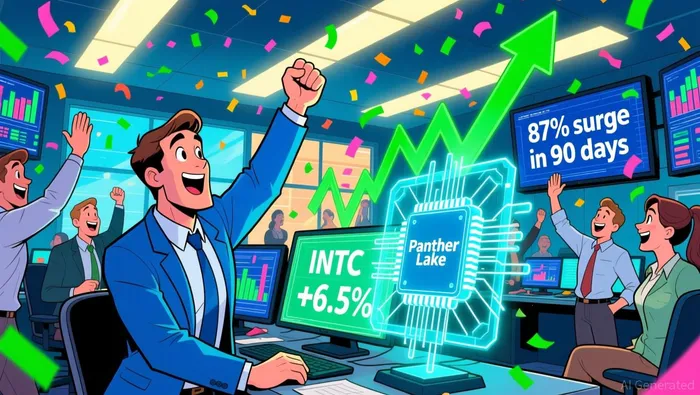
The launch delivers a tangible product on a new process, but the competitive math is tight. Intel is putting its most advanced U.S.-manufactured technology to work: the Core Ultra Series 3 processors are the first platform built on Intel 18A, the company's most advanced semiconductor process ever developed and manufactured in the United States. This is the core of the bet. The chips themselves promise a significant leap, with graphics and central processors integrated in Panther Lake delivering 50% faster performance than its previous generation of chips, Lunar Lake. More broadly, the Series 3 family is designed to power over 200 PC designs from global partners, aiming for the broadest adoption of any Intel AI PC platform.
Yet the execution risk is immediate and specific. The primary hurdle is yield-the number of functional chips per wafer. Intel has struggled with the yield for Panther Lake processors, a known weakness that could delay ramp-up and inflate early costs. While executives say yields are improving monthly, any persistent yield issues would directly threaten the chip's ability to compete on price and availability. The company is launching this high-volume product on 18A with the explicit goal of reclaiming market share it has lost to Advanced Micro Devices (AMD). That sets up a direct battle, especially as AMD is also launching new AI-focused PC chips at the same event.
The performance claims are strong, but the market will judge the real-world value. The chips are built for the AI PC race, with integrated AI acceleration aimed at workloads like robotics and smart cities. However, the launch's success hinges on converting this technological promise into design wins and market share. The 6.5% stock pop was a relief for execution, but the next test is whether these processors can actually move the needle against AMD's offerings and the broader ecosystem.
The Valuation Setup: Price Action and Near-Term Catalysts
The stock's recent run has been explosive. Over the past five days, Intel shares have climbed 14.29%, a surge that includes the 6.5% pop on the launch news. This moves the stock to $42.63, just a few dollars shy of its 52-week high of $44.57. The broader picture is even more dramatic, with shares up 87% over the past 120 days. This isn't a minor bounce; it's a sustained rally that has reset the valuation narrative. The market is pricing in a fundamental turnaround, but the setup now hinges on whether the company can deliver on the next tangible steps.
The immediate catalyst is the start of system shipments. According to Intel, laptops and mini PCs powered by the new Core Ultra Series 3 processors will begin shipping by the end of January. This is the first real test of demand. The launch was a product milestone; these shipments will be a sales milestone. The company has already confirmed the chips are in production and available for order, but the market will watch for early order flow and shipment data to see if the promised adoption materializes. Any sign of weak initial uptake could quickly deflate the recent optimism.
The primary risk is a classic "sell the news" event. The 14%+ pop over five days prices in a successful launch and strong demand. If the January shipment data shows tepid orders or if yield issues persist and delay volume, the stock could see a sharp reversal. The volatility metrics underscore this risk, with the stock showing a daily amplitude of 11.11% and 11.29% intraday volatility. This choppiness reflects a market that is highly sensitive to new information. The valuation multiples also highlight the premium being paid for execution. With a trailing P/E of over 1,000, the market is valuing Intel as a growth story, not a value one. That leaves little room for error.
The bottom line is a high-stakes test of momentum. The stock has rallied on a single catalyst, and its next move will be dictated by the first hard data on demand. For now, the setup is one of high reward and high risk, where the next few weeks of shipment reports will determine if the pop was just a relief rally or the start of a sustained re-rating.





Comentarios
Aún no hay comentarios