
The Institutionalization of Crypto Derivatives: CME vs. Binance in 2025
The institutionalization of crypto derivatives in 2025 marked a seismic shift in the market's structure, volatility, and regulatory landscape. What was once a speculative playground for retail traders has evolved into a sophisticated arena dominated by institutional players, with CME GroupCME-- and Binance emerging as pivotal forces. This transformation, driven by regulatory clarity and infrastructure development, has redefined how crypto derivatives are traded, hedged, and perceived as an asset class.
Regulatory Clarity and Market Legitimacy
The foundation for institutional adoption was laid by 2025 through landmark regulatory developments. In the U.S., the GENIUS Act and the EU's Markets in Crypto-Assets (MiCA) framework provided a clear legal structure for crypto derivatives, enabling traditional financial institutions to treat digital assets as legitimate investments according to Binance's analysis. According to Bloomberg, the Commodity Futures Trading Commission (CFTC) began enforcing consistent rules for crypto derivatives, reducing ambiguity and attracting pension funds, hedge funds, and asset managers. This regulatory convergence-seen also in Singapore, the UAE, and Hong Kong-created a global ecosystem where institutional capital could flow with confidence according to Chainalysis.
CME Group capitalized on this shift by positioning itself as the premier venue for regulated crypto derivatives. By late 2025, CMECME-- had not only surpassed Binance in BitcoinBTC-- futures open interest (OI) but also launched the CME CF Bitcoin Volatility Index (BVX), a tool for institutional investors to gauge market expectations of price swings. As stated by CME, these indices reflect the maturation of the Bitcoin options market and the demand for advanced risk management tools.
Binance's Institutional Gambit
While CME's dominance in regulated derivatives is undeniable, Binance's 2025 strategies underscored its adaptability in a rapidly institutionalizing market. The exchange regained its lead in Bitcoin futures OI by late 2025, holding $11.2 billion in notional value compared to CME's $11 billion. This resurgence was fueled by Binance's aggressive regulatory overtures, including securing licenses in 21 jurisdictions and allocating 22% of its workforce to compliance roles.
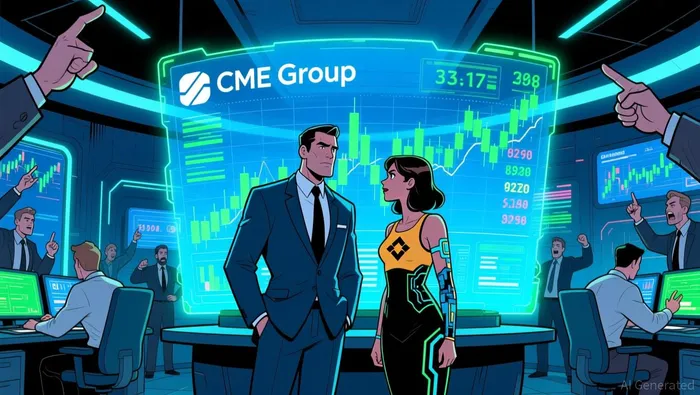
Binance's institutional push extended beyond compliance. The launch of spot ETFs for Bitcoin, EthereumETH--, and other major assets attracted billions in net inflows, signaling a shift from speculative trading to long-term portfolio allocation. Richard Teng, Binance's Co-CEO, emphasized at Blockchain Week 2025 that institutions are only beginning to explore crypto's potential, a sentiment echoed by the rise of tokenized real-world assets (RWAs) and stablecoins as liquidity infrastructure.
Market Structure and Volatility Dynamics
The institutionalization of crypto derivatives has introduced new complexities to market structure. In 2025, extreme volatility events-such as a $16.7 billion liquidation in September-highlighted the fragility of margin systems and the interconnectedness of centralized and decentralized derivatives markets. While CME's regulated environment offered stability, Binance's decentralized counterparts, like Hyperliquid, captured 73% of DEX derivatives volume, catering to niche strategies and cross-chain arbitrage.
CME's volatility indices (BVX and BVXS) provided a benchmark for institutional risk assessment, but the market's reliance on leverage and macroeconomic factors-such as U.S.–China trade tensions and central bank policies-continued to amplify swings. Bitcoin's beta-like behavior, tracking global liquidity conditions, further underscored its sensitivity to systemic risks.
Long-Term Implications
The 2025 institutionalization of crypto derivatives signals a broader trend: the convergence of traditional finance and digital assets. As regulatory frameworks solidify in 2026, the UK, Canada, and Australia are expected to finalize their digital asset rules, potentially unlocking trillions in institutional capital. This will likely accelerate the adoption of tokenized RWAs and stablecoins, which now command $312.63 billion in capitalization.
However, the coexistence of CME's regulated products and Binance's hybrid model raises questions about market fragmentation. While CME's volatility indices and spot-quoted futures enhance transparency, Binance's focus on innovation and global compliance may foster a more inclusive but less centralized derivatives ecosystem.
Conclusion
The institutionalization of crypto derivatives in 2025 has redefined market structure, volatility, and regulatory expectations. CME's dominance in regulated products and Binance's institutional adaptability reflect divergent but complementary paths toward mainstream adoption. As 2026 unfolds, the interplay between these forces-and the regulatory frameworks that govern them-will determine whether crypto derivatives become a cornerstone of global finance or remain a volatile niche. For investors, the key takeaway is clear: institutional adoption is not just about capital inflows but about building infrastructure resilient enough to withstand the next market shock.





Comentarios
Aún no hay comentarios