
The Institutionalization of Bitcoin: Implications for Market Stability and Retail Investors
Regulatory Clarity and Institutional Adoption
The U.S. regulatory environment has been a catalyst for Bitcoin's institutional adoption. According to analysis, the passage of the CLARITY Act and the implementation of the GENIUS Act in 2025 eliminated much of the uncertainty that previously deterred institutional participation. These reforms streamlined the approval process for spot Bitcoin ETFs, reducing the SEC's review timeline from 270 days to 75 days. As a result, institutional capital inflows surged: spot Bitcoin ETFs alone absorbed $12.4 billion in net inflows during Q3 2025, with BlackRock's IBITIBIT-- dominating the market with $100 billion in assets under management and a 61.4% market share.
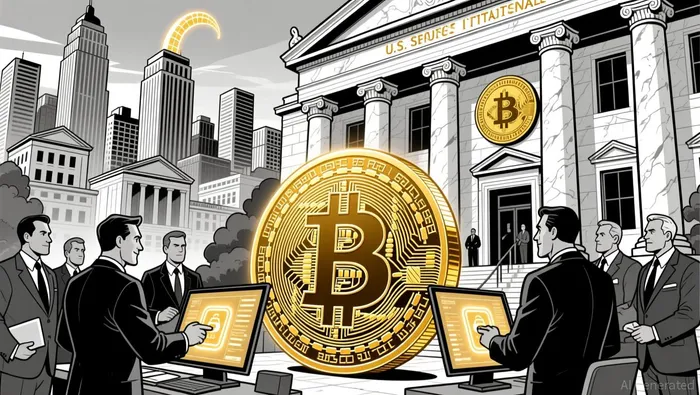
Corporate treasuries have also embraced Bitcoin as a strategic reserve asset. Over 50 publicly traded firms now hold Bitcoin, with MicroStrategy leading the charge at 640,000 BTC in reserves. Governments, too, are accumulating Bitcoin, holding 463,000 BTC (2.3% of total supply) as of Q3 2025. This institutional validation has transformed Bitcoin from a speculative token into a legitimate store of value, akin to gold but with superior programmability and divisibility.
Capital Reallocation from Traditional Assets
The rise of Bitcoin as an institutional asset class has triggered a measurable reallocation of capital from traditional assets. While gold has outperformed Bitcoin in 2025 (up 55.2% year-to-date versus Bitcoin's -1.2%), institutional investors are increasingly diversifying their allocations. For instance, corporate Bitcoin reserves reached $117 billion in Q3 2025, with firms like MicroStrategy and Tesla allocating billions to the asset. Meanwhile, institutional-grade real estate investments in India totaled $4.3 billion in the first nine months of 2025, though this marked a 9% decline year-on-year according to industry reports.
The reallocation is not uniform. Real estate remains resilient due to structural demand drivers like urbanization and infrastructure development according to market analysis, while equities face pressure from macroeconomic volatility. However, Bitcoin's role as a hedge against inflation and currency devaluation is gaining traction. For example, Coinbase reported a 122% quarter-on-quarter increase in institutional trading revenue in Q3 2025, reaching $135 million, signaling a shift toward crypto-centric strategies.
Market Stability and Volatility
Institutional adoption has significantly reduced Bitcoin's volatility. Annualized volatility has dropped by 75% from historical peaks by mid-2025, attributed to the "strong hands" effect-institutional investors are less prone to panic selling during downturns. Regulated vehicles like spot Bitcoin ETFs have also enhanced liquidity, making Bitcoin more attractive to conservative institutions such as pension funds and insurers.
However, Bitcoin's correlation with equities has risen. During periods of market stress, Bitcoin now exhibits a positive correlation of 0.5 with U.S. stocks according to economic analysis, a shift from its historical uncorrelated status. This reflects its integration into broader investment strategies, particularly during economic uncertainty. Long-term forecasts suggest an average correlation of 0.39 to U.S. stocks over the next decade according to market projections, indicating a maturing asset class.
Implications for Retail Investors
For retail investors, the institutionalization of Bitcoin presents both opportunities and challenges. On one hand, deeper liquidity and reduced volatility make Bitcoin more accessible to everyday investors. The proliferation of ETFs and institutional-grade custodians has democratized access to Bitcoin, reducing barriers to entry. On the other hand, retail investors must navigate a market increasingly influenced by institutional strategies. For example, MicroStrategy's decision to pause Bitcoin purchases ahead of earnings announcements in Q4 2025 caused short-term price fluctuations, highlighting how institutional actions can dominate market sentiment.
Retail investors should also consider Bitcoin's evolving role in a diversified portfolio. While its correlation with equities has increased, its unique properties-such as its hard supply cap and decentralized nature-still offer distinct advantages over traditional assets. As institutional allocations grow, Bitcoin's price may become less susceptible to retail-driven speculation, creating a more stable environment for long-term holders.
Conclusion
The institutionalization of Bitcoin marks a seismic shift in global finance. Regulatory clarity, macroeconomic tailwinds, and technological advancements have transformed Bitcoin into a mainstream asset class, attracting capital from traditional sectors like gold, real estate, and equities. While this reallocation has reduced Bitcoin's volatility and enhanced market stability, it has also introduced new dynamics for retail investors. As the asset matures, its role as a hedge against inflation and a store of value will likely solidify, reshaping the investment paradigm for decades to come.







Comentarios
Aún no hay comentarios