
The Institutionalization of Altcoins: How Solana, Litecoin, and Hedera ETFs Are Reshaping Crypto Access and Returns
The crypto market is undergoing a seismic shift as institutional capital floods into altcoin ETFs, driven by regulatory clarity and yield-seeking strategies. In 2025, the launch of SolanaSOL--, LitecoinLTC--, and HederaHBAR-- ETFs marks a pivotal moment in the mainstream adoption of digital assets. These products are not just speculative tools-they are redefining how investors access crypto returns while balancing risk and reward in a maturing ecosystem.
Regulatory Progress: A Gateway to Institutional Capital
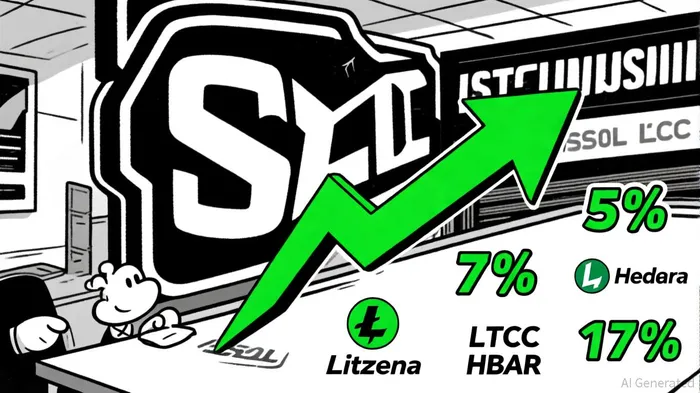
The U.S. Securities and Exchange Commission's (SEC) adoption of generic listing standards for crypto ETFs has removed a major barrier to institutional participation, according to a Sherwood News report. This shift enabled the rapid approval of the first Solana Staking ETF, which offers investors exposure to Solana's native token (SOL) while generating 7% staking rewards. The fund's proof-of-stake mechanism has already attracted projections of $3 billion to $6 billion in inflows within its first year, according to that report, signaling a new era of institutional confidence in altcoins.
Canary Capital's Litecoin (LTCC) and Hedera (HBR) ETFs further illustrate this trend. Despite the U.S. government shutdown delaying SEC approvals, these funds leveraged streamlined regulatory frameworks to launch in October 2025, according to a CryptoTimes filing. The Hedera ETF, in particular, has seen HBAR's price surge 326% year-to-date, reflecting strong demand for high-growth altcoins, as reported by Sherwood News.
Yield-Driven Diversification: Altcoins as Institutional Assets
Institutional investors are increasingly allocating capital to altcoin ETFs as part of yield-driven diversification strategies. The Solana Staking ETF, for instance, offers a 5% yield through staking rewards, per the CryptoTimes filing, outpacing traditional fixed-income instruments like U.S. Treasuries, which hover near 4% in 2025. Similarly, the Litecoin ETF's 0.95% management fee-also noted in the CryptoTimes filing-though higher than BitcoinBTC-- ETFs, reflects its role in capturing growth from the 30th-largest cryptocurrency by market cap, according to Sherwood News.
Hedera's HBARHBAR-- token, now the 26th-largest crypto asset, has demonstrated exceptional performance, with a 17% 24-hour gain and 326% annual return as reported by Sherwood News. This volatility, while daunting, aligns with institutional strategies that prioritize high-risk, high-reward allocations in crypto. As one analyst notes, "These ETFs are not for conservative portfolios-they're for investors seeking alpha in a digital-first world," noted in a Coinpaper article.
Risk-Return Analysis: Altcoins vs. Traditional Assets
The risk-return profiles of these ETFs highlight their disruptive potential. Solana's price has surged nearly 10% in a week, as Coinpaper reported, while Litecoin and Hedera have delivered 44% and 326% annual returns, respectively, per Sherwood News. By comparison, the S&P 500's 2025 annualized return of ~9% pales in contrast. However, altcoins' volatility demands careful allocation. For example, the Solana Staking ETF's 7% yield must be weighed against its exposure to network risks, such as validator performance or regulatory shifts, according to the coinotag coverage.
Institutional portfolios are mitigating these risks through multi-asset strategies that blend altcoin ETFs with Bitcoin and EthereumETH-- products. Bitwise's Solana Staking ETF, with its 0% fee for the first $1 billion in assets, exemplifies how cost efficiency can enhance risk-adjusted returns, a point noted by Sherwood News. Meanwhile, Grayscale's conversion of its Solana Trust into an ETF underscores the sector's shift toward institutional-grade liquidity, as Coinpaper reported.
The Road Ahead: A Maturing Market
The launch of these ETFs is not just a regulatory victory-it's a catalyst for broader crypto adoption. As institutional capital flows into altcoins, it drives liquidity, price discovery, and innovation in decentralized finance (DeFi) and tokenization. However, challenges remain. The SEC's delayed approvals during the government shutdown and the 0.95% management fees for Litecoin and Hedera ETFs, both detailed in the CryptoTimes filing, highlight the need for continued regulatory clarity and cost optimization.
For investors, the key takeaway is clear: altcoin ETFs are no longer niche. They represent a bridge between traditional finance and the next frontier of digital assets. As Polymarket data shows an 88% probability of Litecoin ETF approval by year-end, reported in the CryptoTimes filing, the stage is set for a wave of institutional adoption that could redefine crypto's role in global portfolios.






Comentarios
Aún no hay comentarios