
The Institutional Shift to Altcoins: A New Era for Crypto Diversification
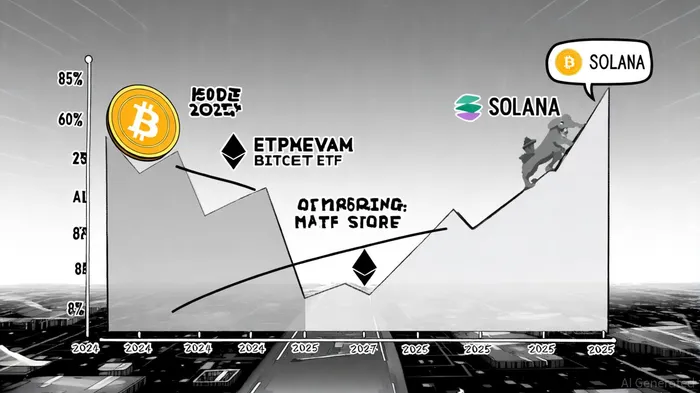
The crypto market is undergoing a seismic shift. For years, BitcoinBTC-- dominated institutional portfolios as the “digital gold” narrative took hold. But as Bitcoin stabilizes post-halving and institutional adoption matures, capital is now flowing into altcoins—marking a pivotal moment for portfolio diversification. This transition isn’t just speculative; it’s driven by macroeconomic tailwinds, regulatory clarity, and technological innovation.
Bitcoin’s Stabilization: The Foundation for Altcoin Growth
Bitcoin’s institutional adoption has reached a critical inflection point. By August 2025, 59% of institutional portfolios included Bitcoin, with over 134 publicly listed firms holding the asset [3]. This adoption is underpinned by Bitcoin’s scarcity and its role as a hedge against monetary debasement. However, as Bitcoin consolidates near key resistance levels and gains legitimacy via spot ETFs, its dominance has dipped below its 250-day moving average—a classic precursor to altcoin season [5].
The stabilization of Bitcoin has created a “safe haven” for institutional capital, allowing investors to rebalance portfolios toward riskier, high-growth assets. According to a report by TokenMetrics, this dynamic mirrors historical bull cycles, where Bitcoin’s dominance wanes as capital rotates into altcoins with innovative use cases [2].
Institutional Capital Reallocation: From Bitcoin to Altcoins
The shift is evident in Q3 2025 data. EthereumETH-- ETFs attracted $2.22 billion in inflows, pushing their market dominance to 57.3% [3]. SolanaSOL--, with its high-performance blockchain and staking yields of 3–4%, captured $1.72 billion in institutional capital during the same period [3]. These movements reflect a broader reallocation driven by yield generation and technological differentiation.
Ethereum’s deflationary supply model and corporate staking activity ($3 billion in Q3 2025) have made it a cornerstone of diversified crypto portfolios [3]. Meanwhile, projects like Zora, Spark, and PancakeSwap are gaining traction for their integration with AI and tokenization ecosystems [1]. The ETH/BTC ratio crossing above its 250-day moving average in July 2025 further signals a structural shift in capital allocation [5].
Strategic Rebalancing: Key Altcoin Sectors to Target
Institutional investors are now prioritizing altcoins with clear utility and defensible market positions. Three sectors stand out:
1. Layer 1 Blockchains: Ethereum and Solana remain top picks due to their robust ecosystems and staking yields.
2. AI-Integrated Protocols: Projects like Sahara AI are leveraging machine learning to optimize DeFi strategies, attracting capital from tech-savvy institutions [2].
3. DeFi and Tokenization Platforms: Zora and PancakeSwap are benefiting from renewed interest in decentralized finance, driven by tokenized real-world assets and yield-generating mechanisms [1].
Diversification strategies now emphasize sectoral balance, with investors allocating 10–15% of crypto exposure to altcoins. Gradual position building and technical analysis tools like RSI are critical for managing volatility [4].
Regulatory Tailwinds: A Catalyst for Institutional Confidence
Regulatory clarity has been a game-changer. The U.S. GENIUS and STABLE Acts, alongside Europe’s MiCA framework, have reduced legal uncertainties, enabling institutions to deploy capital with greater confidence [3]. The Federal Reserve’s decision to stop factoring “reputational risk” into bank supervision has further normalized crypto as an asset class [3].
These developments are accelerating the approval of altcoin ETFs, with tokens like Solana and XRPXRP-- in the pipeline. As stated by XBTO, structured products and institutional-grade risk management tools are now available to hedge against altcoin volatility [2].
Conclusion: A New Era of Diversification
The institutional shift to altcoins isn’t a fad—it’s a strategic response to a Bitcoin-stabilized market. With regulatory tailwinds, yield-driven innovation, and macroeconomic support, altcoins are transitioning from speculative assets to core components of diversified portfolios. Investors who rebalance early, prioritize utility-driven projects, and leverage institutional-grade tools will be best positioned to capitalize on this new era.
Source:
[1] How Bitcoin's Stability Is Fueling the Next Market Surge [https://www.tokenmetrics.com/blog/altcoins-on-the-rise-how-bitcoins-stability-is-fueling-the-next-market-wave?0fad35da_page=6&74e29fd5_page=69]
[2] Diversified Crypto Portfolio Strategies for 2025 [https://www.xbto.com/resources/building-a-diversified-crypto-portfolio-best-practices-for-institutions-in-2025?619c498a_page=9]
[3] Institutional Capital Floods Crypto Market: Bitcoin ETFs Drive Record Inflows [https://markets.financialcontent.com/wral/article/marketminute-2025-9-9-institutional-capital-floods-crypto-market-bitcoin-etfs-drive-record-inflows]
[4] Altcoin Season 2025: Key Trends, Metrics, and Emerging... [https://www.okx.com/learn/altcoin-season-2025-trends-metrics-narratives]
[5] The Data Behind Alt Seasons [https://acherontrading.com/blog/the-data-behind-alt-seasons]






Comentarios
Aún no hay comentarios