
Institutional Partnerships and Stablecoins: Catalyzing the Next Wave of Financial Infrastructure
Institutional Partnerships: The Liquidity Engine
Institutional adoption of stablecoins has surged as firms recognize their role in bridging traditional finance (TradFi) and decentralized ecosystems. A prime example is Citi and Coinbase's collaboration, which aims to enable 24/7 cross-border stablecoin payments for institutional clients. By leveraging Coinbase's digital asset infrastructure and Citi's global network, the partnership reduces settlement times from days to seconds while cutting operational costs by up to 70%, according to a Citi–Coinbase report. CitiC-- estimates the stablecoin market could grow from $300 billion in 2025 to over $1 trillion within five years, driven by demand for programmable, real-time settlements.
Visa's stablecoin prefunding pilot further illustrates this trend. Through Visa Direct, businesses can now fund cross-border transactions using stablecoins like USDCUSDC--, bypassing traditional fiat reserves, according to a Visa pilot. This initiative processed $225 million in stablecoin payments by Q3 2025, per a Visa Q3 report, reducing liquidity constraints and accelerating fund availability for global merchants. Similarly, Zelle's expansion into stablecoins-backed by JPMorgan, Bank of America, and Wells Fargo-targets cross-border remittances, aiming to cut costs by 40% compared to legacy systems, per Zelle statistics.
Cross-Border Payment Innovations: A New Paradigm
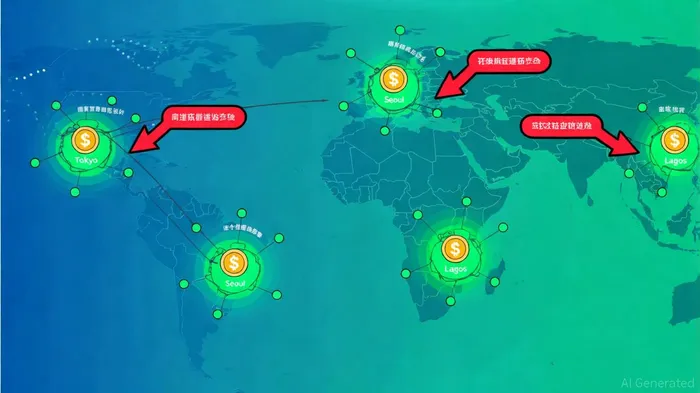
Stablecoins are dismantling barriers in international finance, particularly in regions with underdeveloped banking infrastructure. In Asia, Japan's JPYC (yen-backed stablecoin) and South Korea's KRW1 (won-backed stablecoin) have achieved regulatory approval, enabling seamless cross-border transactions between institutional clients, according to a Cryptopolitan article. These projects, coupled with Orochi Network and SOOHO.IO's collaboration, are building infrastructure that combines verifiable data with multi-chain interoperability, reducing settlement risks and enhancing privacy, as outlined in an Orochi press release.
The impact is quantifiable: stablecoin transaction volumes hit $4 trillion annually in 2025, an 83% increase from 2024, according to a Cryptopolitan analysis. For instance, JPMorgan's JPM Coin facilitated over $1 billion in daily transactions by late 2023, per the Citi–Coinbase report, while Visa's partnerships in Sub-Saharan Africa and Southeast Asia processed $59 billion in stablecoin transfers in Nigeria alone, according to a Yahoo Finance report. These figures underscore stablecoins' role in democratizing access to global financial systems.
Regulatory Clarity: The Catalyst for Mass Adoption
Regulatory frameworks are accelerating institutional confidence. The GENIUS Act (2025) in the U.S. mandates stablecoin reserves be held in liquid assets like Treasury bills, while the EU's MiCA regulations and Hong Kong's Stablecoin Bill provide clear compliance standards, as noted in the Cryptopolitan analysis. These measures address past vulnerabilities, such as the 2023 SVB collapse, where Circle's USDC temporarily depegged due to $3.3 billion in reserves at the failed bank, detailed in a FinchTrade case study.
The result? A surge in institutional-grade stablecoins. BlackRock's USD Institutional Digital Liquidity Fund and Franklin OnChain U.S. Government Money Fund now offer yield-bearing stablecoins, blending TradFi returns with blockchain efficiency. Meanwhile, Coinbase Asset Management's partnership with Apollo Global is pioneering stablecoin-backed credit products, targeting $1 trillion in tokenized lending by 2026, according to a CryptoBriefing report.
The Road Ahead: Metrics and Projections
Quantitative trends validate the sector's momentum. Stablecoin market cap grew to $287.6 billion in Q3 2025, with Tether's USDTUSDT-- adding $17 billion in reserves and Ethena's USDeUSDe-- surging 177.8%, per the Cryptopolitan analysis. Cost efficiencies are equally compelling: Solana-based stablecoin transactions average <$0.01 per transfer, compared to $5–$10 for traditional cross-border wires.
Adoption rates are outpacing expectations. The U.S. remains the second-largest stablecoin market, with crypto transaction volumes rising 50% year-on-year, and South Asia-despite regulatory bans in countries like Bangladesh-has seen grassroots adoption surge through decentralized networks, as reported in the Cryptopolitan analysis.
Conclusion: A New Financial Ecosystem
Institutional partnerships are no longer speculative-they are the bedrock of a new financial ecosystem. By integrating stablecoins into cross-border payments, yield generation, and tokenized assets, these alliances are addressing liquidity gaps, reducing costs, and expanding financial inclusion. As regulatory clarity and infrastructure innovation converge, stablecoins are poised to become the default medium for global commerce, with a $1 trillion market cap within five years, according to the Citi–Coinbase report. For investors, the lesson is clear: the future of finance is digital, and it's being built by institutions, not speculators.





Comentarios
Aún no hay comentarios