
Institutional Onramps and Whale Activity: Assessing Chainlink and ASTER for Strategic Entry Points
Chainlink: Building the Enterprise-Grade Infrastructure for Tokenized Finance
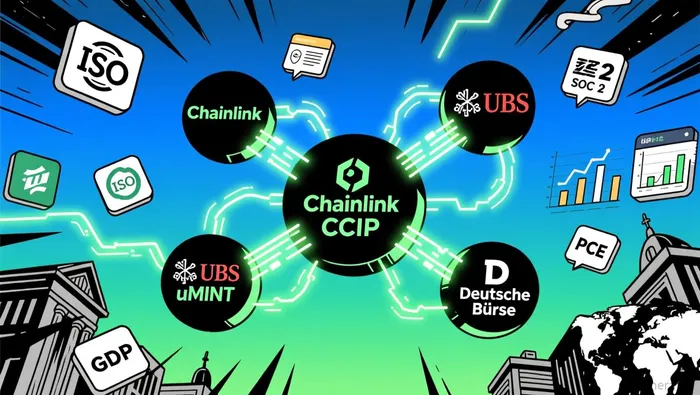
Chainlink's Q3 2025 performance underscores its evolution from a decentralized oracleADA-- provider to a foundational layer for tokenized financial systems. The launch of the Digital Transfer Agent (DTA) technical standard in a Chainlink Quarterly Review: Q3 2025 marks a critical milestone, enabling institutions to tokenize assets onchain while maintaining compliance with existing regulatory frameworks. UBS uMINT, a tokenized money market fund, became one of the first adopters of this standard, signaling a broader acceptance of Chainlink's infrastructure in traditional finance.
Regulatory alignment has further bolstered Chainlink's credibility. Its partnership with the U.S. Department of Commerce to onboard macroeconomic data like GDP and PCE Price Index onto blockchains, as detailed in a Chainlink Quarterly Review: Q3 2025, demonstrates its role in bridging real-world data with decentralized applications. Meanwhile, ISO 27001 and SOC 2 certifications, validated by Deloitte, position Chainlink as a trusted partner for banks, exchanges, and regulators. These certifications are notNOT-- just compliance checkboxes-they are signals to institutional investors that Chainlink's infrastructure meets enterprise-grade security standards.
On the interoperability front, Chainlink's Cross-Chain Interoperability Protocol (CCIP) now spans over 65 networks, as noted in a Chainlink Quarterly Review: Q3 2025, including MoveVM-based chains like AptosAPT--. This expansion has driven adoption of cross-chain tokens (CCTs) such as SolvBTC and syrupUSDCSYRUP--, facilitating seamless asset workflows across ecosystems. For investors, this means Chainlink is not just a price oracle but a critical enabler of cross-chain liquidity-a growing demand in a fragmented crypto landscape.
ASTER: Whale Accumulation and Regulatory Catalysts in a High-Volatility Play
While Chainlink's story is one of institutional infrastructure, ASTER's narrative is driven by speculative momentumMMT-- and whale activity. In November 2025, Coinbase added ASTER to its listing roadmap, as reported in a Coinbase Adds Aster Token to Listing Roadmap, Hinting at Future Trading Potential, hinting at potential trading support once infrastructure requirements are met. This move aligns with Coinbase's strategy to diversify its BNBBNB-- Chain offerings, a chain where ASTER has seen significant adoption.
Whale activity has further amplified ASTER's profile. A notable investor, previously known for a $36 million profit from PEPEPEPE--, has accumulated 8.41 million ASTER tokens at an average price of $0.97, as reported in a Crypto News Sentiment 24 hours, signaling confidence in the token's upside. This accumulation, coupled with a 34.47% surge in derivatives trading volume over 24 hours, as reported in a Crypto News Sentiment 24 hours, suggests growing speculative interest. However, ASTER's price remains volatile, with critical resistance at $1.3, as noted in a Crypto News Sentiment 24 hours, and its long-term sustainability remains unproven.
A token buyback program launched by ASTER's team, as reported in a Crypto News Sentiment 24 hours, aims to stabilize prices and reduce supply pressure, a move that could attract retail and institutional buyers alike. While buybacks are common in crypto, their effectiveness depends on execution and market sentiment. For now, ASTER's trajectory appears to hinge on whale-driven liquidity and the success of its on-chain initiatives.
Strategic Entry Points: Balancing Institutional Credibility and Speculative Potential
For investors, the contrast between Chainlink and ASTER highlights two distinct approaches to institutional-grade altcoin exposure. Chainlink offers long-term infrastructure value with regulatory and interoperability milestones that reduce counterparty risk. Its partnerships with Deutsche Börse, UBS, and the U.S. Department of Commerce, as detailed in a Chainlink Quarterly Review: Q3 2025, provide a stable foundation for growth, making it a safer bet for investors prioritizing compliance and scalability.
ASTER, on the other hand, represents a high-risk, high-reward scenario. Its recent regulatory developments (Coinbase listing) and whale accumulation, as reported in a Coinbase Adds Aster Token to Listing Roadmap, Hinting at Future Trading Potential and a Crypto News Sentiment 24 hours, suggest short-term volatility but also potential for rapid appreciation if the buyback program stabilizes the token. Investors here must weigh the risks of speculative trading against the possibility of a breakout if ASTER gains broader institutional traction.
A strategic entry point for Chainlink could be during consolidation phases, as seen in its current tight trading range, as noted in a Chainlink Quarterly Review: Q3 2025, while ASTER's critical resistance at $1.3, as noted in a Crypto News Sentiment 24 hours, offers a technical level to monitor for potential breakouts. Both tokens, however, require careful due diligence on regulatory updates and on-chain activity to mitigate risks.
Conclusion
The institutionalization of crypto is accelerating, and tokens like Chainlink and ASTER are at the forefront of this shift. Chainlink's enterprise-grade infrastructure and regulatory certifications position it as a cornerstone for tokenized finance, while ASTER's whale-driven momentum and speculative appeal make it a volatile but potentially lucrative play. For investors, the key lies in aligning their risk appetite with the unique value propositions of each token-and staying attuned to the regulatory and on-chain signals that will shape their trajectories in 2025 and beyond.






Comentarios
Aún no hay comentarios