
The Institutional Manipulation and Macro Risks Behind Bitcoin's Recent Decline
Bitcoin's recent price decline has sparked debates about the forces driving its volatility. While market participants often point to macroeconomic factors, a deeper analysis reveals that high-frequency trading (HFT) strategies and Federal Reserve policy shifts are pivotal in shaping Bitcoin's short-term price dynamics. This article examines how these elements interact to amplify volatility and create risks of institutional manipulation, drawing on recent research and market events from 2023 to 2025.
High-Frequency Trading: A Double-Edged Sword
High-frequency trading (HFT) has become a dominant force in cryptocurrency markets, leveraging algorithms to exploit price discrepancies across exchanges and trading pairs. Strategies such as arbitrage and market making have tightened bid-ask spreads but also introduced "ghost liquidity," where orders vanish before execution, exacerbating volatility (as research shows). For instance, during Q1 2025, BitcoinBTC-- surged to $109,000 but quickly corrected amid macroeconomic uncertainties and a $1.5 billion hack on Bybit, highlighting how HFT-driven liquidity can evaporate under stress.
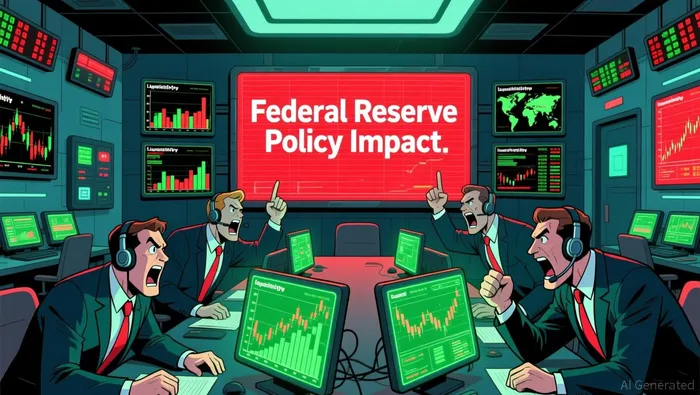 The integration of AI and machine learning into HFT systems has further refined these strategies, enabling real-time adjustments to order books and market sentiment. However, this sophistication has also raised concerns about fairness. Smaller traders struggle to compete with HFT firms that use co-location services, fiber-optic networks, and direct market access to execute trades in microseconds, a dynamic that creates technological asymmetry. This technological asymmetry creates a market environment where institutional players can disproportionately influence price movements, particularly during periods of macroeconomic uncertainty.
Fed Policy: A Macroeconomic Magnifier
The Federal Reserve's monetary policy has been a critical driver of Bitcoin's volatility. Between 2023 and 2025, delayed rate cuts and quantitative tightening contributed to sharp price swings, with Bitcoin oscillating between $109,000 and $70,000. For example, a 25 basis point rate cut in Q3 2025 initially injected liquidity into markets, but its impact on Bitcoin was muted unless paired with dovish forward guidance. This dynamic reflects Bitcoin's growing correlation with traditional assets like the Nasdaq 100, as institutional adoption through ETFs and retirement vehicles has deepened.
Fed policy also interacts with HFT in amplifying volatility. During the October 2025 FOMC meeting, Bitcoin's price dropped sharply as HFT algorithms liquidated long positions, wiping $112 million in trades within moments. Such events underscore how macroeconomic signals-whether actual policy changes or expectations-trigger rapid, algorithmic responses that destabilize markets.
Institutional Manipulation and Macroeconomic Feedback Loops
The interplay between HFT and Fed policy creates fertile ground for institutional manipulation. Research indicates that when institutional ownership exceeds 40%, markets face heightened risks of centralization and price manipulation. This is particularly relevant in crypto, where HFT algorithms can exploit fragmented liquidity across exchanges like Binance and Bybit to execute large-scale arbitrage or spoofing strategies, as detailed in recent research. For example, during the 2025 Fed rate hike cycle, institutional HFT players capitalized on sub-second price discrepancies, exacerbating volatility while maintaining profitability.
Macroeconomic feedback loops further complicate this landscape. Bitcoin's price has shown strong reactions to inflation data, with a 3.7% inflation report in October 2025 triggering an 86.76% seven-day gain. However, such movements are not purely organic; they often reflect institutional strategies to front-run Fed policy signals or manipulate order books during high-impact events, as studies have shown. The Decker Comparative Maturity Equation (DCME) models this risk, highlighting how liquidity provision by institutions can double as a tool for market control.
Implications for Investors
For investors, the convergence of HFT and Fed policy underscores the need for caution. Bitcoin's volatility is no longer driven solely by speculative retail trading but by institutional-grade infrastructure and macroeconomic forces. Regulatory scrutiny is intensifying, with proposals for HFT taxes and stricter market manipulation rules gaining traction. However, until these measures are implemented, investors must remain vigilant about liquidity traps and sudden price dislocations, particularly around Fed announcements.
Conclusion
Bitcoin's recent decline is a symptom of broader systemic forces: HFT's capacity to amplify volatility and the Fed's role in shaping macroeconomic sentiment. While these factors contribute to market efficiency, they also create risks of institutional manipulation and uneven playing fields. As the crypto market matures, the challenge will lie in balancing innovation with regulatory safeguards to ensure fair and stable price discovery.






Comentarios
Aún no hay comentarios