
Institutional Liquidity Signals in Crypto: Decoding BlackRock and SpaceX's BTC/ETH Moves Ahead of PCE Data
The institutional crypto landscape in 2025 has become a battleground of liquidity signals, with BlackRockBLK-- and SpaceX emerging as pivotal players. Their movements in BitcoinBTC-- (BTC) and EthereumETH-- (ETH) have sparked debates about whether these transfers reflect bearish sentiment or routine portfolio management. As the U.S. PCE Price Index-a critical Fed inflation gauge-looms on the horizon, understanding these dynamics is essential for investors navigating a volatile market.
BlackRock's Strategic ETF-Driven Liquidity
BlackRock's November 2025 on-chain activity-shifting $589 million in BTC and ETH-has been interpreted as a response to ETF redemptions rather than fresh capital inflows. This aligns with broader trends where market makers hedge ETF redemptions by selling assets, signaling capital exiting the ETF system. However, this does not necessarily indicate bearishness. The firm's Bitcoin ETF (IBIT) has attracted massive inflows, with Nasdaq proposing to quadruple its trading capacity to meet demand. BlackRock's BUIDL fund, which tokenizes U.S. Treasuries and money-market funds, has also reached $2 billion in assets under management, underscoring institutional confidence in blockchain infrastructure. These moves suggest a focus on liquidity optimization and strategic asset allocation rather than capitulation.
SpaceX's Custodial Restructuring: Security Over Sentiment
SpaceX's recent Bitcoin transfers, including $106.14 million and $105 million movements, have been framed as part of a custodial restructuring strategy. Analysts emphasize that these transfers-routed to Coinbase Prime and segregated wallets-reflect operational flexibility and enhanced security protocols rather than panic selling. The company's pattern of moving BTC to institutional-grade custody solutions aligns with standard treasury management practices, particularly as corporations increasingly adopt crypto as part of diversified portfolios. While Ethereum's total value locked (TVL) remains robust at $70 billion, its underperformance against Bitcoin in 2024–2025 highlights a shift in institutional preference toward BTC as a store of value.
PCE Data and Macroeconomic Uncertainty
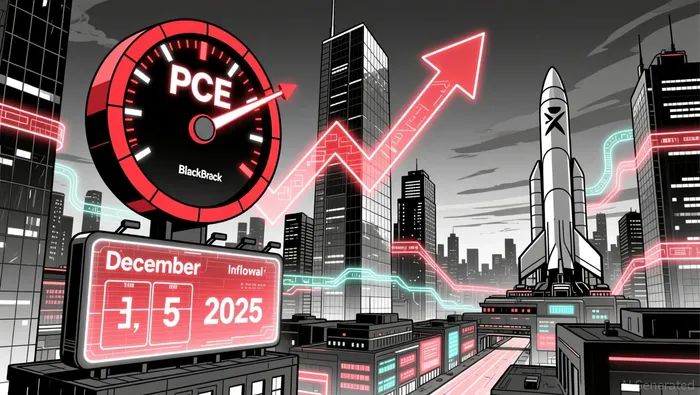
The delayed release of the September 2025 PCE data-pushed to December 5-has added to market uncertainty. BlackRock's BTC deposits in early September, such as the 900 BTC ($101.67 million) transfer to Coinbase Prime, occurred prior to this delay and appear tied to ETF flow dynamics rather than PCE-driven sentiment. Meanwhile, bearish signals persist: Bitcoin fell 7% and Ethereum 9.52% amid rising U.S. bond yields and leveraged liquidations as the market slides. Yet, BlackRock's IBITIBIT-- ETF saw a $75.47 million net inflow on November 19, signaling short-term stabilization. This duality-declining prices amid ETF resilience-suggests a market balancing macroeconomic headwinds with institutional conviction.
Bearish Indicators vs. Institutional Resilience
On-chain metrics remain bearish, with CryptoQuant CEO Ki Young Ju warning of a red-cycle unless macro liquidity returns. Retail traders' preference for protective puts over bullish calls further reinforces risk aversion as bearish sentiment in IBIT remains strong. However, BlackRock's strategic BTC accumulation and MicroStrategy's Bitcoin treasury expansions have provided a floor for prices above $100K as institutional players actively manage portfolios. The Federal Reserve's potential rate cut, driven by a cooling labor market, could also mitigate downward pressure. These factors indicate that while bearish sentiment is present, institutional players are actively managing portfolios to withstand volatility.
Conclusion: Routine Management Amid Macro Noise
The transfers by BlackRock and SpaceX should be viewed through the lens of routine portfolio management rather than overt bearishness. BlackRock's ETF-driven liquidity and custody-focused BTC movements reflect strategic positioning in a maturing crypto market, while SpaceX's custodial shifts prioritize security and operational efficiency. Although the PCE data delay and broader macroeconomic risks create uncertainty, institutional inflows and tokenization innovations suggest a long-term bullish narrative. Investors must distinguish between short-term volatility and the structural adoption of digital assets by institutional players.





Comentarios
Aún no hay comentarios