
Why Institutional Investors Should Rethink XRP Amid Shifting Crypto Priorities
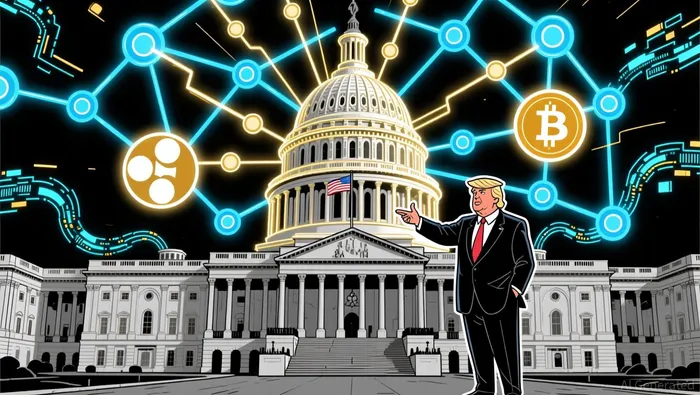
The cryptocurrency landscape is undergoing a seismic shift, driven by regulatory clarity and institutional realignment. As the U.S. government under President Donald Trump prioritizes establishing the nation as the "crypto capital of the world," the playing field for digital assets is reshaping. For institutional investors, this environment demands a reevaluation of traditional crypto allocations-particularly in light of XRP's explosive performance and its unique positioning amid Bitcoin's dominance and Ethereum's regulatory turbulence.
Regulatory Momentum: A New Era of Clarity
The Trump administration's aggressive overhauling of crypto policy has created a fertile ground for innovation. Key regulatory bodies, including the SEC, FDIC, and CFTC, now boast leadership aligned with the industry's growth ambitions. This shift has moved the U.S. away from enforcement-heavy tactics toward a collaborative framework that prioritizes clarity for market participants. For XRPXRP--, this means a stark contrast to the prolonged legal battles that once clouded its utility. Ripple's conditional approval to charter a national trust bank and its expanding partnerships with Japanese financial institutions underscore a regulatory alignment that positions XRP as a low-risk, high-utility asset for institutions.
XRP's Outperformance: A Case for Institutional Reentry
While BitcoinBTC-- and EthereumETH-- remain household names, their recent trajectories tell a different story. According to CNBC, XRP has emerged as the "hottest crypto trade of 2026," outperforming both Bitcoin and Ethereum in early 2026. This surge is not speculative-it's driven by tangible demand. XRP-focused ETFs have attracted over $1.3 billion in institutional inflows within 50 days, a stark contrast to the outflows seen in Bitcoin and Ethereum ETFs during the same period. The asset's real-world utility in cross-border payments, coupled with its energy efficiency and scalability, makes it a compelling alternative to legacy blockchains struggling with regulatory scrutiny.
Contrasting Sentiments: Retail Fear vs. Institutional Confidence
Retail investor sentiment has hit an extreme low, with the Crypto Fear & Greed Index registering a record 24 in late December 2025. This capitulation reflects broader market anxiety, yet institutional activity tells a divergent tale. XRP's ETF inflows and Ripple's strategic partnerships indicate a quiet but deliberate accumulation phase. Institutions are betting on XRP's ability to capitalize on regulatory tailwinds and its entrenched role in global payment networks. This divergence between retail pessimism and institutional optimism often precedes significant market reversals-a pattern investors should heed.
Strategic Entry Point: Navigating the Altcoin Rebound
For investors seeking high-growth altcoin exposure with clearer compliance pathways, XRP represents a strategic entry point. Unlike Bitcoin's energy-intensive model or Ethereum's unresolved regulatory challenges, XRP's regulatory alignment and proven use cases reduce counterparty risk. As CNBC highlights, the asset's performance in early 2026 suggests it is primed to benefit from a broader institutional reallocation. This is particularly relevant for portfolios aiming to balance exposure between blue-chip assets and high-conviction altcoins.
Conclusion: Reallocating for the Future
The confluence of regulatory momentum, institutional inflows, and real-world utility positions XRP as a standout opportunity in 2026. While Bitcoin and Ethereum will remain focal points, their dominance is no longer unchallenged. For institutional investors, the time to rethink XRP is now-leveraging the current sentiment extremes and regulatory tailwinds to secure a position in what could be one of the most transformative assets of the year.







Comentarios
Aún no hay comentarios