
Institutional Investors Drive Bitcoin and Ethereum Accumulation: Strategic Buying and Market Confidence in 2025
The Institutional Shift: From Speculation to Strategic Allocation
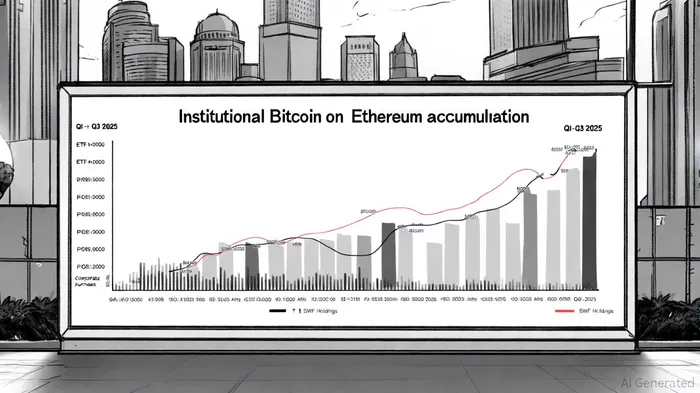
Institutional investors have transitioned from viewing BitcoinBTC-- and EthereumETH-- as speculative assets to treating them as core components of diversified portfolios. This shift is evident in the explosive growth of U.S. spot Bitcoin ETFs, corporate treasury allocations, and Sovereign Wealth Fund (SWF) participation. For Bitcoin, the opening of 401(k) investment channels and the dominance of BlackRock's iShares Bitcoin Trust (IBIT)—which alone attracted $1.3 billion in net inflows within two days in July 2025[3]—signal a structural redefinition of institutional capital flows.
According to a report by Pinnacle Digest, Bitcoin's realized volatility has plummeted by mid-2025, attributed to deeper liquidity and the “strong hands” effect from institutional investors who are less prone to panic selling[1]. This stability contrasts sharply with Bitcoin's historical volatility profile, underscoring the maturation of its market structure. On-chain metrics further reveal a shift toward high-value, low-frequency transactions, indicating that institutions are prioritizing long-term holding strategies over short-term trading[2].
Ethereum's Institutional Surge: Staking, Treasuries, and Real-World Utility
While Bitcoin's institutional adoption has been well-documented, Ethereum's trajectory in 2025 has been equally transformative. The launch of the Ether Machine—a institutional-grade staking and DeFi infrastructure product—has attracted over $1.5 billion in total value locked (TVL), demonstrating confidence in Ethereum's post-merge utility[1]. Concurrently, corporate treasuries have expanded their Ethereum holdings to 4.1 million ETH ($17.6 billion), with Nasdaq-listed SharpLink GamingSBET-- adding $73.21 million in ETH to its portfolio, bringing its total holdings to $611 million[2].
Ethereum's 175% price surge over three months—outpacing Bitcoin and altcoins—has been fueled by these strategic inflows and regulatory clarity. As stated by The Financial Analyst, Ethereum's price surge past $2,850 in July 2025 reflects institutional validation of its role in both staking ecosystems and real-world applications[2]. This momentum is further reinforced by Ethereum's non-correlation to traditional assets, making it an attractive hedge against macroeconomic uncertainty.
Market Confidence Indicators: Liquidity, Volatility, and Structural Trends
The interplay between institutional buying and market dynamics reveals critical confidence indicators. For Bitcoin, the average transaction size has increased due to high-value institutional transfers, signaling a move toward “large, low-frequency” trading models[2]. This trend aligns with Bitcoin's adoption as a store of value, akin to gold, but with enhanced liquidity.
Ethereum's institutional accumulation, meanwhile, is reshaping its volatility profile and use cases. The Ether Machine's TVL and corporate staking activity highlight Ethereum's transition from a speculative asset to a foundational infrastructure layer for decentralized finance (DeFi). As noted by CoinEngineer, Ethereum's institutional treasuries now represent a $17.6 billion market segment, underscoring its growing legitimacy[3].
Projected Outcomes and Strategic Implications
Analysts project Bitcoin to reach $190,000 by Q3 2025, driven by record institutional liquidity and regulatory tailwinds[2]. For Ethereum, the 175% price surge in a single quarter suggests that institutional demand is outpacing supply constraints, particularly as SWFs and corporations methodically build positions[1].
Investors should monitor on-chain metrics such as institutional wallet activity, ETF inflow velocity, and TVL growth in Ethereum's staking infrastructure. These indicators will provide early signals about the sustainability of current trends and potential inflection points in 2026.
Conclusion
The 2025 institutional adoption of Bitcoin and Ethereum marks a paradigm shift in global finance. By treating these assets as strategic allocations rather than speculative bets, institutions are reinforcing their role as pillars of a diversified, digital-first portfolio. As regulatory frameworks solidify and use cases expand, the next phase of institutional accumulation will likely accelerate, further entrenching Bitcoin and Ethereum as mainstream assets.





Comentarios
Aún no hay comentarios