
Institutional-Grade Crypto Access via MT5: A New Era for FX Brokers and Traders
The institutionalization of cryptocurrency markets in 2025 has reached a tipping point, driven by regulatory clarity, infrastructure innovation, and the convergence of traditional finance (TradFi) with digital assets. At the forefront of this transformation is the strategic integration of OKX's institutional-grade liquidity into the Fortex Liquidity Hub, enabling MetaTrader 5 (MT5) brokers and traders to access over 900 spot and futures crypto pairs directly from their familiar trading interface. This development marks a pivotal shift in how institutional and professional participants engage with crypto markets, bridging the gap between legacy systems and the fast-evolving digital asset ecosystem.
The Fortex-OKX Integration: A Plug-and-Play Solution for Institutional Access
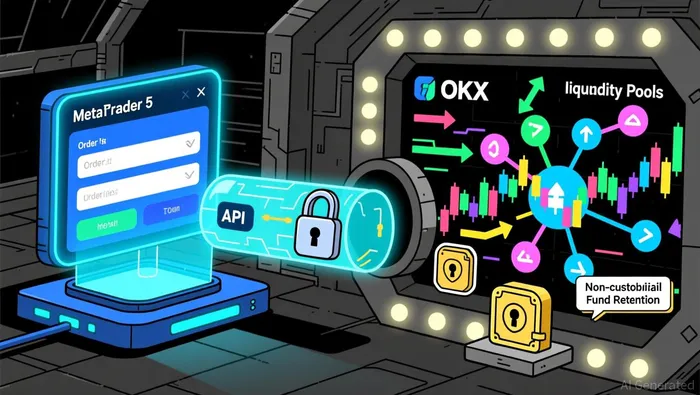
The integration of OKX's liquidity into Fortex's platform is more than a technical upgrade-it's a strategic enabler for brokers and traders seeking to capitalize on the crypto boom. By routing trades from MT5 to OKX, users can execute positions on major assets like BTCBTC-- and ETHETH-- without leaving their existing workflows, leveraging OKX's deep liquidity pools and low-latency execution. This seamless interoperability is critical for institutions and prop firms, which require robust infrastructure to manage risk, automate strategies via Expert Advisors (EAs), and scale operations efficiently.
A key innovation is the non-custodial model, where clients' digital assets remain in their OKX accounts rather than being transferred to brokers. This design reduces operational risks for brokers, simplifies compliance, and aligns with institutional-grade security standards. For traders, the setup is straightforward: an active OKX account and an API key suffice to begin trading within hours this plug-and-play approach democratizes access to institutional-grade crypto markets, enabling even smaller brokers to compete with larger players in a rapidly expanding sector.
Catalyst for Market Expansion: Bridging TradFi and Crypto
The Fortex-OKX integration is part of a broader trend of merging traditional finance infrastructure with digital assets. In 2025, the global crypto exchange market is projected to reach $63.38 billion in value, expanding at a 24.4% compound annual growth rate, as institutional investors pour capital into regulated crypto products like spot BitcoinBTC-- ETFs. Platforms like Fortex are accelerating this transition by providing the tools necessary for forex professionals to expand into crypto without overhauling their existing systems.
Regulatory developments have further catalyzed this shift. The U.S. repeal of SAB 121 and the EU's MiCA framework have created a legal foundation for banks and asset managers to engage with crypto, while the launch of ETFs like BlackRock's IBIT has brought over $115 billion in assets under management to the sector. These milestones have transformed crypto from a speculative asset into a strategic allocation tool for pension funds, corporations, and investment banks. The Fortex-OKX integration complements this institutionalization by offering scalable, compliant access to liquidity-a critical factor in attracting serious capital.
Real-World Impact: Case Studies and Market Dynamics
The integration's impact is already evident in market dynamics. OKX's trading volume surged 53-fold after its expansion into the U.S. and European Economic Area (EEA), driven by regulatory compliance and strategic partnerships. Daily active wallets on OKX doubled in 2025, with decentralized exchange (DEX) volume rising 262% globally these figures underscore the growing demand for accessible, institutional-grade crypto infrastructure, which Fortex's integration directly addresses.
For brokers, the Fortex-OKX solution has proven to be a scalable business model. By offering clients access to OKX's liquidity, brokers can diversify their offerings and capture a share of the $63.38 billion crypto market. This is particularly relevant as crypto exchanges like Bybit and Bitget expand into TradFi services, such as CFD trading with stablecoin margins, blurring the lines between crypto and traditional markets. Fortex's role in this ecosystem is to provide the middleware that connects legacy systems with next-generation crypto infrastructure.
Challenges and the Road Ahead
Despite the momentum, challenges persist. Regulatory scrutiny remains a wildcard, with jurisdictions like the U.S. and EU still refining their frameworks. Market volatility and environmental concerns also linger as barriers to mass adoption. However, the integration of AI with blockchain-enhancing smart contracts, data processing, and algorithmic trading-offers a counterbalance to these risks. Additionally, the tokenization of real-world assets (RWAs) is projected to grow from $13 billion to $50 billion in 2025, further legitimizing crypto as a mainstream asset class.
For FX brokers and traders, the Fortex-OKX integration represents a low-risk, high-reward opportunity to future-proof their platforms. By leveraging OKX's liquidity and Fortex's infrastructure, they can navigate the complexities of crypto markets while maintaining the operational efficiency of MT5. As the industry evolves, the ability to adapt to hybrid financial ecosystems will separate leaders from laggards.
Conclusion
The integration of OKX's liquidity into the Fortex Liquidity Hub is more than a technical achievement-it's a catalyst for the next phase of crypto market expansion. By enabling institutional-grade access to crypto through MT5, Fortex and OKX are empowering brokers and traders to participate in a $63.38 billion market without compromising on compliance, security, or scalability. As regulatory clarity and technological innovation continue to converge, this integration exemplifies how strategic partnerships can drive the institutionalization of crypto, transforming it from a niche asset into a cornerstone of global finance.






Comentarios
Aún no hay comentarios