
The Institutional Exodus: Ethereum ETF Outflows and Their Implications for Price Stability
The recent wave of EthereumETH-- ETF outflows has sparked a critical debate about institutional sentiment and the broader implications for Ethereum's price stability. While the data paints a mixed picture of investor behavior, a deeper analysis of on-chain activity and direct institutional accumulation reveals a nuanced story. This article dissects the divergence between ETF outflows and on-chain metrics, offering insights into how Ethereum's ecosystem is navigating macroeconomic headwinds and evolving institutional dynamics.
The ETF Exodus: A Signal of Retreat or Rebalancing?
In late December 2025, Ethereum spot ETFs faced a sharp reversal, with net outflows totaling $553 million in a short period. This followed a $75.44 million outflow on December 19 alone, attributed entirely to BlackRock's iShares Ethereum Trust. Such outflows, coupled with a $225 million exodus earlier in the month, have raised concerns about waning institutional confidence. However, these figures must be contextualized within a broader narrative of shifting capital allocation strategies.
Data from Q3 2025 reveals that Ethereum ETFs outperformed Bitcoin counterparts, attracting $2.4 billion in inflows over a six-day period compared to Bitcoin's $827 million. This outperformance underscores Ethereum's appeal as a utility-driven asset, driven by its staking capabilities, smart contract infrastructure, and DeFi integration. The recent outflows, therefore, may reflect a temporary recalibration rather than a permanent withdrawal of institutional capital.
Direct Accumulation: The Hidden Pillar of Institutional Demand
While ETFs have seen redemptions, direct on-chain accumulation by institutional players has remained robust. BitMine, for instance, added 102,259 ETH (worth $310 million) in a single week amid ETF outflows. This highlights a critical distinction: ETF outflows do not equate to a broader exodus from Ethereum. Instead, they signal a shift in how institutions are accessing the asset-favoring direct holdings over ETFs during periods of volatility.
On-chain data further reinforces this trend. Ethereum's staked supply reached an all-time high of 35.3 million ETH in Q3 2025, representing 29% of the total supply.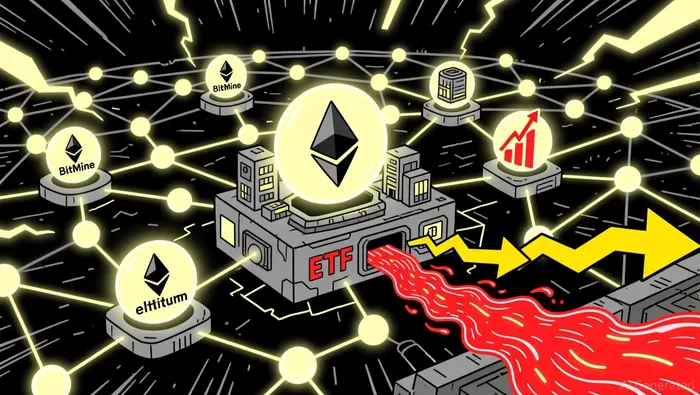 The Pectra upgrade, activated in May 2025, enhanced staking efficiency by introducing automatic compounding and higher validator balance caps. These improvements have incentivized institutional participation, with over 750,000 ETH now held by validators leveraging these mechanisms.
On-Chain Resilience: Price Stability Amid Selling Pressure
Despite the ETF outflows, Ethereum's price demonstrated remarkable stability in late 2025. Even during a $19.41 million net outflow in U.S. ETH spot ETFs and a whale sale of 7,621 ETH ($23.85 million), the price remained anchored near the realized price of $3,129. This resilience can be attributed to strong on-chain demand absorption, driven by institutional staking and DeFi activity.
The Ethereum network also saw a surge in unique addresses and daily active users, with 31.5 million new addresses created in H1 2025 and daily activity ranging between 380K and 420K. Meanwhile, the on-chain lending market expanded, with centralized stablecoins like USDT and USDC dominating over synthetic alternatives. These metrics suggest that Ethereum's utility beyond speculative trading-such as staking yields and DeFi participation-continues to underpin its value proposition.
Macroeconomic and Regulatory Tailwinds
The Federal Reserve's dovish policy and projected rate cuts through 2026 have created a favorable macroeconomic backdrop for crypto assets. Institutional investors, particularly hedge funds and investment advisors, have capitalized on this environment, with the latter holding 541K ETH and hedge funds doubling their positions to 296K ETH. Regulatory developments, including the launch of Ethereum perpetual futures on SGX and the pending GENIUS Act, further reinforce long-term confidence.
Conclusion: A Tale of Two Markets
The Ethereum ETF outflows of late 2025 reflect a temporary shift in institutional exposure rather than a collapse in demand. While ETFs have seen redemptions, direct on-chain accumulation, staking growth, and DeFi activity indicate sustained institutional interest. The price stability observed during this period underscores Ethereum's ability to absorb selling pressure, supported by its utility-driven ecosystem. For investors, this divergence between ETF flows and on-chain behavior highlights the importance of looking beyond headline metrics to assess the true health of the market.







Comentarios
Aún no hay comentarios