
The Institutional Crypto Revolution in Africa: Strategic Entry Points Amidst Global Housing Market Downturns
The Housing Market Downturn: A Case Study in Institutional Retreat
D.R. Horton's Q3 2025 results epitomize the fragility of the U.S. housing sector. Earnings per share fell 22% year-over-year to $3.04, while revenues declined 3.2% to $9.68 billion. The company attributed this to "ongoing housing market softness," including declining consumer confidence and affordability challenges. To combat waning demand, D.R. Horton resorted to sales incentives-a strategy that eroded profit margins. Even its Q4 2025 performance, marked by $4.8 billion in shareholder returns, masked underlying structural weaknesses in a sector increasingly reliant on artificial stimulus.
This mirrors broader trends in global real estate. While senior housing segments, such as Ventas Inc.'s Senior Housing Operating Portfolio, saw a 15.9% increase in NOI, as reported in the Ventas NOI report, these gains are localized and insufficient to offset macroeconomic risks like rising interest rates and demographic shifts. The housing market's reliance on debt-driven growth and regulatory tailwinds makes it a vulnerable asset class in a low-interest-rate, inflationary environment.
Africa's Blockchain Ecosystem: A Contrarian Growth Engine
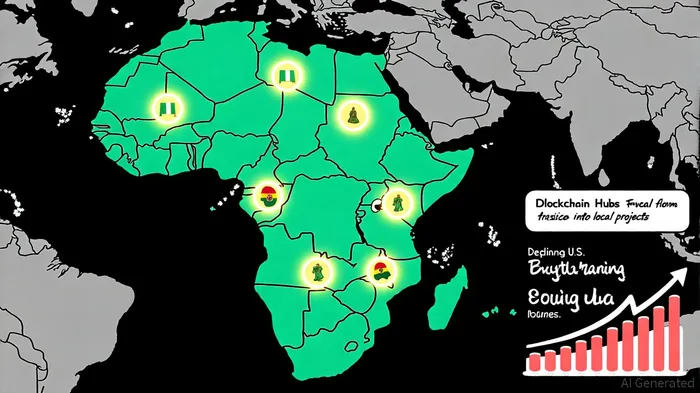
In stark contrast, Africa's blockchain infrastructure is experiencing a renaissance. Sub-Saharan Africa now ranks third globally in crypto adoption, with Nigeria and South Africa leading the charge, according to Chainalysis. Nigeria's 22 million crypto users-32% of its population-have turned to stablecoins like USDTUSDT-- as a hedge against inflation and foreign currency restrictions, per a BoundlessPay post. Meanwhile, South Africa's regulatory clarity has attracted institutional players like Absa Bank, which is developing BitcoinBTC-- ETFs and tokenized investments, according to Chainalysis.
The institutionalization of Africa's crypto market is accelerating. In Q3 2025 alone, the Solana Foundation funded pre-seed projects in Nigeria with $10,000 grants, while Base (Coinbase's layer-2 blockchain) supported seven Nigerian startups, as covered in a TechCabal article. Binance Labs and LiskLSK-- have also injected capital into local ecosystems, with projects like Xend Finance and Verxio Protocol processing millions in transactions. These developments signal a shift from speculative retail adoption to institutional-grade infrastructure.
Regulatory Momentum and Cross-Border Utility
Africa's regulatory environment is evolving in tandem with its technological adoption. Kenya's Virtual Asset Service Providers Bill, passed in 2025, designates the Central Bank of Kenya and Capital Markets Authority as crypto regulators, according to Decrypt. This framework, coupled with South Africa's 2023 licensing regime, has created a "safe harbor" for institutional capital. For instance, stablecoins now account for 43% of Sub-Saharan Africa's crypto transaction volume, reducing remittance costs from 7.9% to near 1%.
The continent's mobile-first infrastructure further amplifies blockchain's utility. With over 85% mobile penetration, Africa is leapfrogging traditional banking systems. Projects like Upesa (supported by the StellarXLM-- Community Fund) and Azza (funded by Base) are leveraging this to enable cross-border trade and microfinance.
Strategic Allocation: Why Africa's Blockchain Outpaces Housing
The case for contrarian allocation is clear. While D.R. Horton's housing model is constrained by affordability crises and regulatory uncertainty, Africa's blockchain ecosystem is expanding into unmet demand. For every $1 invested in U.S. housing, investors face declining returns and margin compression; for every $1 allocated to African crypto, they gain exposure to a 52% annualized growth market, per Chainalysis.
Moreover, Africa's crypto adoption is inherently inflation-resistant. In Nigeria, where Bitcoin accounts for 89% of crypto purchases, the asset serves as both a store of value and a medium of exchange. This dual utility-absent in traditional real estate-positions blockchain as a hedge against macroeconomic volatility.
Conclusion: A New Frontier for Institutional Capital
As global housing markets contract and interest rates remain elevated, Africa's blockchain revolution offers a rare combination of growth, resilience, and regulatory progress. Institutional investors who allocate to this space-whether through venture capital, stablecoin infrastructure, or tokenized real assets-stand to benefit from a market that is notNOT-- only outpacing traditional sectors but also redefining financial inclusion.
The time to act is now. While D.R. Horton's Q3 2025 results underscore the fragility of legacy models, Africa's crypto ecosystem is building the infrastructure of the future. For investors seeking asymmetric upside, the continent's digital asset revolution is not just a contrarian bet-it's a strategic imperative.





Comentarios
Aún no hay comentarios