
Institutional Conviction in Bitcoin Amid Volatility
The 2023–2024 Bear Market: A Laboratory for Institutional Conviction
The 2023–2024 bear market, marked by the FTX collapse and SVB's failure, initially seemed to erode trust in crypto. Yet, North America's institutional sector defied expectations. Between July 2023 and June 2024, U.S. on-chain value received a hit of $1.3 trillion, with 70% of transactions exceeding $1 million in size. This surge was catalyzed by the January 2024 launch of U.S. spot Bitcoin ETPs, including the iShares Bitcoin TrustIBIT-- (IBIT), which became the fastest ETP to reach $20 billion in assets under management.
The strategic logic here was twofold: price dislocation and regulatory tailwinds. As Bitcoin's price fell from $69,000 to $30,000 in late 2022, institutions viewed it as a buying opportunity. Simultaneously, the SEC's delayed approval of ETPs created a regulatory vacuum that institutions exploited to accumulate directly via on-chain transfers. By Q1 2024, the market had priced in ETPs as a bridge between TradFi and crypto, with Bitcoin surging to $73,000-a 140% rebound from its 2022 lows.
Q3 2025: Strategic Value in a Tokenized World
By Q3 2025, institutional Bitcoin accumulation had evolved beyond mere price speculation. Companies like American Bitcoin Corp. (ABTC) exemplified this shift. ABTC expanded its reserves to 3,418 Bitcoin through mining and at-market purchases, leveraging its Nasdaq listing to scale capital efficiency. Meanwhile, the GENIUS Act's passage in July 2025 brought regulatory clarity to stablecoins, spurring institutional adoption of tokenized assets for cross-border payments and asset-backed use cases.
This period underscored Bitcoin's dual role: a store of value and a gateway to broader crypto innovation. Even as Bitcoin's price rose only 6% in Q3 2025, institutional inflows into stablecoins and tokenized securities grew by 400% year-over-year. The lesson? Institutions were no longer betting solely on Bitcoin's price-they were building infrastructure around it.
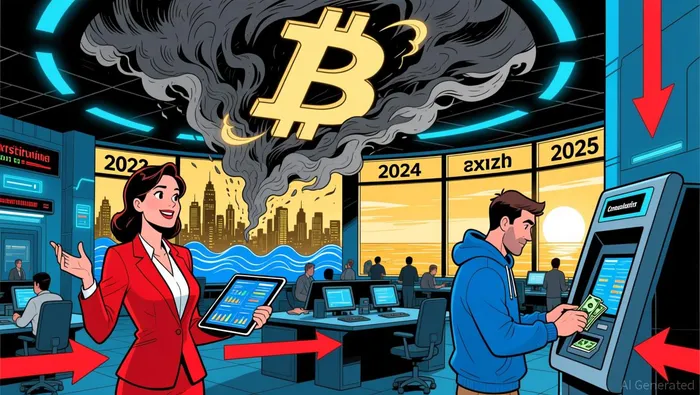
Q4 2025: Bearish Conditions and the Illusion of Weakness
By late 2025, Bitcoin faced a familiar foe: bearish sentiment. Prices oscillated between $97,000 and $111,900, with sellers dominating near the $100,000 psychological level. U.S. spot Bitcoin ETFs recorded a record $869 million outflow in November 2025 as prices dipped below $100,000. Yet, this narrative of weakness masked a deeper truth: institutional demand remained resilient.
Key indicators told a different story. Open interest in Bitcoin perpetual futures fell, but short-term holder cost bases remained above $111,900-a critical threshold for sustained recovery. Options traders maintained defensive put protection around $100,000, signaling anticipation of volatility rather than capitulation. Meanwhile, Cathie Wood's Ark Investment continued buying shares in crypto-focused firms like Bullish, adding 190,000 shares in November 2025. Retail traders on Stocktwits interpreted this as a bullish signal, betting Ark's actions reflected insider confidence.
The Strategic Case for Aggressive Accumulation
The data from 2023–2025 paints a compelling case for institutional conviction in bearish conditions. Three pillars underpin this strategy:
- Discounted Pricing: Institutions capitalize on bear markets to acquire Bitcoin at prices far below long-term holders' cost bases. For example, ABTC's Q3 2025 purchases occurred at an average price of $98,000-well below the $111,900 threshold for sustained recovery.
- Regulatory Tailwinds: The GENIUS Act and Singapore's perpetual futures launched in November 2024 created new avenues for institutional participation, diversifying Bitcoin's value proposition beyond speculation.
- Network Effects: Even during outflows, institutions are building infrastructure (e.g., stablecoin networks, tokenized assets) that lock in Bitcoin's role in the global financial system.
Critics argue that bear markets test liquidity and risk appetite. Yet, institutions' ability to weather short-term volatility-coupled with their access to tools like perpetual futures and ETPs-positions them to outperform in the long run.
Conclusion: Conviction in the Face of Chaos
Bitcoin's 2023–2025 journey has been a masterclass in institutional resilience. While bearish conditions may trigger short-term outflows, they also create opportunities for strategic accumulation. The data is clear: institutions are not just buying Bitcoin-they are building a future where it operates as a foundational asset class. For investors, the takeaway is simple: volatility is not a barrier to entry-it's a prerequisite for long-term value.





Comentarios
Aún no hay comentarios