
Institutional Composure Amid Retail Volatility: A New Era in Market Dynamics
The financial markets of 2025 are defined by a stark dichotomy: retail investors, driven by FOMO and social media hype, fuel speculative frenzies, while institutional investors adopt a measured, long-term approach to navigate the resulting volatility. This divergence has reshaped market dynamics, with retail-driven turbulence creating opportunities—and risks—for institutional players.
The Rise of Retail Speculation and Its Consequences
Retail investors have become a dominant force in speculative markets, propelled by accessible trading platforms and the gamification of finance. In 2024 alone, 10.2 billion equity options contracts were traded, a figure that underscores the surge in high-risk, short-term bets[3]. Cryptocurrencies, meme stocks, and zero-day-to-expiration (0DTE) options have become playgrounds for a new generation of traders, many of whom treat investing like a dopamine-driven game[3].
Psychological factors amplify this behavior. A survey by eToroETOR-- revealed that 84% of U.S. retail investors believe they are taking the right—or even too little—risk[6]. This optimism, however, often clashes with reality. When market corrections strike, panic selling ensues, exacerbating volatility. For instance, in early April 2025, institutional and retail investors collectively shed $27 billion in U.S. stocks during a selloff[3]. Retail investors, prone to herd behavior, disproportionately drive such episodes, creating feedback loops that destabilize markets[4].
Institutional Strategies: Stability in a Storm
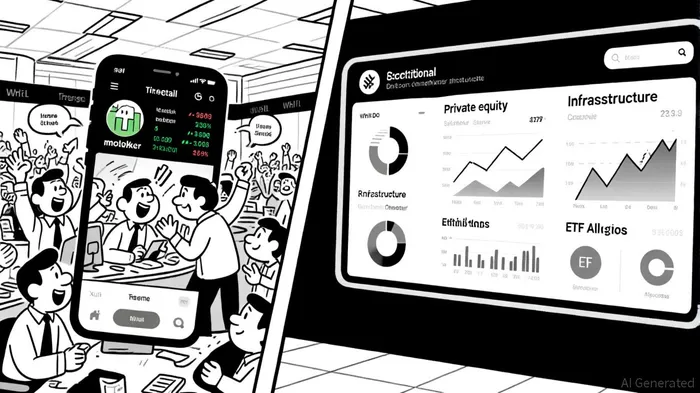
While retail investors chase quick wins, institutional investors have recalibrated their strategies to mitigate risk and capitalize on dislocation. Faced with a slowdown in private equity exits and tightening capital, institutions are reallocating to private markets—infrastructure, real estate, and private debt—viewed as havens for stable returns[1]. This shift is not merely defensive: it reflects a broader recognition that fixed-income yields and alternatives offer better risk-adjusted returns in an era of high interest rates[4].
Institutional investors have also pivoted to ETFs and diversified portfolios to reduce exposure to individual stock volatility[3]. During Q3 2025, as retail investors exited speculative assets, institutions rotated capital into sectors like real estate and utilities, which offer predictable cash flows[3]. Hedge funds and index funds, meanwhile, have emerged as key buyers of assets offloaded by both retail and institutional players, exploiting market dislocations for tactical gains[3].
This composure is underpinned by institutional access to advanced analytics and risk-management tools. Unlike retail investors, who often lack the expertise to assess fundamentals, institutions prioritize long-term value. For example, universities like Harvard have offloaded billions in private equity stakes to secure liquidity, a move that underscores institutional pragmatism in the face of illiquid markets[4].
Contrasting Behaviors: Retail Noise vs. Institutional Signal
The behavioral divide between retail and institutional investors is stark. Retail-driven volatility is particularly pronounced in stocks with low institutional ownership or high retail concentration, where idiosyncratic volatility (IVOL) spikes[4]. In contrast, institutional flows tend to stabilize markets during crises by providing liquidity and anchoring prices to fundamentals[2].
This contrast is evident in IPO dynamics. Institutional sentiment correlates with accurate pricing and sustained long-term returns, while retail enthusiasm often leads to overpricing and sharp corrections[5]. Similarly, during market crashes, institutions deploy hedging and rebalancing strategies, whereas retail investors frequently exacerbate declines through panic selling[2].
The Future of Market Dynamics
As retail speculation continues to reshape financial markets, institutions are adapting to a new normal. The rise of semi-liquid alternatives and the integration of specialist asset managers reflect efforts to balance liquidity needs with long-term growth[5]. Yet challenges persist: the influx of retail capital into private markets risks distorting fee structures and liquidity expectations[2].
For now, institutional investors remain the stabilizing force in a market increasingly dominated by retail-driven noise. Their ability to navigate volatility with discipline and foresight will likely define the next chapter of financial market evolution.





Comentarios
Aún no hay comentarios