
Institutional Capital Shifts: Why Solana and XRP ETFs Are Outperforming Bitcoin and Ethereum
ETF Flow Dynamics: Altcoins Steal the Spotlight
The data tells a stark story. On November 11, 2025, Bitcoin ETFs saw a record $524 million in inflows, led by BlackRock's IBIT with $224 million. However, just two days later, combined outflows for Bitcoin and Ethereum ETFs exceeded $1 billion, with Bitcoin shedding $867 million and Ethereum losing $260 million. In contrast, the newly launched XRP ETF (XRPC) attracted $58 million in first-day trading volume, setting a 2025 record. Solana ETFs, meanwhile, have maintained a five-day inflow streak, with cumulative inflows reaching $269.26 million.
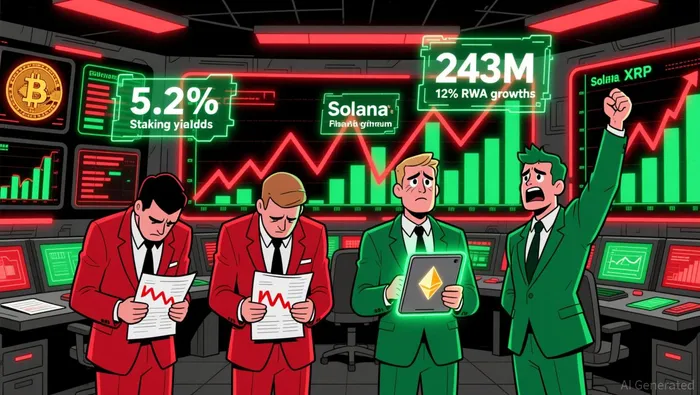
This divergence is notNOT-- accidental. Solana's staking-enabled ETFs, such as Bitwise's BSOL, have drawn $195 million in their first week, leveraging yields of 4–6% to attract capital. XRP's institutional appeal is equally compelling: Canary Capital's XRPC ETF recorded $243 million in net inflows on its debut, outperforming even BlackRock's IBIT. These figures underscore a critical trend: investors are prioritizing products that offer active yield generation and clear use cases over passive Bitcoin and Ethereum exposure.
Institutional Sentiment: From Hype to Pragmatism
Institutional investors are increasingly favoring Solana and XRP ETFs due to their alignment with pragmatic, use-case-driven strategies. XRP's role in cross-border payments-facilitating $364.2 million in RWA market capitalization via tokenized treasury funds-positions it as an infrastructure asset rather than a speculative play. Ripple CEO Brad Garlinghouse has emphasized this distinction, noting XRP's utility in reducing friction in global value transfers.
Solana's institutional traction stems from its staking features and ecosystem growth. The Bitwise Solana Staking ETFBSOL--, for instance, offers exposure to a network that processes 65,000 transactions per second, far outpacing Ethereum's 30 TPS. This scalability, combined with a 215% surge in Solana's RWA market cap, has made it a magnet for capital, seeking both yield and utility.
Meanwhile, Bitcoin and Ethereum ETFs face headwinds. Despite Harvard Management Company's 257% increase in Bitcoin ETF holdings, broader institutional redemptions suggest waning enthusiasm. A three-day period in late October 2025 saw Bitcoin ETFs lose $492 million, with BlackRock's IBIT leading the exodus. Ethereum's struggles are even starker: all nine Ethereum ETFs recorded outflows of $107 million on November 11.
Regulatory Tailwinds and Market Realities
Regulatory clarity has been a double-edged sword. The Trump administration's SEC approvals of over 20 spot Bitcoin ETFs since 2024 created a fertile environment for institutional entry. However, this same regulatory framework has also enabled altcoin ETFs to gain traction. FalconX's acquisition of 21shares, for example, has integrated institutional-grade trading infrastructure with altcoin ETF expertise, accelerating adoption.
Yet, market dynamics complicate the narrative. While XRP ETFs have attracted record inflows, the token's price fell 8% post-launch, highlighting the disconnect between ETF performance and underlying asset valuation. This underscores a key risk: institutional capital can drive ETF success without necessarily translating to price appreciation.
Conclusion: A New Paradigm in Crypto Investing
The rise of Solana and XRP ETFs signals a maturing crypto market. Institutions are no longer captivated by hype alone; they demand tangible utility, yield, and regulatory certainty. As staking-enabled products and RWA integrations redefine value propositions, Bitcoin and Ethereum ETFs may struggle to retain their dominance. For investors, this shift offers a critical lesson: the future of crypto investing lies not in chasing the "next Bitcoin," but in identifying assets that solve real-world problems.





Comentarios
Aún no hay comentarios