
Institutional Capital's Great Migration: Why a $100M Pre-Built Blockchain Platform Is Outpacing Solana and Polkadot in 2025
In 2025, the blockchain landscape is witnessing a seismic shift in institutional capital allocation. While SolanaSOL-- and PolkadotDOT-- have long been darlings of the Layer 1 space, a new contender-Zero Knowledge Proof (ZKP)-is emerging as a $100M pre-built platform that is redefining the criteria for institutional adoption. This migration is not merely speculative but rooted in ZKP's unique infrastructure, privacy-first design, and strategic differentiation from its competitors.
The Solana Paradox: Growth vs. Volatility
Solana's 2025 performance has been a study in contrasts. The network generated $2.39 billion in application revenue, a 46% year-over-year increase, and processed 33 billion non-vote transactions-a testament to its high-throughput architecture and developer ecosystem. Institutional interest further surged with the launch of US-listed Solana ETFs, which attracted $1.02 billion in net inflows. However, these gains are shadowed by a nearly 50% decline in Solana's native token price from its peak, exposing the platform's vulnerability to market volatility.
While Solana's Rust-based infrastructure and low fees remain competitive, its reliance on speculative token dynamics and occasional outages (e.g., network downtime in 2024) have raised red flags for risk-averse institutions. As one analyst notes, "Solana's speed and scalability are unmatched, but its token's volatility and centralization risks make it a less-than-ideal long-term bet for institutional portfolios".
Polkadot's Interoperability Gambit
Polkadot, meanwhile, has carved a niche in cross-chain interoperability through its parachain model and Elastic Scaling upgrades. Its 200% surge in transaction volume underscores its role as a modular hub for decentralized applications. Yet, despite these innovations, Polkadot's market cap of $6.3 billion in 2025 lags behind EthereumETH-- and Solana, reflecting limited institutional traction. The platform's complexity and fragmented parachain ecosystem also pose barriers to mainstream adoption, particularly for institutions seeking streamlined, single-chain solutions.
ZKP's $100M Pre-Built Model: A New Paradigm
Enter Zero Knowledge Proof (ZKP), a platform that has disrupted the status quo by investing $100 million upfront in infrastructure before seeking external capital-a stark departure from the traditional "raise first, build later" model. This approach ensures a fully operational network from day one, addressing institutional concerns about unproven development timelines and overhyped promises.
ZKP's architecture is designed for privacy-preserving computation, leveraging zero-knowledge proofs to enable verifiable transactions without exposing sensitive data. This is a critical differentiator in sectors like healthcare, finance, and AI, where confidentiality and regulatory compliance are paramount. For instance, ZKP allows institutions to process encrypted data while maintaining audit-ready verification-a capability absent in Solana and Polkadot.
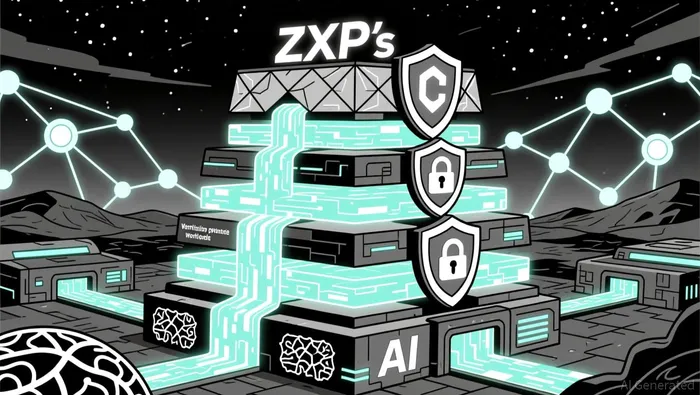
Moreover, ZKP's four-layer architecture supports decentralized AI workloads and private computations, positioning it as a scalable solution for institutional-grade applications. Its transparent auction system for presale distribution-allocating 90 billion ZKP coins over 450 days- further reinforces trust, contrasting with the opaque fundraising practices of many Layer 1 projects.
Competitive Advantages: ZKP vs. Solana and Polkadot
- Privacy and Verifiability: Unlike Solana's public ledger or Polkadot's parachain model, ZKP's zero-knowledge proofs enable confidential transactions while ensuring cryptographic validation. This is particularly appealing to institutions in regulated industries.
- Build-First Approach: ZKP's $100M pre-built infrastructure eliminates the risk of delayed development, a common criticism of projects like Solana and Polkadot, which rely on phased upgrades.
- Institutional-Grade Compliance: ZKP's certifications (e.g., ISO/IEC 27001) and focus on audit-ready verification align with institutional demands for regulatory clarity, a gap in Solana's and Polkadot's offerings.
- Market Positioning: While Solana and Polkadot compete on speed and interoperability, ZKP targets privacy-centric use cases-$1.2 trillion in real-world assets and secure AI training.
The Bigger Picture: Capital Migration and Market Trends
Institutional capital is increasingly favoring platforms that address specific pain points rather than chasing general-purpose scalability. ZKP's focus on privacy and verifiable computation aligns with the 2025 surge in tokenized RWAs and AI-driven applications, where data confidentiality is non-negotiable. Meanwhile, Solana's token volatility and Polkadot's fragmented ecosystem highlight the limitations of their current models.
As of September 2025, $4.39 billion in institutional inflows has flowed into crypto products, with ZKP's presale attracting significant attention from venture capital firms and family offices. This trend suggests a broader reallocation of capital toward platforms that offer differentiated value propositions and institutional-grade infrastructure.
Conclusion: The Future of Institutional Blockchain Investment
The migration of institutional capital to ZKP underscores a fundamental shift in the Layer 1 space: performance and scalability are no longer sufficient. Institutions now demand privacy, compliance, and proven infrastructure-criteria where ZKP excels. While Solana and Polkadot remain relevant, their inability to address these emerging priorities positions ZKP as a formidable challenger in 2025 and beyond.
For investors, the message is clear: the next era of blockchain adoption will be defined not by speed or interoperability alone, but by platforms that solve real-world institutional needs with cryptographic precision.






Comentarios
Aún no hay comentarios