
Institutional Capital Flows and Market Implications: Analyzing the $303M SOL Transfer to Binance
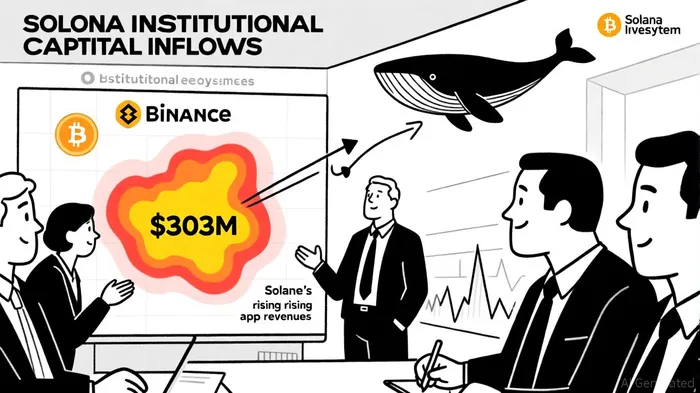
The recent transfer of $303 million worth of SolanaSOL-- (SOL) to BinanceETH-- has ignited intense speculation about institutional liquidity strategies and whale behavior in the crypto market. This movement, occurring amid a 213% surge in Solana app revenues driven by memecoins, underscores the growing intersection of institutional capital and decentralized ecosystems. To assess its implications, we must dissect the interplay between whale activity, institutional positioning, and broader market dynamics.
Institutional Activity: A New Era for Solana
Institutional interest in Solana has accelerated sharply in recent months. Fidelity Digital Assets reported a 22% increase in institutional client activity over the past 30 days, while new Solana-based treasury firms—backed by Pantera Capital, Galaxy, and Multicoin—have announced plans for a combined $2.25 billion in investments. These developments signal a strategic shift as institutions seek exposure to high-growth blockchain platforms.
The $303M SOLSTKE-- transfer to Binance aligns with this trend. Binance, the largest crypto exchange by volume, serves as a critical liquidity hub for institutional players. The movement of such a large asset pool to Binance could reflect efforts to optimize trading efficiency or hedge against volatility in a market where altcoin trading volumes have risen 45% quarter-on-quarter. For context, Sol Strategies—a major institutional player—holds 142,000 SOL ($46 million) and operates four Solana validators, illustrating the depth of institutional infrastructure now embedded in the network.
Whale Behavior: Strategic Positioning or Market Signal?
Whale activity often acts as a barometer for market sentiment. The $303M SOL transfer to Binance mirrors broader patterns observed in August 2025, when BitcoinBTC-- whales realized $4 billion in profits in a single day. Such movements typically indicate either profit-taking or strategic rebalancing. In Solana's case, the timing coincides with a 213% surge in app revenues, driven by memecoins like Dogwifhat and others. This suggests that whales may be capitalizing on the platform's momentum, either to lock in gains or to amplify liquidity for emerging projects.
Binance's role in this dynamic is pivotal. The exchange reported $737.1 billion in trading volume for August 2025, making it a primary venue for large-scale transactions. The influx of SOL to Binance could also reflect a shift in capital allocation, as institutional investors diversify away from Bitcoin. For instance, an ancient Bitcoin whale recently converted $3.7 billion in BTC to ETH, highlighting a broader trend of capital rotation into altcoins. Solana, with its high-speed infrastructure and memecoin-driven growth, is now a key beneficiary of this shift.
Market Implications: Liquidity, Volatility, and Sustainability
The $303M SOL transfer raises critical questions about Solana's ecosystem sustainability. While the platform's app revenues have surged, the long-term viability of memecoin-driven growth remains uncertain. Institutions are likely hedging against this risk by deploying liquidity strategies that balance exposure to high-growth assets with downside protection. For example, platforms like Hyperliquid have enabled leveraged trading and passive earnings through liquidity provision, offering institutions tools to manage risk while participating in Solana's rally.
However, the transfer also highlights potential volatility. A sudden drop in Bitcoin's price to $93,000 in late August wiped out $303 million in long positions, illustrating the fragility of leveraged positions in a market prone to rapid shifts. If Solana's price were to correct, the $303M SOL on Binance could exacerbate selling pressure, particularly if the tokens are liquidated. This underscores the dual-edged nature of institutional liquidity: while it enhances market depth, it can also amplify short-term swings.
Conclusion: A Tipping Point for Solana?
The $303M SOL transfer to Binance is more than a single transaction—it is a symptom of a larger transformation in crypto markets. Institutions are increasingly treating Solana as a strategic asset, leveraging its infrastructure and memecoin-driven demand to deploy liquidity strategies that mirror traditional finance. Yet, the sustainability of this growth hinges on whether Solana's ecosystem can evolve beyond memecoins to deliver robust, real-world applications.
For investors, the key takeaway is clear: institutional and whale activity in Solana is intensifying, but the market remains a high-stakes game of positioning and timing. As Binance continues to act as a liquidity conduit, the interplay between these forces will shape Solana's trajectory—and by extension, the broader crypto landscape.





Comentarios
Aún no hay comentarios