
Institutional Buying and Price Catalysts: The Case for Bitcoin and Ethereum in 2025
Institutional Buying and Price Catalysts: The Case for BitcoinBTC-- and EthereumETH-- in 2025
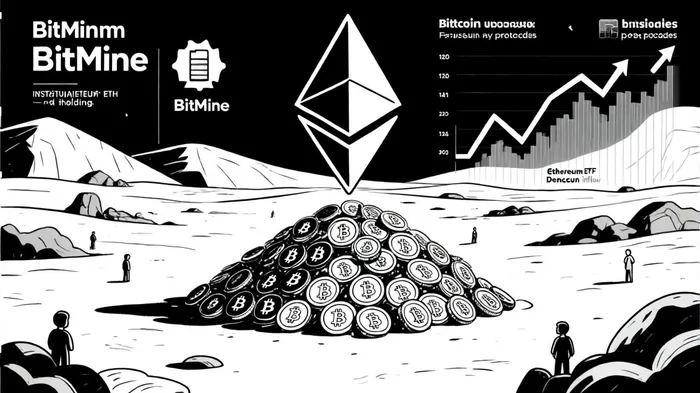
The cryptocurrency market in 2025 is witnessing a seismic shift driven by institutional adoption and strategic price catalysts. With Ethereum (ETH) and Bitcoin (BTC) at the forefront, the interplay between corporate treasury allocations, regulatory developments, and protocol upgrades is reshaping the investment landscape. This analysis examines the evidence from Tom Lee's BitMine, Bitcoin ETF dynamics, and macroeconomic trends to build a compelling case for near-term crypto exposure.
Ethereum's Institutional Momentum: A $13B Bet on the Future
Tom Lee's BitMine ImmersionBMNR-- Technologies has cemented its position as the largest corporate ETHETH-- holder, accumulating $103.68 million in Ethereum through a single transaction from BitGo, as reported by on-chain analytics firm Lookonchain in BitMine adds $103.6M ETH. This move, which increased BitMine's total ETH holdings to 2,853,974 tokens ($12.35 billion), underscores Ethereum's growing appeal as a long-term store of value. The firm's aggressive accumulation-adding 179,251 ETH in a single week-reflects a strategic bet on Ethereum's role in AI-driven finance and institutional-grade infrastructure, as detailed in BitMine Immersion expands holdings.
Fundstrat, where Lee serves as Chief Investment Officer, has further reinforced this narrative by projecting ETH could surge to $5,500 as the recent price pullback nears its end. This optimism is fueled by Ethereum's dual role as a foundational asset for tokenization and a beneficiary of rising institutional demand. BlackRock's recent pivot to prioritize Ethereum as the "core engine" of next‑generation finance highlights the asset's institutional legitimacy, a shift covered in BlackRock's Ethereum focus.
Bitcoin's Institutional Adoption: Beyond ETFs
While Ethereum's institutional adoption is accelerating, Bitcoin's institutional buying trends have reached unprecedented levels. The approval of spot Bitcoin ETFs in early 2024 catalyzed a $58 billion inflow into these products by Q2 2025, with BlackRock's iShares Bitcoin Trust (IBIT) alone amassing $80 billion in assets under management, according to Bitcoin ETF inflows. However, institutional demand extends beyond ETFs. Public and private companies added 46,187 BTCBTC-- in September 2025 alone, with total institutional holdings now exceeding 3.8 million BTC ($435 billion), as documented in a Bitcoin Magazine analysis.
MicroStrategy's recent $4.5 billion Bitcoin purchase exemplifies this trend, while advanced trading infrastructure-such as AI-driven execution algorithms-enables large-scale, discreet accumulation described in the same Bitcoin Magazine analysis. These strategies reflect Bitcoin's dual identity as both a hedge against fiat depreciation and a cornerstone of diversified institutional portfolios.
Price Catalysts: Upgrades, Macro Trends, and Regulatory Clarity
Ethereum's price trajectory is being propelled by a trifecta of catalysts:
1. Protocol Upgrades: The Fusaka upgrade, scheduled for November 2025, will introduce parallel execution in the Ethereum Virtual Machine (EVM), enhancing scalability and reducing gas congestion, a point emphasized in an Ethereum price surge analysis. This follows the Dencun upgrade, which slashed Layer-2 fees by ~90% in 2024.
2. Regulatory Developments: The proposed GENIUS Act, which seeks to regulate Ethereum-based stablecoins, is fostering institutional trust and broader adoption.
3. Macro Trends: Dovish signals from the Federal Reserve and improved global risk appetite have amplified Ethereum's appeal as a "tech-like" asset.
For Bitcoin, the combination of ETF-driven inflows and reduced exchange liquidity is creating upward pressure. With ETF holdings exceeding 1.47 million BTC and institutional buying reducing circulating supply, projections for BTC's price range from $600,000 to $1.3 million, a forecast discussed alongside institutional shifts in coverage of BlackRock's strategy.
Investment Thesis: Why Act Now?
The convergence of institutional buying, regulatory clarity, and protocol innovation creates a unique inflection point for crypto. Ethereum's $5,500 price target from Fundstrat and Bitcoin's projected multi-hundred-thousand-dollar range are not speculative-they are grounded in real-world capital flows and macroeconomic tailwinds.
For investors, the key is to align with assets that are both beneficiaries of institutional adoption and catalysts for systemic change. Ethereum's role in AI and tokenization, coupled with Bitcoin's status as a digital gold standard, positions both as essential components of a forward-looking portfolio.
Conclusion
The 2025 crypto market is no longer a niche experiment but a mainstream asset class. With institutions allocating billions to Ethereum and Bitcoin, and price catalysts accelerating, the time to act is now. As Tom Lee aptly notes, Ethereum is the "biggest macro trade of the decade"-a sentiment echoed by on-chain data, regulatory progress, and institutional capital flows.





Comentarios
Aún no hay comentarios