
Institutional Blockchain Adoption in Europe: Strategic Investment in DeFi Infrastructure Enabling Tokenized Securities
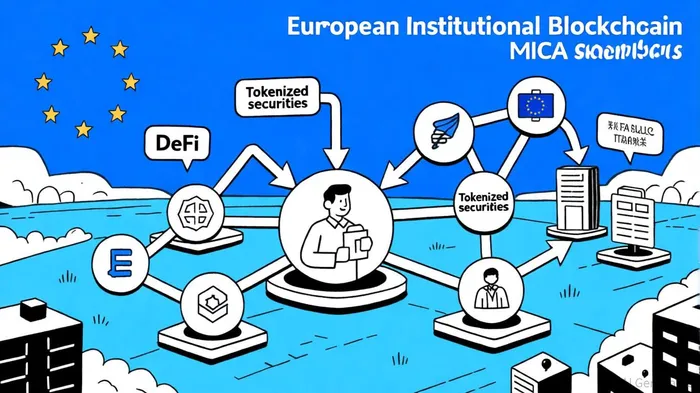
The European financial landscape is undergoing a quiet revolution. By 2025, 8.9% of Europeans had adopted cryptocurrency, a surge driven by regulatory clarity and institutional innovation[1]. At the heart of this shift lies a strategic pivot toward blockchain-based DeFi infrastructure, enabling tokenized securities and real-world assets (RWA). European institutions are no longer just observers—they are architects of a new financial ecosystem, blending the efficiency of decentralized systems with the rigor of traditional compliance.
Regulatory Catalysts: MiCA and the DLT Pilot Regime
The European Union's Markets in Crypto-Assets (MiCA) framework, finalized in 2023, has been a game-changer. By establishing clear rules for stablecoins, custodians, and digital assetDAAQ-- exchanges, MiCA has created a sandbox for institutional experimentation[3]. Complementing this, the DLT Pilot Regime—launched in March 2023—allowed approved market infrastructures to tokenize assets like bonds and real estate, reducing settlement times from days to seconds[2]. These frameworks have not only mitigated regulatory uncertainty but also attracted capital: the European crypto market is projected to reach $26 billion in revenue by 2025, growing at a 17.1% CAGR[1].
Institutional Case Studies: From JPMorganJPM-- to 21X
Major European banks are leading the charge. JPMorgan's Onyx network, for instance, has explored permissioned DeFi solutions for institutional-grade tokenized lending and cross-border settlements[2]. Similarly, BlackRockBLK-- and Franklin Templeton have tokenized money market funds and U.S. Treasuries, demonstrating blockchain's potential to streamline collateral management[4].
A landmark development in 2025 was the launch of 21X, the first regulated exchange for tokenized cash and securities in the EU. Backed by ChainlinkLINK--, CircleCRCL--, and Polygon, 21X enables atomic trading and settlement using blockchain, slashing settlement times to near real-time[4]. This platform, which went live on September 8, 2025, has attracted corporate clients and institutional investors, signaling a shift toward programmable finance.
Meanwhile, startups like BlockInvest and Securitize are building modular infrastructure for tokenized securities, supported by venture capital and institutional partnerships[4]. These platforms leverage Ethereum's ERC-1400 and ERC-3643 standards to enforce compliance, ensuring transfer restrictions and administrative controls meet legal requirements[4].
Strategic Investment Drivers: Efficiency, Liquidity, and Access
Institutions are drawn to DeFi infrastructure for three key reasons:
1. Operational Efficiency: Tokenized securities reduce settlement costs by up to 70% and enable 24/7 trading[2].
2. Liquidity: Stablecoins like USDCUSDC-- and TetherUSDT-- provide 45% of liquidity in decentralized exchanges, a critical enabler for institutional participation[3].
3. Market Access: Tokenization unlocks fractional ownership in traditionally illiquid assets like real estate and private credit, expanding investor bases[4].
The total value locked (TVL) in tokenized RWA assets hit $65 billion by mid-2025, driven by projects like KKR's tokenized private equity funds and Swiss SIX Digital Exchange's tokenized bonds[4]. This growth is underpinned by infrastructure investments: stablecoin-related DeFi infrastructure alone attracted $2.5 billion in venture capital in 2025[3].
Challenges and the Road Ahead
Despite progress, challenges persist. The European Central Bank has warned of stablecoin risks, including contagion and systemic instability[3]. Additionally, interoperability between permissioned and public DeFi platforms remains a technical hurdle. However, initiatives like the ISO 20022 upgrade—hardwiring digital tokens into financial messaging standards—signal a path forward[5].
For investors, the strategic imperative is clear: European institutions are betting on blockchain as a foundational layer for the next-generation financial system. With MiCA's implementation and platforms like 21X, the continent is poised to lead in tokenized securities, offering a blueprint for global adoption.





Comentarios
Aún no hay comentarios