
Institutional Bitcoin Adoption: A Macroeconomic Pivot in Post-Quantitative Easing Portfolios
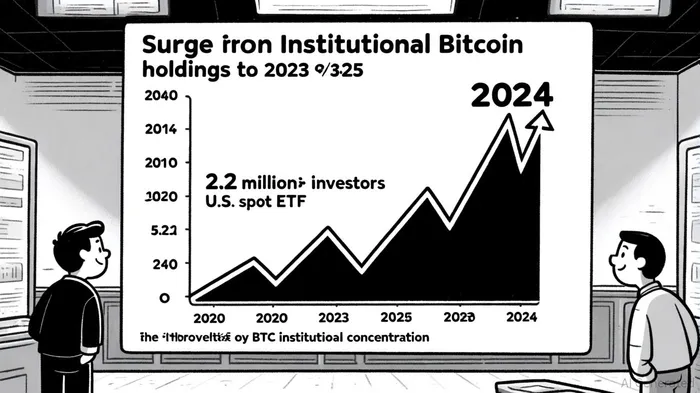
The approval of U.S. spot BitcoinBTC-- ETFs in early 2024 marked a tectonic shift in institutional finance, transforming Bitcoin from a speculative asset into a regulated, institutional-grade investment vehicle. According to a report by Chainup, these ETFs attracted over $45 billion in monthly inflows and $11 billion in net inflows in the last quarter of 2024 alone, rivaling traditional fixed-income funds [1]. This surge has positioned Bitcoin as a strategic treasury asset, with corporations like MicroStrategy and Semler ScientificSMLR-- allocating portions of their balance sheets to BTCBTC--. By 2025, institutional investors collectively hold over 2.2 million BTC—roughly 10% of the total supply—primarily through ETFs and custody solutions, stabilizing price floors and reducing circulating supply [1].
Macroeconomic Positioning: Bitcoin as a Hedge and Diversifier
Bitcoin's appeal as a macroeconomic hedge has intensified amid concerns over fiat credibility and geopolitical instability. Its fixed supply of 21 million coins offers a compelling alternative to traditional assets in an era of aggressive monetary easing and rising inflation [1]. Regulatory clarity, including the U.S. Financial Innovation and Technology for the 21st Century Act (Genius Act) and the EU's Markets in Crypto-Assets Regulation (MiCA), has further legitimized Bitcoin's role in institutional portfolios [1].
Bitcoin's volatility has also declined significantly, with 30-day rolling volatility dropping to levels comparable to the S&P 500 and gold [2]. This shift has improved its viability as a medium of exchange and a diversification tool. A 2025 EY survey found that 60% of institutions already allocate 1–5% of their portfolios to crypto assets, primarily Bitcoin, with many planning to increase exposure [1]. As ETFs and institutional-grade custody solutions gain traction, Bitcoin is being integrated into traditional investment frameworks, including pension funds and retirement portfolios [2].
Strategic Accumulation: From DCA to Structured Products
Institutional accumulation strategies have evolved beyond traditional dollar-cost averaging (DCA). A 2025 study by OrBit Markets revealed that “accumulator” strategies—structured products allowing investors to purchase Bitcoin at discounted strike prices—outperformed DCA by 10–26% over 3–12 month periods [3]. These strategies, particularly suited for corporate treasuries, enable disciplined accumulation at a discount while mitigating market timing risks [3]. For example, MicroStrategy's disciplined capital strategy—financing Bitcoin acquisitions via at-the-market offerings and convertible notes—allowed it to nearly double its BTC holdings every 16–18 months, with its stock surging 3,000% over five years [4].
Corporate treasuries are also leveraging Bitcoin as a productive asset. Miners like Marathon Digital and Riot PlatformsRIOT-- now collateralize BTC for expansion, while Sovereign Wealth Funds (SWFs) and pension funds view it as a hedge against geopolitical instability and monetary expansion [5]. By 2025, over 250 organizations, including public companies and pension funds, had adopted Bitcoin as a reserve asset, following the treasury model pioneered by Michael Saylor [4].
Macroeconomic Implications: Monetary Policy and Inflation
Bitcoin's institutional adoption is reshaping central bank monetary policy. Empirical studies show that Bitcoin prices now respond to U.S. monetary policy announcements, reacting similarly to stocks and gold but with greater volatility [6]. The Minneapolis Federal Reserve has warned that Bitcoin's existence could constrain government deficit spending by offering an alternative store of value, forcing policymakers to either ban it or impose specific taxes [6].
Bitcoin's role as an inflation hedge remains context-dependent. While it outperformed traditional assets in high-inflation economies like Argentina and Turkey, its effectiveness in developed markets is nuanced. For instance, Bitcoin returns increased after a positive inflation shock as measured by the CPI but not the Core PCE index [7]. The approval of Bitcoin ETFs has further complicated its inflation-hedging narrative, as initial enthusiasm was followed by volatility-driven sell-offs [7].
Risks and Future Outlook
Despite its growth, institutional Bitcoin adoption carries risks. The growing influence of institutional capital and regulatory oversight may challenge Bitcoin's decentralized nature, raising questions about long-term autonomy and market dynamics [1]. Additionally, Bitcoin's correlation with traditional assets—peaking at 0.87 with the S&P 500 in 2024—suggests it is no longer a pure alternative asset but an integrated component of financial markets [8].
Looking ahead, Bitcoin's integration into traditional finance will likely accelerate. Innovations like Bitcoin-backed bonds, mortgages, and multi-jurisdictional custody solutions are redefining its utility [5]. However, institutions must balance Bitcoin's potential for portfolio resilience with its inherent volatility and regulatory uncertainties.
Conclusion
Institutional Bitcoin adoption represents a macroeconomic pivot in post-quantitative easing portfolios. By stabilizing price floors, reducing volatility, and offering diversification benefits, Bitcoin has emerged as a strategic asset for institutional investors. Yet, its evolving role in monetary policy and its integration into traditional markets underscore the need for careful risk management. As the line between crypto and conventional finance blurs, the challenge for institutions will be to harness Bitcoin's potential without compromising its foundational principles.






Comentarios
Aún no hay comentarios