
Institutional Adoption and Long-Term Value Accrual in Digital Asset Treasuries: A Strategic Investment Analysis
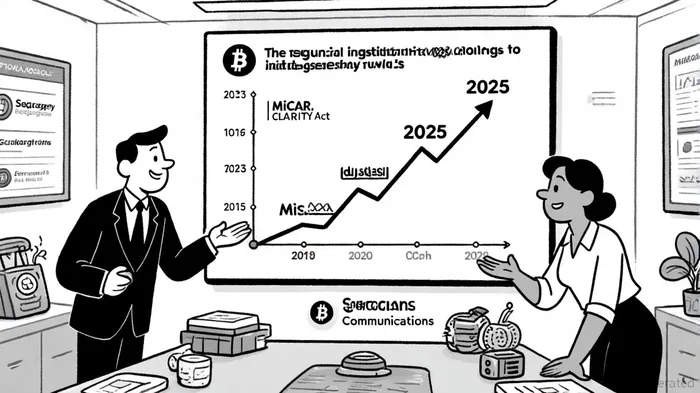
The institutionalization of digital assets has transitioned from speculative curiosity to strategic necessity. By 2025, corporations and investment firms are increasingly integrating BitcoinBTC--, stablecoins, and utility tokens into their treasury strategies, driven by a confluence of regulatory clarity, technological advancements, and macroeconomic imperatives. This shift is not merely about diversification but about redefining liquidity management, capital efficiency, and long-term value creation in an era of persistent inflation and digital transformation.
Drivers of Institutional Adoption: Regulatory Clarity and Technological Trust
Regulatory frameworks such as the EU's Markets in Crypto-Assets Regulation (MiCAR) and the U.S. CLARITY and GENIUS Acts have provided a critical foundation for institutional participation[1]. These frameworks address concerns around transparency, custody, and market integrity, enabling firms to treat digital assets as legitimate balance sheet components. For instance, Sequans Communications executed a structured financing strategyMSTR-- in 2024, raising capital through equity, convertible debt, and warrants to accumulate over 2,300 Bitcoin tokens[3]. This approach exemplifies how corporations are leveraging digital assets to hedge against inflation while optimizing capital structures.
Technological advancements in custody solutions—such as multi-party computation (MPC) and interoperable platforms—have further reduced operational risks[2]. Institutions can now manage digital assets with the same rigor as traditional treasuries, fostering confidence in their adoption.
Digital Asset Treasury Companies (DATCOs): A New Capital Structure
The rise of Digital Asset Treasury Companies (DATCOs) marks a paradigm shift in institutional investment. These entities, such as Strategy (formerly MicroStrategy) and Metaplanet, function as permanent capital vehicles designed to accumulate and manage digital assets as primary reserves[1]. Unlike traditional firms that might hold crypto incidentally, DATCOs prioritize digital assets through perpetual capital structures, including at-the-market (ATM) equity programs. This allows them to raise funds continuously and reinvest proceeds into Bitcoin or other tokens, creating a compounding effect on asset per share for investors[1].
For example, Strategy's conversion of cash reserves into Bitcoin has positioned it as a regulated vehicle for institutional exposure to digital assets. By 2025, DATCOs collectively hold over $100 billion in digital assets, with companies like SharpLink Gaming (SBET) and CEA Industries further diversifying into utility tokens like BNBBNB-- and SOL[2]. These tokens offer additional value streams through staking yields, transaction fees, and decentralized finance (DeFi) participation, enhancing long-term accrual potential[4].
Solana and the Institutionalization of Yield Generation
Solana (SOL) has emerged as a focal point for institutional digital asset treasuries, particularly in 2025. Public companies and investment firms are treating SOLSOL-- as an institutional-grade asset due to its high throughput, low fees, and robust DeFi ecosystem. For instance, Forward Industries has embedded itself in Solana's validator network, staking SOL to earn passive income while participating in governance[1].
Pantera Capital's $1.25 billion Solana-focused public treasury and Galaxy Digital's commitment to stake 6.8 million SOL underscore the growing institutional confidence in blockchain infrastructure[1]. These initiatives are not speculative but strategic, aligning with the 24/7 global nature of digital markets and offering yield generation through staking and validator delegation.
Long-Term Value Accrual: Metrics and Market Sentiment
Institutional investors are increasingly allocating capital to digital assets as a core component of their long-term strategies. A 2025 survey by CoinbaseCOIN-- and EY-Parthenon revealed that 80% of institutional investors plan to increase their digital asset holdings, with 59% targeting allocations exceeding 5% of their assets under management[2]. This surge is fueled by innovations in stablecoins, tokenization, and DeFi, which provide liquidity and utility beyond traditional treasuries.
The appeal of crypto treasuries lies in their visibility and alignment with digital market dynamics. Unlike fiat reserves, digital assets can generate yield through staking and DeFi protocols, creating multiple revenue streams[4]. For example, CEA Industries' focus on BNB highlights the strategic advantages of utility tokens, which power ecosystems and derive value from transaction fees and decentralized applications[4].
Risks and the Road Ahead
While the institutional adoption of digital assets is accelerating, challenges remain. Regulatory uncertainty, market volatility, and cybersecurity risks necessitate robust governance frameworks. However, the structural advantages of DATCOs—such as flexibility in investor subscriptions and redemptions—make them resilient to short-term fluctuations[1].
As of 2025, the institutional digital asset landscape is characterized by innovation and caution. With over $100 billion in digital assets under management and a growing number of firms exploring tokenized assets and private funds[3], the future of treasuries is increasingly digital.







Comentarios
Aún no hay comentarios