
Institutional Adoption of Layer 2 Ecosystems: The Strategic Move of Deploying ETH on Linea
The institutional-grade blockchain landscape is undergoing a seismic shift. As Ethereum's Layer 2 (L2) ecosystems mature, financial institutions are increasingly deploying capital to these networks, driven by their scalability, compliance-ready infrastructure, and yield-generating potential. Among these, Linea-a zero-knowledge EthereumETH-- virtual machine (ZK-EVM) platform-has emerged as a pivotal player, offering an ETH-native yield and burn model tailored for institutional-grade DeFi strategies. This article evaluates the long-term viability and yield potential of deploying ETHETH-- on LineaLINEA--, drawing on recent institutional activity, technical upgrades, and risk frameworks.
The Rise of Institutional-Grade L2s
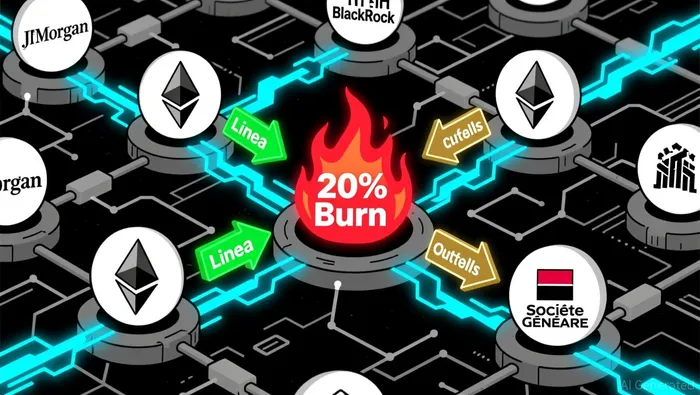
Ethereum's Layer 2 solutions are no longer experimental. Institutions like JPMorganJPM--, BlackRockBLK--, and Société Générale have transitioned from pilot projects to production systems, leveraging L2s for tokenized asset settlements, cross-border payments, and yield generation. Linea, in particular, has positioned itself as a bridge between Ethereum's security and institutional demands. Its customizable execution environments, cost reductions via transaction batching, and privacy-preserving zero-knowledge proofs make it an attractive hub for regulated workflows.
The platform's ETH-native yield model further strengthens its appeal. By burning 20% of fees in ETH and 80% in LINEA tokens, Linea creates deflationary pressure while aligning incentives for long-term capital holders. This model mirrors Ethereum's own tokenomics but scales it for institutional-grade liquidity, offering a compelling alternative to traditional staking or lending protocols.
Case Study: Sharplink Gaming's $170M ETH Deployment
One of the most notable institutional moves in Q4 2025 was Sharplink Gaming's deployment of $170 million in ETH to Linea. This multi-year initiative, executed via partnerships with etherETH--.fi and EigenCloud, underscores the platform's growing credibility. Sharplink's CEO emphasized the strategic value of "dynamic capital management" through Ethereum's L2s, positioning the company at the forefront of the "Ethereum institutional supercycle".
The deployment's success is tied to Linea's Limitless Prover upgrade, which pushed transaction processing speeds to 5,000 TPS by late 2025, enabling high-throughput, low-cost yield generation. For Sharplink, this meant accessing institutional-grade DeFi primitives-such as restaking and tokenized real-world assets (RWAs)-without compromising on security or compliance. The company's Q3 2025 earnings highlighted a 1,100% revenue surge and $104.3 million net income, partly attributed to its Ethereum treasury strategy.
Technical Upgrades and Yield Potential
Linea's technical roadmap is a critical factor in its institutional adoption. The Limitless Prover upgrade not only boosted throughput but also optimized gas efficiency, reducing execution costs for complex DeFi strategies. By Q4 2025, institutional investors had added $1.8 billion in ETH to Ethereum-based protocols, with $63 million deposited on December 29 alone. This surge reflects confidence in L2s like Linea, which offer scalable infrastructure for yield farming, liquidity provision, and tokenized asset management.
Moreover, Linea's integration with tokenized RWAs-such as US Treasuries and commodities-has expanded its yield opportunities. Platforms like Aave and Morpho, which now support tokenized public-market assets, have seen increased liquidity from institutional participants. This trend aligns with broader DeFi maturation, where stablecoins and RWAs form the backbone of a "connected financial stack".
Risk Assessments and Institutional Viability
While yield potential is compelling, institutional-grade DeFi strategies require robust risk frameworks. Linea's alignment with Ethereum's data availability and validation models ensures that high-value workflows inherit the security of the base layer. Additionally, its ZK-EVM architecture minimizes smart contract risks, a critical consideration for regulated entities.
The 2025 DeFi landscape also saw consolidation in lending and credit markets, with platforms like Aave and Morpho expanding into tokenized RWAs. This specialization reduced systemic risks by focusing liquidity on protocols with transparent economic models and proven execution. For Linea, this means operating within a mature ecosystem where risk is mitigated through specialization and institutional-grade infrastructure.
Conclusion: A Strategic Bet on Ethereum's Future
The strategic deployment of ETH on Linea represents more than a yield play-it's a bet on Ethereum's long-term dominance in institutional finance. With technical upgrades, institutional case studies like Sharplink Gaming, and a maturing DeFi ecosystem, Linea is well-positioned to become a cornerstone of institutional-grade blockchain infrastructure. As Ethereum's L2s continue to scale, the convergence of traditional finance and decentralized systems will only accelerate, making platforms like Linea essential for capital preservation and growth.





Comentarios
Aún no hay comentarios