
Institutional Adoption of Digital Assets: A Strategic Inflection Point in 2026
The year 2026 marks a pivotal turning point in the institutional adoption of digital assets, driven by a confluence of regulatory alignment and surging capital inflows into digital finance infrastructure. As global regulators harmonize frameworks and institutional investors deepen their participation, digital assets are transitioning from speculative novelties to core components of diversified portfolios. This analysis explores how cross-jurisdictional regulatory clarity and infrastructure innovation are reshaping the landscape, creating unprecedented opportunities for institutional capital.
Regulatory Alignment: A Foundation for Institutional Confidence
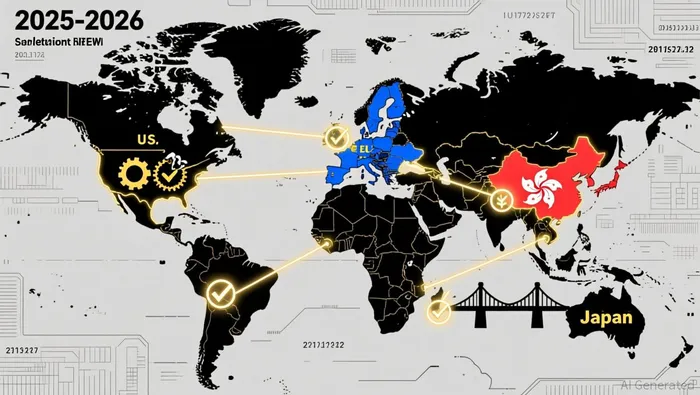
The regulatory landscape in 2025 laid the groundwork for 2026's institutional boom. In the U.S., the passage of the GENIUS Act in July 2025 established a federal framework for stablecoin regulation, mandating 1:1 reserve backing and enhanced AML compliance according to Chainalysis. This legislation aligned the U.S. with the EU's Markets in Crypto-Assets (MiCA) Regulation, which took full effect in 2025, creating a unified regulatory environment for cross-border digital asset activity as detailed in a policy review. These frameworks reduced uncertainty for institutions, enabling them to engage with stablecoins, tokenized assets, and blockchain-based payment systems without fear of regulatory arbitrage.
International collaboration further accelerated alignment. The Transatlantic Taskforce for Markets of the Future, a U.S.-UK initiative, facilitated regulatory coordination on digital assets, while jurisdictions like Hong Kong and Japan introduced stablecoin-specific frameworks, reinforcing a global consensus according to a regulatory roundup. According to Chainalysis, these developments encouraged traditional financial institutions to enter the crypto space, offering custody, trading, and issuance services at scale.
Capital Inflows into Digital Finance Infrastructure
Regulatory clarity directly spurred institutional capital inflows into digital finance infrastructure, particularly in custody, blockchain platforms, and payment systems.
1. Custody Solutions: The Bedrock of Institutional Trust
Institutional demand for secure custody solutions surged in 2025-2026, with providers like Coinbase Custody, BitGo, and Fidelity Digital Assets expanding their enterprise-grade offerings as reported by Hashlock. These platforms combined regulatory compliance, cold storage, and staking capabilities, addressing institutional concerns about security and operational efficiency. By Q1 2026, global crypto ETPs (exchange-traded products) had attracted $87 billion in net inflows since 2024, with spot BitcoinBTC-- and EthereumETH-- ETFs capturing $31 billion in 2025 alone according to Grayscale research. BlackRock's IBIT and Fidelity's FBTC, with combined AUM exceeding $115 billion, became flagship vehicles for institutional exposure as noted in The Block.
2. Blockchain Platforms: Scaling Infrastructure for Mainstream Use
Venture capital funding for crypto infrastructure reached $30 billion in Q4 2025-Q1 2026, with late-stage projects in payments, stablecoins, and regulated trading attracting the lion's share of capital according to Gate Ventures. This growth was fueled by macroeconomic demand for alternative value stores and the maturation of blockchain infrastructure. For example, Visa's stablecoin settlement pilot using USDCUSDC-- demonstrated how blockchain could integrate with traditional payment rails, while JPMorgan's tokenized money-market funds highlighted the shift from theory to practice as detailed in GFR Law insights.
3. Payment Systems: Stablecoins as Financial Infrastructure
Stablecoins emerged as a cornerstone of institutional adoption, particularly for cross-border payments. Ripple's On-Demand Liquidity (ODL) service, leveraging XRPXRP--, provided faster and cheaper alternatives to SWIFT, while partnerships with Stripe and PayPal expanded digital dollar usage according to European Business Magazine. By 2026, stablecoins were no longer viewed as speculative instruments but as critical infrastructure, with institutional investors allocating capital to platforms that offered real-world utility.
4. Tokenization of Real-World Assets (RWAs): Expanding Use Cases
The tokenization of RWAs, such as gold and U.S. Treasuries, gained traction in 2025, with assets under management reaching $3.5 billion according to Chainalysis. BlackRockBLK-- and Franklin Templeton launched on-chain treasury products, enabling institutions to diversify portfolios with tokenized yields. This trend was supported by regulatory frameworks that balanced innovation with risk management, ensuring compliance with AML and financial stability standards as outlined in a policy review.
The Road Ahead: 2026 and Beyond
Looking ahead, institutional adoption is poised to accelerate further. Bipartisan crypto market structure legislation in the U.S. is expected to deepen integration between public blockchains and traditional finance, while global regulators continue to prioritize cross-border alignment according to Grayscale research. By 2026, institutional capital is projected to drive broader adoption of digital asset technologies, with tokenization and stablecoin ecosystems expanding into new sectors.
Conclusion
The strategic inflection point in 2026 is defined by two forces: regulatory alignment and institutional-grade infrastructure. As frameworks like the GENIUS Act and MiCA solidify trust, and capital inflows into custody, blockchain platforms, and payment systems scale, digital assets are becoming indispensable to institutional portfolios. For investors, this represents a unique opportunity to capitalize on a market undergoing structural transformation.







Comentarios
Aún no hay comentarios