
Institutional Adoption of Chainlink (LINK) and Its Implications for Long-Term Value
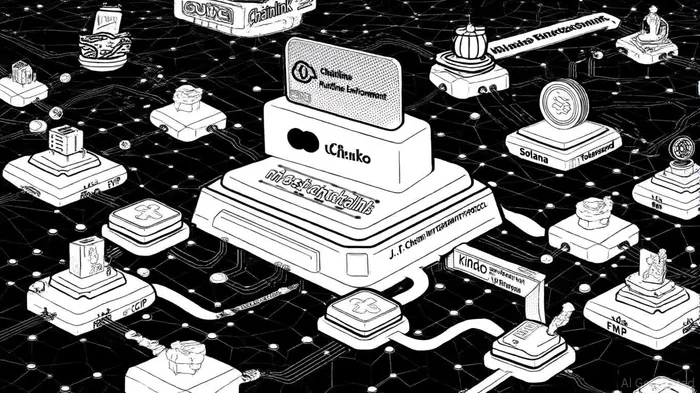
The convergence of traditional finance (TradFi) and blockchain technology has accelerated in 2025, driven by institutional demand for scalable, secure, and compliant infrastructure. At the forefront of this evolution is ChainlinkLINK-- (LINK), whose decentralized oracleORCL-- network has become a critical enabler of cross-chain interoperability, tokenized asset settlement, and institutional-grade risk management. As traditional financial institutionsFISI-- increasingly adopt blockchain-based solutions for treasury diversification, Chainlink's role in bridging decentralized finance (DeFi) and TradFi is reshaping long-term value dynamics in the crypto ecosystem.
Strategic Partnerships: Bridging TradFi and DeFi
Chainlink's institutional adoption has been catalyzed by strategic partnerships that address core pain points in traditional treasury operations. A landmark example is the collaboration between J.P. Morgan's Kinexys, Ondo Finance, and Chainlink, which executed the first atomic Delivery versus Payment (DvP) transaction across permissioned and public blockchains. This transaction involved the tokenized Short-Term U.S. Government Treasuries Fund (OUSG) on Ondo's platform, settled against J.P. Morgan's Kinexys network using Chainlink's Runtime Environment (CRE). The CRE's ability to coordinate cross-chain settlements in real-time underscores its potential to streamline institutional asset management, reduce counterparty risk, and enhance liquidity[1].
Mastercard's Q2 2025 partnership with Chainlink further expanded onchain accessibility for institutional and retail investors. By integrating Chainlink's Swapper app into its global payment infrastructure, MastercardMA-- enabled over 3 billion cardholders to purchase crypto assets directly onchain. This move not only democratized access to tokenized assets but also demonstrated Chainlink's capacity to meet regulatory and security standards required by traditional financial institutions[1].
Chainlink's expansion to Solana via the Cross-Chain Interoperability Protocol (CCIP) has also unlocked over $19 billion in tokenized asset value. By bridging non-EVM chains, CCIP supports institutional use cases such as cross-border settlements, asset tokenization, and multi-chain portfolio diversification. This infrastructure growth reflects Chainlink's strategic focus on interoperability—a key requirement for institutions seeking to hedge against blockchain-specific risks[1].
Regulatory Alignment and Institutional Confidence
Regulatory clarity has been a cornerstone of Chainlink's institutional adoption. Co-founder Sergey Nazarov's engagement with the U.S. Securities and Exchange Commission (SEC) and White House officials has helped shape frameworks for tokenized real-world assets (RWAs). The SEC's recent FAQ on blockchain-based broker-dealer compliance and the GENIUS Act—which established a regulatory framework for fiat-backed stablecoins—signal growing acceptance of blockchain infrastructure in financial policy[1].
Chainlink's role in providing proof of reserves, onchain identity verification, and cross-chain compliance tools aligns with institutional demands for transparency and auditability. For instance, its integration with stablecoin protocols ensures that tokenized assets maintain 1:1 collateralization, a critical requirement for institutions managing liquidity risk. This regulatory alignment has positioned Chainlink as a trusted infrastructure layer for tokenized assets, enabling institutions to diversify treasuries into RWAs without compromising compliance[1].
Total Value Secured (TVS) and Long-Term Value Dynamics
Chainlink's Total Value Secured (TVS) surged by over 50% in Q2 2025, reaching $89 billion. This growth reflects its adoption across DeFi, stablecoins, and tokenized assets, with institutions leveraging its infrastructure for multi-chain, multi-jurisdictional applications[1]. The TVS metric is particularly significant for long-term value assessment, as it quantifies the economic security staked on Chainlink's network—directly correlating with its utility in institutional-grade use cases.
Strategic Treasury Diversification: Risk Mitigation and Allocation
Traditional institutions are increasingly adopting blockchain-based risk management frameworks inspired by DeFi protocols. For example, collateral management, price oracles, and algorithmic supply control—common in stablecoin ecosystems—are being integrated into institutional treasury strategies to mitigate volatility and operational risks[2]. Chainlink's decentralized oracles provide real-time data integrity for these frameworks, ensuring accurate asset valuation and compliance.
While direct references to banks using Chainlink for treasury diversification are limited in the provided sources, the broader context of blockchain integration suggests growing interest. JPMorgan's shift toward public blockchain adoption, for instance, aligns with Chainlink's infrastructure capabilities, indicating potential future use cases in treasury management[3]. Institutions are likely to adopt oracle-driven systems like Chainlink's to enhance transparency and efficiency in managing digital assets[3].
Conclusion: A Foundation for Long-Term Value
Chainlink's institutional adoption is not merely a function of technological innovation but a response to systemic demands for interoperability, compliance, and risk mitigation in traditional finance. As tokenized assets and cross-chain settlements become mainstream, Chainlink's infrastructure will serve as a foundational layer for institutional treasuries seeking diversification. The platform's TVS growth, regulatory alignment, and strategic partnerships position it as a long-term value driver, with implications extending beyond DeFi into the broader financial ecosystem.
For investors, the key takeaway is clear: Chainlink's role in enabling institutional-grade blockchain solutions is a catalyst for sustained adoption and value creation. As traditional finance continues to embrace tokenization, the demand for robust oracle networks like Chainlink will only intensify.





Comentarios
Aún no hay comentarios