
Why Institutional Adoption Is Catalyzing a New Era for On-Chain Crypto Markets
The on-chain crypto markets are undergoing a seismic transformation, driven by a confluence of regulatory clarity and institutional-grade infrastructure innovations. As of December 2025, the global financial landscape has witnessed a paradigm shift, with institutional players increasingly treating digital assets as a core asset class. This evolution is not merely speculative-it is underpinned by robust regulatory frameworks and cutting-edge infrastructure solutions that have mitigated historical risks and unlocked new avenues for participation.
Regulatory Tailwinds: A Foundation for Trust
The year 2025 marked a pivotal turning point in crypto regulation, with jurisdictions across the globe aligning their policies to foster institutional confidence. In the United States, the passage of the GENIUS Act established a federal framework for stablecoin issuers, addressing long-standing concerns about systemic risk and consumer protection according to Chainalysis. This legislation, coupled with the SEC's ongoing efforts to refine digital asset classifications, has created a predictable environment for institutional investors to navigate as research shows.
Meanwhile, the European Union's Markets in Crypto-Assets (MiCA) Regulation, fully implemented in early 2025, has set a global benchmark for harmonized crypto governance according to Chainalysis. By transitioning from fragmented national regimes to a unified framework, MiCA has streamlined compliance for cross-border operations, though challenges persist due to divergent national interpretations as noted in analysis. Similarly, the UK's Financial Conduct Authority (FCA) has adopted a risk-based approach, emphasizing the principle of "same risk, same regulatory outcome" to ensure crypto activities are held to the same standards as traditional finance according to DLA Piper. These regulatory advancements have collectively reduced ambiguity, enabling institutions to integrate digital assets into their portfolios with greater assurance.
Institutional Infrastructure: The Backbone of On-Chain Participation
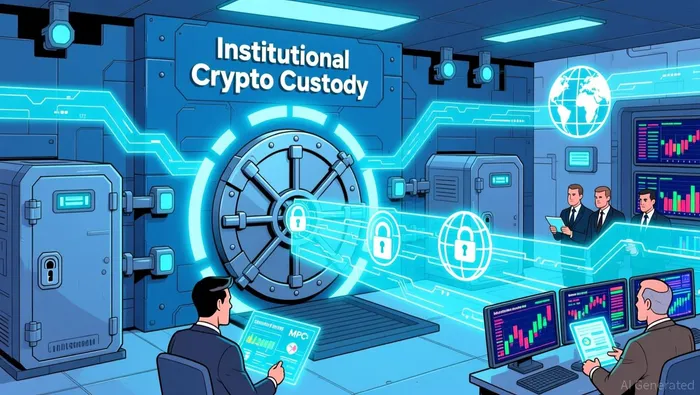 Institutional-grade custody solutions have emerged as a cornerstone of trust, with leading custodians like Anchorage Digital, BNY Mellon, and CoinbaseCOIN-- Custody deploying advanced security protocols such as Multi-Party Computation (MPC) and cold storage according to Yellowcard. These custodians now offer insurance coverage ranging from $75M to $320M, a critical factor in mitigating the residual risks of digital asset management as Yellowcard reports. According to a report by Yellowcard, such measures have reduced successful breaches by over 80% since 2022, reinforcing institutional confidence according to Yellowcard analysis.
Trading platforms have also evolved to meet the demands of institutional participants. Binance, Coinbase Prime, Kraken, and OKX now provide deep liquidity, high-speed execution, and full regulatory compliance across multiple jurisdictions according to CoinAPI. For instance, Binance's global liquidity pool remains unmatched, while Coinbase Prime's integration of custody services offers a seamless experience for institutional traders as detailed in CoinAPI. Kraken's proof-of-reserves reporting and audited cold-storage custody further enhance transparency, addressing a key concern for risk-averse investors according to CoinAPI.
Complementing these advancements are compliance tools that automate anti-money laundering (AML) and know-your-transaction (KYT) processes. Leading custodians now offer real-time data feeds and compliance automation, enabling institutions to meet evolving regulatory requirements without operational friction according to Cobo. The implementation of frameworks like MiCA and the GENIUS Act has further standardized these tools, creating a cohesive ecosystem for institutional on-chain activity as Chainalysis reports.
A New Era of Institutional On-Chain Activity
The synergy between regulatory clarity and infrastructure innovation has already yielded measurable outcomes. As of 2025, approximately 80% of financial institutions in key jurisdictions have announced digital asset initiatives according to Trmlabs, with over half of traditional hedge funds now holding crypto exposure as SumSub reports. This surge in adoption is not limited to speculative trading; institutions are leveraging on-chain markets for cross-border payments, USD liquidity management, and portfolio diversification according to Yellowcard.
Moreover, the integration of stablecoins into mainstream finance has been accelerated by regulatory frameworks. The EU's MiCA and the UK's FCA rules have imposed transparency requirements on stablecoin issuers, ensuring that these assets function as reliable mediums of exchange according to SumSub. This has opened new avenues for institutions to utilize stablecoins in on-chain trading, particularly in emerging markets where traditional infrastructure remains underdeveloped according to CoinAPI.
Conclusion
The convergence of regulatory tailwinds and institutional infrastructure innovations has irrevocably altered the trajectory of on-chain crypto markets. What was once a niche, high-risk asset class is now a legitimate component of institutional portfolios, supported by robust legal frameworks and enterprise-grade tools. As 2025 draws to a close, the stage is set for a new era-one where digital assets are not just tolerated but embraced as a cornerstone of global finance.





Comentarios
Aún no hay comentarios