
Institutional Adoption in Blockchain: The New Gold Rush in DeFi and Web3 Infrastructure
The blockchain industry is undergoing a seismic shift as institutional capital floods into DeFi and Web3 infrastructure. What was once a niche experiment for crypto-native enthusiasts is now a $16 trillion opportunity for traditional finance, driven by regulatory clarity, technological maturation, and the urgent demand for secure custody solutions. Let's break down the value propositions reshaping this landscape.
1. Custody: The Bedrock of Institutional Trust
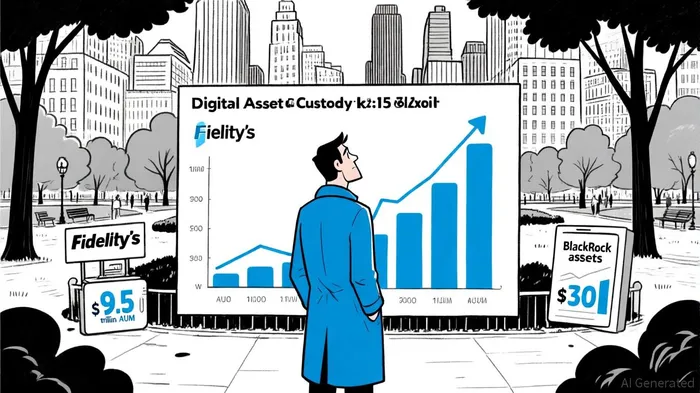
Institutional adoption hinges on one critical factor: secure custody. According to a 2024 PwC report, 70% of institutional investors plan to increase their exposure to digital assets over the next three years, with 68% of U.S.-based institutions actively seeking custody solutions. The market for institutional-grade custody services has already surpassed $300 billion in assets under custody, with firms like Fidelity Digital Assets, Anchorage Digital, and Fireblocks leading the charge.
Fidelity's reported $9.5 trillion in assets under administration (as of early 2025) underscores the scale of institutional confidence. Meanwhile, the global digital asset custody market is projected to grow from $683 billion in 2024 to $847 billion in 2025, with a 24% CAGR through 2033. This growth is fueled by innovations like multi-party computation (MPC) wallets and insured storage, which, according to Grand View Research, address cybersecurity concerns that deter 53% of potential institutional investors.
2. Tokenized Assets: Liquidity Meets Transparency
Tokenization is unlocking new frontiers for institutional capital. BlackRock's tokenization of $300 million in money market fund shares on EthereumETH-- in Q4 2024 marked a watershed moment, while Ripple Custody is positioning itself as a key infrastructure provider for banks entering the tokenization market. By 2030, the tokenized asset market could reach $16 trillion, encompassing everything from government bonds to real estate and carbon credits.
The appeal is clear: tokenized assets offer automated settlement, 24/7 liquidity, and transparent ownership. Over 10% of the world's assets are projected to be tokenized by 2030, according to Web3 Infrastructure in 2025, with real-world assets (RWAs) like private credit and art gaining traction. This shift is amplified by blockchain interoperability protocols like PolkadotDOT--, CosmosATOM--, and Chainlink's CCIP, which enable seamless cross-chain communication.
3. Tech Upgrades and Regulatory Clarity: The Twin Engines of Growth
Institutional adoption is accelerating thanks to technical advancements and regulatory progress. Solana's Alpenglow upgrade, which achieved 107,540 TPS, demonstrates the scalability needed for DeFi and NFT marketplaces. Similarly, Ethereum's L2 solutions and Solana's high-throughput architecture are becoming the go-to platforms for institutional applications, as noted in the Top 10 Web3 Projects.
Regulatory frameworks like the GENIUS and CLARITY Acts have reduced legal uncertainties, while cloud partnerships with AWS and Alibaba have cut operational costs by up to 50%. These developments are attracting capital to infrastructure-first projects rather than consumer-facing apps, signaling a shift toward foundational layer development.
4. M&A and Consolidation: A Sign of Institutional Alignment
The Web3 infrastructure sector is witnessing a wave of mergers and acquisitions as institutions prioritize high-compliance standards. For example, Helio and Alterya's consolidation in Q3 2025 highlights the growing alignment between institutional-grade security and scalable infrastructure. Such moves are critical for building the robust ecosystems required to handle trillions in digital assets.
The Bottom Line: A $16 Trillion Opportunity
The institutionalization of blockchain is no longer speculative-it's a $16 trillion inevitability. From custody solutions to tokenized assets and interoperability protocols, the value propositions are clear: liquidity, transparency, and efficiency. As regulatory frameworks solidify and technology matures, the next decade will see traditional finance fully integrate with Web3.
For investors, the key is to focus on infrastructure-first projects and compliant custodians. The gold rush is on, and the winners will be those who build the rails for institutional capital to flow.






Comentarios
Aún no hay comentarios