
Institutional Adoption of Blockchain Assets: Strategic ETF Innovations and Diversification Dynamics in 2025
The institutional investment landscape in blockchain assets has undergone a seismic shift in 2025, marked by a confluence of regulatory clarity, technological maturation, and strategic innovation in financial products. As digital assets transition from speculative novelties to core components of diversified portfolios, institutional players are leveraging ETFs and ETPs to navigate volatility while capturing growth. This analysis explores the drivers of adoption, the role of ETF innovations, and the evolving diversification benefits of blockchain assets, supported by granular data from leading industry reports.
The Rise of Institutional Adoption: A Structural Shift
Institutional demand for blockchain assets has surged, with 86% of institutional investors either allocating to digital assets or planning to do so in 2025. This momentum is underpinned by regulatory milestones such as the U.S. GENIUS Act (July 2025), which provided much-needed clarity for market participants. The U.S. BitcoinBTC-- ETF market alone grew 45% in 2025 to reach $103 billion in assets under management (AUM), with institutional investors accounting for 24.5% of this total. Bitcoin, with a market cap of $1.65 trillion as of November 2025, remains the dominant asset, representing 65% of the global crypto market.
Beyond Bitcoin, Ethereum's $500 billion market cap and the proliferation of stablecoins-facilitating $46 trillion in annual transactions-have expanded institutional strategies to include hybrid finance models and tokenized real-world assets. Over 3.5% of all Bitcoin and 2.5% of EthereumETH-- in circulation are now held by digital asset treasury companies, signaling a shift toward treating crypto as a legitimate asset class.
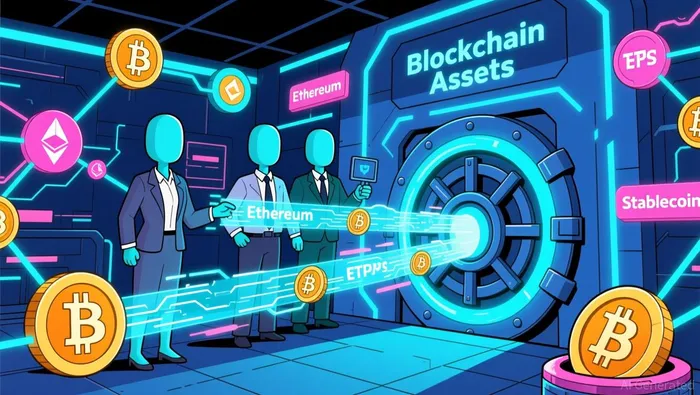
Strategic ETF Innovations: Bridging Traditional and Digital Markets
The approval of spot Bitcoin ETPs in the U.S. and other jurisdictions has democratized access for institutional investors, who now favor registered vehicles like ETFs for their operational simplicity and compliance advantages. For instance, 68% of institutional investors have either invested in or plan to invest in Bitcoin ETPs. These products are not limited to Bitcoin; innovation-driven ETFs now target emerging technologies such as artificial intelligence (AI) and blockchain, offering exposure to high-growth sectors while mitigating some of the volatility inherent in direct crypto holdings.
A well-structured crypto portfolio in 2025 typically allocates 60–70% to core assets like Bitcoin and Ethereum, with the remainder diversified across altcoins and stablecoins for liquidity and risk management. This approach reflects a broader trend: institutional investors are no longer viewing digital assets as speculative gambles but as tools to enhance risk-adjusted returns and hedge against macroeconomic risks like inflation.
Diversification Benefits and Correlation Dynamics
The diversification potential of blockchain assets hinges on their evolving correlation with traditional markets. Historical data from 2024–2025 reveals that Bitcoin's 90-day rolling correlation with the S&P 500 reached 0.42, indicating a moderate but growing alignment with equities. However, Bitcoin remains uncorrelated with safe-haven assets like gold or U.S. Treasuries, maintaining its unique risk profile. Stablecoins, engineered to preserve value, further act as stabilizers in volatile environments, with their correlation to Bitcoin near zero.
Portfolio managers are increasingly allocating 1–6% of total assets to blockchain exposures, depending on risk tolerance. Research from Bitwise Investments demonstrates that adding Bitcoin to a traditional 60/40 stock/bond portfolio has historically improved risk-adjusted returns over longer horizons. Yet, the high volatility and beta of digital assets-significantly higher than stocks or bonds-necessitate a balanced approach that integrates traditional and alternative assets.
Risk Management and Future Outlook
While blockchain ETFs offer a pathway to diversification, their high volatility and tail risks mean they are best suited as satellite holdings rather than core assets. Institutional investors are also exploring tokenization of real-world assets (e.g., real estate, art) and hybrid finance models to further diversify risk and capitalize on blockchain's infrastructure advantages.
Looking ahead, the maturation of regulatory frameworks-such as the EU's MiCA and U.S. GENIUS Act-will likely accelerate adoption, with institutional allocations projected to rise from 7% to 16% of total AUM within three years. As digital assets become embedded in traditional portfolios, their role as both growth engines and macroeconomic hedges will define the next phase of institutional investment strategy.






Comentarios
Aún no hay comentarios