
Institutional Adoption of Bitcoin Through Regulated Platforms: Strategic Shifts and Market Implications
Strategic Shifts in Long-Term Holder Behavior
Long-term institutional Bitcoin holders have undergone a marked strategic evolution since 2023. Initially, direct on-chain accumulation dominated, but recent trends reveal a pivot toward regulated platforms and derivative instruments. For instance, over 815,000 BTC was offloaded by long-term holders in a single month in 2025, reflecting profit-taking amid broader risk-off sentiment. However, this activity contrasts with the persistent buying pressure exerted by institutional-grade players, who increasingly favor Bitcoin spot ETFs and custody solutions to mitigate operational risks.
A prime example is MicroStrategy, which has amassed 641,205 bitcoins, valued at roughly $64 billion as of 2025. The company's treasury strategy-prioritizing Bitcoin as a hedge against inflation and fiat devaluation-has set a precedent for corporate adoption. Notably, MicroStrategy's debt structure allows it to repay obligations using cash or common stock, reducing the likelihood of forced Bitcoin liquidation even in severe downturns. This approach underscores a broader institutional trend: treating Bitcoin as a long-term reserve asset rather than a speculative trade.
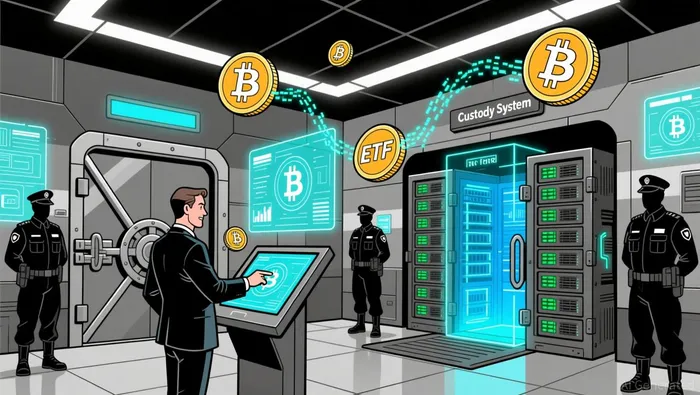
Similarly, BlackRock's iShares Bitcoin Trust (IBIT) has become a linchpin of institutional adoption. By April 2025, IBITIBIT-- alone had attracted $18 billion in assets under management (AUM), with spot Bitcoin ETFs collectively amassing $65 billion globally according to market analysis. These vehicles provide institutional investors with a familiar, regulated pathway to Bitcoin exposure, bypassing the complexities of direct custody and exchange trading. The result is a more stable, less retail-driven market structure.
Regulatory Clarity and Market Infrastructure
Regulatory developments have been pivotal in enabling institutional participation. The GENIUS Act of 2025, for example, established a stablecoin framework that facilitates institutional use cases. In Latin America, Tether's partnership with Parfin has leveraged this infrastructure to expand institutional USDT adoption, further integrating stablecoins into traditional finance ecosystems.
The U.S. regulatory landscape, though still fragmented, has seen critical milestones. The approval of spot Bitcoin ETFs-categorized as commodities rather than securities has provided a legal framework for institutional investment. However, ongoing debates between the SEC and CFTC over jurisdictional boundaries highlight the need for further clarity on asset classification and investor protections according to market analysts.
Market Implications: Volatility, Liquidity, and Price Dynamics
The influx of institutional capital has significantly altered Bitcoin's volatility profile. By mid-2025, realized volatility had dropped by 75% compared to historical peaks. This stabilization is attributed to two factors:
1. Strong hands effect: Large institutional investors, with longer time horizons, are less prone to panic selling during downturns.
2. Deepened liquidity: ETFs and regulated platforms have injected billions into the market, reducing slippage and improving price discovery.
For example, MicroStrategy's aggressive accumulation has dried up over-the-counter Bitcoin supply, forcing institutional buyers to purchase directly from exchanges-a dynamic that exerts upward pressure on spot prices. Similarly, the entry of sovereign wealth funds into Bitcoin markets could introduce hundreds of billions in strategic buying pressure, creating a persistent bid during corrections.
Price projections for Bitcoin have also become more ambitious. Analysts now anticipate a potential price range of $200,000–$210,000 within 12–18 months, driven by factors such as stock-to-flow models, network growth, and Bitcoin's growing share of the global store-of-value market.
Risks and the Road Ahead
Despite these bullish fundamentals, risks remain. Regulatory setbacks, macroeconomic headwinds (e.g., interest rate hikes), and technical failures in custody infrastructure could disrupt the current trajectory. Additionally, while Bitcoin's volatility has decreased, it remains higher than traditional assets, necessitating robust risk management frameworks.
Looking ahead, the institutional adoption cycle is expected to continue maturing. As more corporations and SWFs allocate Bitcoin to their treasuries, the asset's role as a non-correlated hedge will strengthen. However, sustained growth will depend on continued regulatory alignment, technological innovation, and the ability of market participants to navigate macroeconomic uncertainties.
Conclusion
The institutional adoption of Bitcoin through regulated platforms marks a pivotal inflection point for the cryptocurrency market. Strategic shifts in long-term holder behavior-from direct accumulation to ETFs and custody solutions-have reduced volatility, enhanced liquidity, and reinforced Bitcoin's legitimacy as a global asset class. While challenges persist, the convergence of regulatory clarity, macroeconomic demand, and institutional-grade infrastructure suggests that Bitcoin's integration into traditional finance is not a question of if, but how quickly.







Comentarios
Aún no hay comentarios