
Institutional Accumulation and Staking Momentum in Solana (SOL): A Bullish Flywheel in Motion
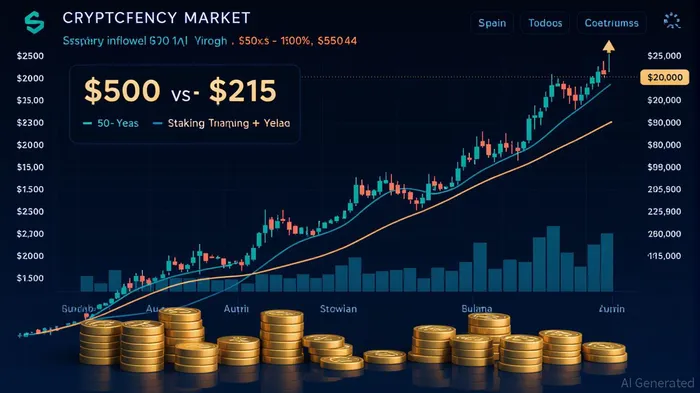
The SolanaSOL-- (SOL) ecosystem is experiencing a seismic shift as institutional capital and strategic staking converge to create a self-reinforcing bullish flywheel. With $1.72 billion in institutional holdings staked across Q2 2025—representing 1.44% of the total supply and an average yield of 6.86%—the network is not only securing its infrastructure but also fueling a compounding cycle of demand and innovation [1]. This momentum is amplified by the Alpenglow upgrade, which slashed transaction finality to sub-150ms and reduced validator costs by 98%, democratizing participation while attracting major players like Stripe, BlackRockBLK--, and ApolloAPO-- [2].
The Institutional Staking Flywheel
Institutional adoption has become a cornerstone of Solana’s growth. The REX-Osprey Solana + Staking ETF, the first U.S.-listed crypto staking ETF, has drawn $316 million in inflows since July 2025, with pending approvals for VanEck and 21Shares ETFs potentially unlocking $3–6 billion in capital [1]. These inflows are not speculative—they’re strategic. By staking 8.277 million SOL at 7.16% yields post-Alpenglow, institutions are locking in returns while bolstering network security [3]. The upgrade’s “20+20” resilience model ensures operational continuity even if 40% of validators are compromised, addressing institutional concerns about decentralization and reliability [4].
This flywheel effect is further reinforced by Solana’s deflationary tokenomics. With 64.8% of the circulating supply staked and liquid staking rates at 12.2%, the network’s TVL surged to $8.6 billion in Q2 2025, a 30.4% quarter-over-quarter increase driven by protocols like Kamino Finance and Jito [1]. The result? A virtuous cycle where higher TVL attracts more institutional capital, which in turn drives TVL higher.
Alpenglow: The Catalyst for Institutional Adoption
The Alpenglow upgrade is the linchpin of this momentum. By introducing Votor and Rotor protocols, Solana now achieves sub-second finality and 98% lower validator costs, making it a direct competitor to VisaV-- and Nasdaq in speed and throughput [2]. This technical leap has unlocked advanced use cases like on-chain central limit order books and high-frequency trading, previously confined to centralized systems. For institutions, this means Solana isn’t just a blockchain—it’s a real-time financial infrastructure.
Validator economics have also shifted dramatically. With annual costs dropping from $60,000 to $1,000, the network now supports 3,248 active validators, a 57% year-over-year decentralization boost [4]. This democratization reduces centralization risks while creating a flywheel: lower costs attract more validators, which enhances security, which attracts more institutions.
The $300 Price Target: A Convergence of Fundamentals
The bullish case for a $300 price target hinges on the interplay of institutional ownership, staking yields, and Alpenglow’s technical gains. Solana’s price surged past $215 in late August 2025, driven by a golden cross of moving averages and a rebound from oversold RSI levels [5]. Analysts argue that a breakout above $207 could validate a rally toward $300, with $176 as a key support level.
The math is compelling. At 7.16% staking yields, institutions earn $123.7 million annually on their $1.72 billion holdings. This compounding effect, combined with Solana’s $37 billion daily transaction volume and 65,000 TPS throughput, positions it as a foundational asset for global finance [1]. Moreover, the network’s integration by RobinhoodHOOD-- and Upexi—alongside a $1.25 billion rebranding initiative—signals institutional confidence [2].
Conclusion
Solana’s institutional adoption and staking momentum are not isolated trends—they’re interconnected forces building a flywheel of growth. The Alpenglow upgrade has positioned Solana as a Web2-level infrastructure, while 7.16% yields and $1.72 billion in staked capital create a compounding engine. As ETF inflows and validator decentralization accelerate, the $300 price target becomes not just a possibility but a probability. For investors, the question isn’t whether Solana can reach this level—it’s whether they’re positioned to capitalize on the flywheel before it gains full momentum.
**Source:[1] Solana's Institutional Adoption and DeFi Expansion
https://www.ainvest.com/news/solana-institutional-adoption-defi-expansion-strategic-buy-opportunity-2025-2508/[2] Solana's Alpenglow Upgrade: A Catalyst for Institutional Adoption and DeFi Growth
https://www.ainvest.com/news/solana-alpenglow-upgrade-catalyst-institutional-adoption-defi-growth-2025-2508/[3] Solana (SOL) Staking Insights and Analysis: First Half 2025
https://everstake.one/crypto-reports/solana-staking-insights-and-analysis-first-half-of-2025[4] Alpenglow: Solana's Largest Protocol Upgrade Ever
https://solanacompass.com/learn/Lightspeed/alpenglow-solanas-largest-protocol-upgrade-ever-brennan-watt-anza[5] Can SOL Break $215 and Surge Toward $300? | Solana
https://cryptorank.io/news/feed/d168d-solana-price-prediction-breakout-to-300





Comentarios
Aún no hay comentarios