
Institutional Access to Solana: The VanEck ETF Filing and Its Implications for Crypto Market Legitimacy
Regulatory Progress: A New Framework for Crypto ETFs
The U.S. Securities and Exchange Commission (SEC) has been a wildcard in crypto's institutional journey, but 2025's regulatory developments suggest a pivot toward pragmatism. In mid-September, the SEC streamlined approval rules for crypto ETFs, removing product-specific reviews for funds that meet custody, pricing, and surveillance standards, as evidenced by NYSE listings. This shift, under Chair Paul Atkins, signals a willingness to innovate while mitigating risks-a balancing act that could unlock billions in institutional capital.
VanEck's Solana ETF, which will operate as a grantor trust and support in-kind transactions, is a direct beneficiary of this new framework, per the VanEck filing. By avoiding the Investment Company Act of 1940, the fund sidesteps regulatory complexity, making it easier for pension funds, endowments, and wealth managers to allocate capital. The SEC's October 16 decision on multiple Solana ETF applications, a decision tied to SEC rulemaking, will be a litmus test: approval would validate Solana as a legitimate asset class, while rejection could delay broader adoption.
Institutional Adoption: Solana's Edge Over EthereumETH-- and Bitcoin
Solana's institutional appeal isn't just regulatory-it's technical and economic. In Q3 2025, Solana's decentralized exchange (DEX) volume surged to $326 billion, a 21% quarter-over-quarter increase, according to CryptoBriefing, driven by its low $0.02 transaction fees and high throughput. This scalability advantage over Ethereum and BNBBNB-- Chain has translated into real-world adoption: nine public companies now hold 2.5% of Solana's supply, compared to just two for BNB Chain, according to a Grayscale report.
Grayscale's latest report underscores this momentum, noting Solana's dominance in smart contract platforms. The network generated $3.41 million in 24-hour app revenue-a figure that outpaces Ethereum and BNB Chain combined. For institutions, this isn't just about holding an asset; it's about participating in a network that's already proving its utility.
The VanEck ETF: Innovation in Design
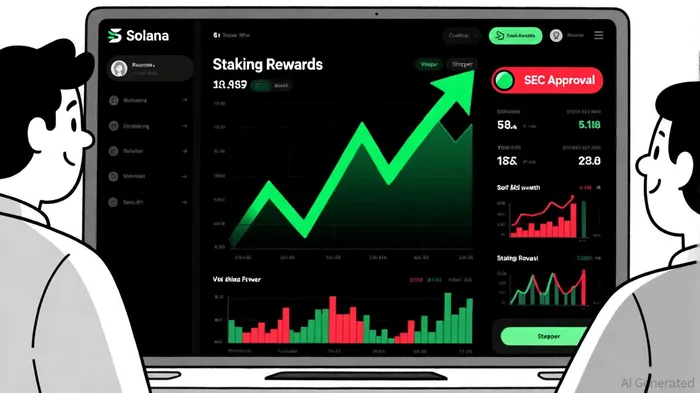
VanEck's ETF isn't just another token wrapper. By staking a portion of holdings through custodians like Gemini and Coinbase, it generates yield for investors-a feature absent in most traditional ETFs, according to the VanEck ETF plan. This dual exposure to price and staking rewards could attract a new cohort of investors who previously shied away from the operational complexity of self-custody.
As the VanEck plan specifies, the fund's 5% redemption buffer is another institutional-friendly tweak. During Solana's 21-day unbonding period, this buffer ensures liquidity isn't compromised-a critical feature for large funds that can't afford to be stuck with illiquid assets. Meanwhile, the MarketVector Solana Benchmark Rate provides daily valuations, aligning the ETF with institutional expectations for transparency.
Market Implications: A Catalyst for Growth
If approved, VanEck's ETF-and the broader wave of Solana ETPs-could trigger a liquidity boom. Analysts estimate that institutional demand could push Solana's price toward $345–$520, depending on inflow scenarios, according to Finbold. This isn't just speculative hype: treasury firms have already been buying SOL below $200, per Bitcoinist, and the asset is currently consolidating near $210, above key support at $185. A breakout above $250 could see Solana retest its 2025 highs.
The broader crypto market is also watching closely. BitcoinBTC-- ETFs have already seen $4.21 billion in October inflows, per Finbold, but Solana's unique value proposition-low fees, high scalability, and now, yield-generating ETFs-positions it to capture a disproportionate share of institutional interest.
Conclusion: A Legitimacy Threshold
VanEck's Solana ETF filing is more than a product launch-it's a signal. It reflects a maturing market where crypto assets are no longer judged solely on speculative potential but on their ability to integrate into traditional financial systems. If the SEC's October decision is favorable, Solana could leapfrog competitors notNOT-- just in price, but in institutional credibility. For investors, this is the moment to watch: the line between crypto and finance is blurring, and Solana is at the forefront.






Comentarios
Aún no hay comentarios