
Instacart's AI-Powered Pivot: Why Retail Media and Subscription Growth Make It a Buy at $55
The retail landscape is undergoing a seismic shift, driven by the fusion of artificial intelligence and the blurring lines between physical and digital commerce. Few companies are positioned to capitalize on this transformation as strategically as Instacart (NASDAQ: CART). Its AI-driven tools—Universal Campaigns and Caper Carts—are not only redefining how brands engage consumers but also fueling a financial turnaround that has analysts scrambling to reassess its valuation. Here's why investors should take note.
The AI Layer: From Delivery Service to Retail Media Powerhouse
Instacart's evolution from a grocery delivery platform to a retail media leader is best exemplified by its Caper Carts—AI-powered smart shopping carts now deployed in over 60 U.S. cities and expanding globally. These carts, equipped with digital screens and sensors, act as in-store advertising hubs, generating 30+ minutes of engaged customer time per visit. Brands like Diana's Bananas and Mondelēz have leveraged Caper Carts to run omnichannel campaigns that sync with Instacart's online marketplace, boosting sales by 40% or more (as seen in Diana's case).
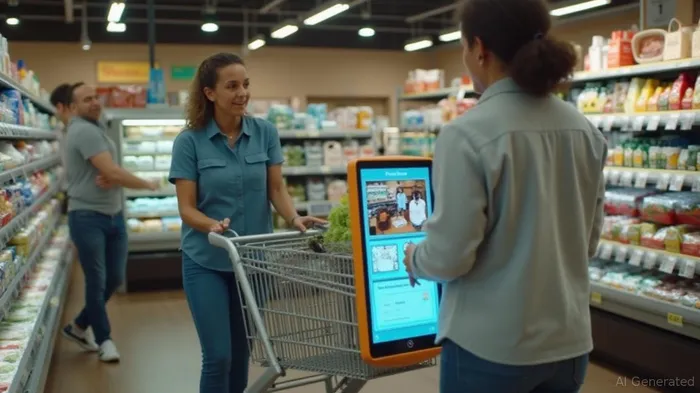
The Universal Campaigns tool, meanwhile, uses AI to optimize ad spend across 220+ e-commerce sites and partnerships with GoogleGOOGL--, Instagram, and YouTube. This system ensures ads are served contextually—whether a shopper is browsing online or pushing a Caper Cart in aisle 3. The result? A 14% year-over-year jump in ad revenue in Q1 2025, outpacing its core Gross Transaction Value (GTV) growth of 10%. For brands, Instacart's platform now offers a “one-stop” solution for reaching consumers at the precise moment they're deciding what to buy.
The Financial Engine: Profitability and Subscription Momentum
Instacart's ad growth isn't just a side hustle—it's becoming the backbone of its financial health. In Q1, advertising revenue contributed to an $897 million revenue beat, while Adjusted EBITDA surged to $244 million, a 23% increase from last year. The Instacart Plus (IC+) subscription service is another key driver. By lowering the minimum basket size to $10, the company has boosted order frequency without cannibalizing larger orders. Urban markets, where vehicle ownership is low, now see members placing orders weekly rather than monthly, driving 14% higher order growth overall.
Critically, Instacart is proving its ability to scale profitably. Its 75.2% gross profit margin and $1 billion share repurchase program signal confidence in its model. While competitors like DoorDashDASH-- and Uber Eats race to replicate its grocery delivery success, Instacart's focus on enterprise solutions—evident in its Windshop acquisition to power retailer-owned storefronts—gives it an edge in locking in long-term partnerships with grocers.
The Investment Case: Underappreciated Tech Stack and a $55 Target
At its current price of $44.86, Instacart trades at a discount to its $52 analyst consensus target, with some firms like BarclaysBCS-- seeing $61. The bull case hinges on two overlooked strengths:
Enterprise Tech Stack: Caper Carts and Carrot Ads aren't just consumer tools—they're enterprise-grade platforms that integrate with POS systems of major retailers like KrogerKR-- and Hy-Vee. This “hidden” B2B revenue stream, often overlooked by investors, creates recurring revenue and high retention among grocers.
Ad-Driven Flywheel: As more brands adopt Instacart's omnichannel ads, they'll pay premiums for its unique ability to target shoppers both online and in-store. The 37% new-to-brand sales seen in Nature Nate's campaigns suggest this flywheel is already gaining momentum.
Analysts at Citi and Citizens JMP have already raised price targets to $57 and $55, respectively, citing AI efficiency gains and IC+ penetration. Risks remain—macroeconomic headwinds and competition are real—but Instacart's $244 million EBITDA cushion and diversified revenue streams (advertising, subscriptions, enterprise) provide a safety net.
Conclusion: A Buy at $55—But Watch for Execution
Instacart is no longer just a grocery delivery app; it's a retail media giant with AI-driven tools that are hard to replicate. Its Q1 results and partnerships suggest it's on track to hit its $9.0 billion GTV guidance for Q2, while ad revenue continues to outpace peers. At current prices, the stock offers a 15% upside to the $52 consensus, with the $55 target achievable if IC+ adoption and Caper Cart expansion accelerate.
Investors should monitor two key metrics: ad revenue growth relative to GTV (a sign of margin expansion) and IC+ member retention in dense urban markets. For now, the data—and the AI—point to a compelling buy.







Comentarios
Aún no hay comentarios