
Insira Technologies' $22.5M Deal: A Pivot to Commercial Dominance or a Hail Mary?
The medtech sector is littered with companies that excel at innovation but stumble when scaling commercial operations. Inspira TechnologiesIINN-- (NASDAQ: IINN), however, now stands at a critical inflection pointIPCX--. A recently announced $22.5 million binding purchase order for its FDA-cleared ART100 life-support system marks a watershed moment: the company is no longer just a lab-bound developer but a revenue-generating entity. For investors, this deal offers a chance to bet on a medtech disruptor—but only if its execution can outpace its financial fragility.
From R&D to Revenue: The Transition That Matters Most
The ART100's FDA clearance in 2023 was a technical milestone, but its adoption in top U.S. medical centers like Westchester Memorial Center in New York represents clinical validation. Now, the $22.5M order—set to be fully paid by 2025—signals the start of scalable revenue. This is no small feat: medtech startups often face a chasm between regulatory approval and commercial success. Inspira's ability to secure this order from a strategic hub-based buyer (likely in the Middle East or Asia, given the geographic hints) suggests two key advantages:
- Beachhead Market Leverage: The buyer's ties to government and institutional healthcare buyers could serve as a gateway to broader distribution networks. If InspiraIINN-- can use this partnership to onboard additional clients in the region, it could establish a template for global expansion.
- Credibility with Payors: A $22.5M order—especially from a buyer with institutional clout—builds trust with insurers and hospitals. This is critical for a device like the ART100, which competes in the high-stakes ECMO (extracorporeal membrane oxygenation) market dominated by giants like MedtronicMDT-- and Getinge.
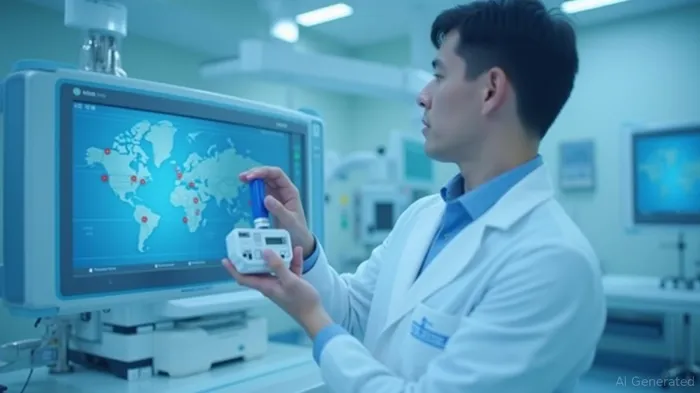
Pipeline Momentum: Beyond the First Deal
While the ART100 is the star, Inspira's pipeline offers clues to its long-term viability. The HYLA blood sensor, which achieved 96% accuracy in clinical trials, is slated for FDA submission by late 2025. Meanwhile, the VORTX oxygenation technology's modular design could make it a complementary product for critical care settings. Most intriguing is the Ennocure collaboration, which uses a bio-electronic patch to reduce bacterial infection risks—a critical unmet need in post-surgical care.
These products aren't just R&D distractions; they're part of a strategy to build a suite of solutions for respiratory and infectious disease management. If the ART100's deployment proves successful, these follow-on products could create recurring revenue streams through subscriptions or service contracts.
The Elephant in the Room: Cash Burn and Dependency Risks
Now the hard truth: Inspira's cash reserves remain perilously thin. As of December 2024, it had just $5.78 million in cash, down 21% year-over-year. While Q1 2025 saw a modest rebound to $3.3 million (driven by cost cuts and operational efficiency), its annual cash burn rate of $10 million—30% lower than 2023 but still unsustainable—threatens its survival.
The $22.5M order alone won't solve this. The deal's full payment by 2025 means most cash will arrive in the latter half of the year, leaving a tight window to cover Q3's operational losses. Worse, 88% of its revenue in Q1 2025 was “low hundreds of thousands,” underscoring reliance on this single order. A delay in delivery or a buyer default could be catastrophic.
Why This Deal Still Tips the Scales Toward a Buy (With Caveats)
Despite the risks, three factors make this a compelling speculative play:
1. Regulatory and Commercial Validation: The order isn't just revenue—it's proof that insurers and institutions are willing to pay for non-invasive oxygenation. This reduces the risk of regulatory or market missteps.
2. Strategic Partnerships as Lifelines: The partnership with Zriha Medical for manufacturing and Glo-Med Networks for distribution creates a “beachhead” advantage. These relationships could lead to follow-on orders, particularly in regions where the buyer has existing ties.
3. Optionality in the Pipeline: The HYLA sensor's FDA submission timeline (late 2025) and the ART500's modular design suggest the company isn't putting all its chips on one product.
Investment Thesis: Buy with a Hedges
Buy: At its current $0.18 share price—a fraction of the $1 Nasdaq minimum—Inspira offers asymmetric upside if it meets its Q3 2025 milestones (e.g., delivery confirmations, HYLA submissions). The $22.5M order's validation of demand and the company's ability to cut costs (cash burn down 30% YoY) suggest management is executing under pressure.
Hedge:
- Options Strategy: Buy out-of-the-money call options with a strike price at $0.30, expiring in late 2025. This limits downside while capturing upside if the stock rallies on positive milestones.
- Watch the Burn Runway: Track Q3 cash reserves. If the company's burn rate rises above $3.5M/month, or it fails to secure additional orders by year-end, consider exiting.
Final Verdict
Inspira Technologies is gambling its future on the execution of this $22.5M deal and its pipeline. The stakes are high, but the rewards for investors who bet correctly could be exponential. This isn't a “buy and hold” stock—it's a high-risk, high-reward play on a company pivoting from lab to marketplace. For those willing to accept the volatility, the setup is there. Just keep your safety net close.







Comentarios
Aún no hay comentarios