
Insider Trading at Supernus Pharmaceuticals: Balancing Investor Confidence and Stock Performance
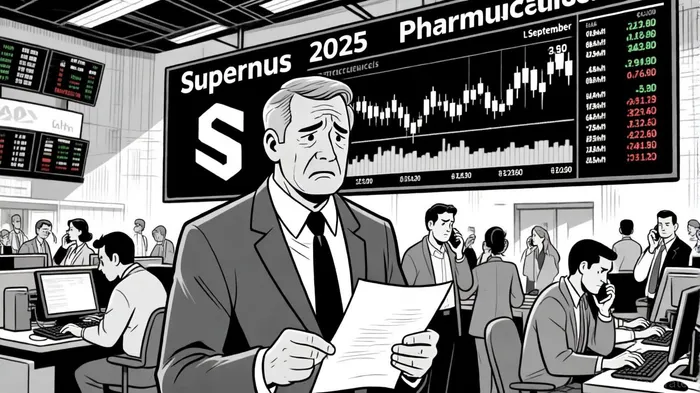
In the volatile world of biopharmaceutical investing, insider trading activity often serves as a double-edged sword—offering both insights and red flags for market participants. Supernus PharmaceuticalsSUPN-- (SUPN) has found itself at the center of this dynamic in late 2025, with a series of high-profile insider sales sparking debates about their implications for investor confidence and stock performance.
The Anatomy of Insider Activity
Between August and September 2025, SupernusSUPN-- executives and directors executed multiple share sales, totaling over 179,606 shares in the 90-day period[1]. Jack A. Khattar, the company's CEO and founder, sold 170,300 shares in August via a Rule 10b5-1 trading plan—a prearranged, non-discretionary schedule designed to mitigate insider trading allegations[2]. Additional sales followed in September, including 55,578 shares on September 4 at $46.01 per share[3]. Other key players, including CFO Timothy Dec and COO Frank Mottola, also liquidated significant holdings, with Dec's direct ownership dropping by 90.43%[4].
While these transactions were technically compliant with SEC guidelines, their timing and scale raised eyebrows. For instance, Khattar's August 22 sale occurred at $45.00 per share, just days before the stock surged to a 52-week high of $46.72 on September 11[5]. Such patterns can erode trust, particularly in sectors where regulatory risks and product pipelines heavily influence valuations.
Market Reactions: Volatility and Contradictions
Supernus' stock price trajectory during this period reflects a mix of optimism and caution. After reporting Q2 2025 earnings on August 8 at $27.44 post-hours[6], the stock climbed to $46.05 by September 19—a 67.7% increase. This growth was fueled by strong sales of key products like Qelbree and Gocovri, as well as the acquisition of Sage Therapeutics, which expanded its neuropsychiatry portfolio[7].
However, trading volume spiked on days coinciding with insider sales. On September 7, for example, the stock closed at $45.82 with 595,400 shares traded—nearly double the average daily volume[8]. Similarly, September 11 saw 470,500 shares exchanged as Mottola sold 5,000 shares at $45.87[9]. Such spikes suggest retail and institutional investors may have interpreted the insider activity as a bearish signal, even as fundamental catalysts pushed the price higher.
Investor Confidence: A Fragile Equilibrium
The interplay between insider sales and market performance highlights a broader tension in investor psychology. According to a report by the Financial Express, Sanjiv Mehta, a former SEC enforcement official, noted that insider trading—even when legally structured—“erodes trust by creating perceptions of unfair advantage”[10]. This sentiment is particularly acute in biotech, where executives' access to non-public information about clinical trials or regulatory hurdles is significant.
Yet Supernus' case is not uniformly negative. The company revised its 2025 revenue guidance upward to $670 million–$700 million following the Sage acquisition[11], and analysts from Stock Analysis maintained a “Buy” rating, citing the strength of its neuropsychiatry pipeline[12]. This duality—where insider selling coexists with positive fundamentals—leaves investors in a quandary.
Regulatory Context and Long-Term Implications
The SEC's 2025 enforcement outlook emphasized heightened scrutiny of Rule 10b5-1 plans, particularly when they are used to mask material non-public information[13]. While Supernus' transactions were disclosed in advance, the agency's focus on “abusive” trading strategies could amplify investor skepticism. For now, the company's insider sales appear to fall within legal boundaries, but reputational risks linger.
From a strategic perspective, Supernus must balance executive liquidity needs with transparency. As noted by MarketBeat, insiders retained substantial holdings post-sale (e.g., Khattar's 1,070,848 directly owned shares[14]), suggesting alignment with long-term value creation. However, without clearer communication about the rationale behind the sales, market jitters may persist.
Conclusion: A Call for Nuanced Analysis
Supernus Pharmaceuticals' insider trading activity in late 2025 underscores the complexity of interpreting executive behavior in public markets. While the sales do not inherently signal corporate malfeasance, they introduce noise into an otherwise promising narrative of product growth and strategic expansion. Investors would be wise to weigh these transactions against the company's robust financial outlook and sector dynamics.
As the stock approaches its 52-week high, the coming months will test whether Supernus can sustain momentum—or if lingering doubts about fairness in trading will dampen confidence. For now, the data suggests a market divided: one that sees both risk and reward in the biopharma giant's next chapter.





Comentarios
Aún no hay comentarios