
Insider Trading at Hims & Hers Health: Investor Sentiment and Valuation Implications
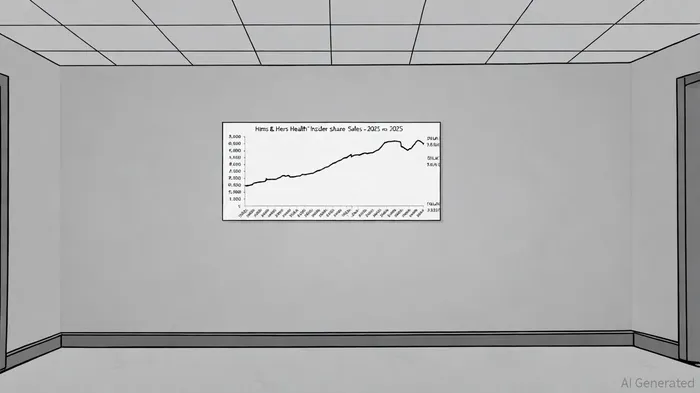
In recent months, HimsHIMS-- & Hers Health, Inc. (HIMS) has seen a surge in insider share sales, sparking debates about investor sentiment and stock valuation. According to a report by Yahoo Finance, CEO Andrew Dudum sold 3,292,906 shares on September 17, 2025, at an average price of $50.57 per share, generating over $166 million in proceeds[2]. This transaction, executed under a Rule 10b5-1 trading plan, was part of a broader wave of insider activity that included five additional sales totaling $5.05 million on the same day[3]. Such concentrated selling raises critical questions about market confidence and the company's long-term trajectory.
Investor Sentiment: A Mixed Signal
Insider sales often serve as a barometer for investor sentiment. While selling shares can signal liquidity needs or diversification strategies, large-scale transactions may also be interpreted as a lack of confidence in the company's future performance. At Hims & Hers, the pattern of sales appears structured. For instance, Dudum's September 2025 sale followed a pre-announced Rule 10b5-1 plan adopted in August 2024[3], a legal framework designed to mitigate accusations of timing trades based on non-public information. This procedural rigor suggests the sales were not impulsive but rather part of a premeditated strategy to manage personal wealth.
However, the sheer volume of shares sold—2.5 million over two years—cannot be ignored[2]. Data from TradingView indicates that insiders have sold 2.51 million shares since 2023, while purchasing 2.2 million, a net outflow of 310,000 shares[3]. Such a trend could erode retail investor confidence, particularly if the market perceives it as a sign of internal skepticism. Yet, the fact that these shares were primarily received as compensation from 2022 and 2023[3] complicates the narrative. Insiders may simply be cashing in on long-vested equity, rather than reacting to recent performance.
Valuation Implications: Liquidity vs. Market Pressure
The financial impact of these sales on Hims & Hers' valuation is nuanced. On one hand, the company's insiders have generated $166 million in proceeds from stock sales in 2025 alone[2], which could indicate a belief that the stock is overvalued or that their personal liquidity needs outweigh long-term holding. On the other hand, the use of Rule 10b5-1 plans implies a degree of strategic planning, potentially reducing the risk of market manipulation accusations.
From a valuation perspective, the stock's performance has remained relatively stable despite the selling. Between June and September 2025, HIMS traded in a range of $48 to $51 per share, with insider sales occurring across this band[3]. This suggests that the market has not yet priced in significant downside risk from the insider activity. However, if selling continues at this pace, it could exacerbate downward pressure on the stock, particularly if the company's fundamentals fail to justify its current valuation.
The Broader Context
Hims & Hers' insider sales must also be viewed through the lens of broader market trends. The telehealth sector has faced volatility in 2025, with investors recalibrating expectations for growth amid rising interest rates. For HIMS, which has historically traded at a premium to earnings, insider selling could amplify skepticism about its ability to sustain high multiples. Yet, the company's recent financial reports show steady revenue growth, with $1.2 billion in annual recurring revenue as of Q2 2025[1], a metric that may still justify its valuation for some investors.
Conclusion
The recent insider trading activity at Hims & Hers Health underscores the delicate balance between liquidity management and market perception. While the use of Rule 10b5-1 plans provides a legal and procedural shield against accusations of market manipulation, the sheer scale of the sales—particularly by top executives—risks eroding investor trust. For now, the stock appears to be trading in a stable range, but sustained insider selling could test its resilience. Investors should monitor not only the volume of shares sold but also the company's ability to meet its financial targets. In a market where sentiment can shift rapidly, HIMS' insiders may have already priced in a scenario that the broader market has yet to fully grasp.





Comentarios
Aún no hay comentarios