
Insider Selling at Stoke Therapeutics: Decoding the Impact on Investor Sentiment and Stock Valuation
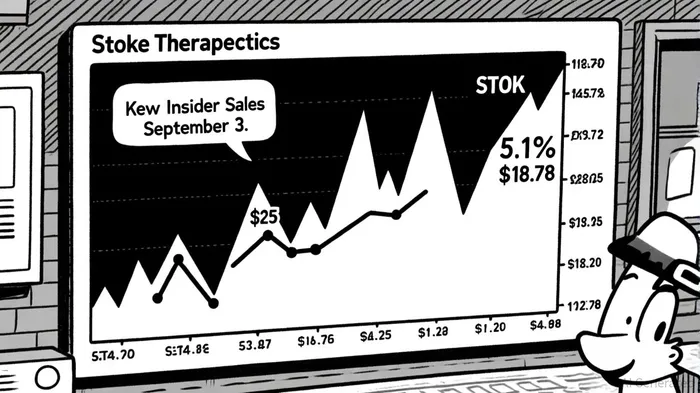
In recent months, Stoke TherapeuticsSTOK-- (NASDAQ: STOK) has drawn attention for a series of insider sales totaling $1.07 million, executed by director Edward M. Kaye and disclosed in an SEC Form 4. These transactions, disclosed via SEC Form 4 filings, occurred between August 29 and September 3, 2025, with shares sold at weighted-average prices near $20, according to the Form 4 filing. While such prearranged plans are designed to insulate insiders from insider trading allegations, the timing and volume of these sales-coupled with broader insider activity-raise questions about their implications for investor sentiment and stock valuation.
The Mechanics of Insider Selling: Compliance vs. Signal
Rule 10b5-1 allows insiders to establish trading plans when they are not in possession of material nonpublic information, provided the plans include safeguards like cooling-off periods, as described in SEC guidance. Kaye's sales, which reduced his beneficial ownership to 91,585 shares per the Form 4 filing, were conducted under this framework. However, the frequency of insider transactions at Stoke Therapeutics-spanning multiple directors, officers, and trusts-suggests a pattern. For instance, the Skorpios Trust sold 30.6 million shares in June 2025 at $10.20 per share, according to the Yahoo Finance insider transactions page, while General Counsel Jonathan Allan offloaded 444,809 shares on September 3 at $20.14 (per that Yahoo page).
Such activity, while legally compliant, can signal mixed messages to the market. On one hand, prearranged plans mitigate concerns about timing trades based on nonpublic information. On the other, concentrated selling-particularly by multiple stakeholders-may erode investor confidence, especially in a volatile sector like biotechnology.
Stock Price Volatility: Correlation or Coincidence?
Stoke Therapeutics' stock price in August 2025 surged from $12.52 to $19.76, reflecting broader market optimism, per Yahoo Finance historical prices. However, the stock experienced a 5.1% decline on September 3, closing at $22.31, despite reporting quarterly earnings that exceeded analyst expectations, according to a MarketBeat alert. This dip coincided with Kaye's final sale of 61,885 shares under the 10b5-1 plan (per the Yahoo insider page), raising questions about market interpretation.
Historical context reveals a nuanced pattern: when STOKSTOK-- has beaten earnings expectations since 2022, short-term price reactions have often been negative. A backtest of these events shows that within 10 days of such announcements, the average return has been negative, with statistically insignificant results (as noted in the MarketBeat alert). However, a positive drift emerges after ~20 days, with a 7.8% cumulative return versus a 5.3% benchmark by day 30-still not statistically significant, according to the same MarketBeat write-up. This suggests that while positive earnings surprises may not immediately translate to gains, longer-term investors might eventually see modest outperformance.
Data from Yahoo Finance indicates that STOK's price peaked at $24.97 on September 30, 2025, but remained volatile throughout the month, oscillating between $22.25 and $24.97 (see the Yahoo Finance history page). Analysts have maintained a cautiously optimistic stance, with a consensus price target of $25.57, as reported in the MarketBeat alert. Yet, the juxtaposition of insider selling and price swings underscores the delicate balance between strategic divestments and perceived lack of confidence.
Investor Sentiment: A Sector-Wide Trend?
The broader market context reveals a surge in insider selling across the consumer cyclical sector in 2025, with a U.S. Insider Buy/Sell Ratio of 0.29 in June-a stark indicator of net selling, per SEC filing data. While Stoke Therapeutics operates in the biotech space, the psychological spillover from sector-wide caution may have influenced retail and institutional investors. Notably, the June 2025 sale by the Skorpios Trust occurred amid a stock price range of $9.65–$12.00 (per the Yahoo Finance history page), suggesting that large block sales can disproportionately impact liquidity and short-term valuation.
Valuation Implications: Balancing Signals
For investors, the challenge lies in distinguishing between routine portfolio management and red flags. Kaye's adherence to Rule 10b5-1 and the absence of material adverse disclosures in the Form 4 provide some reassurance. However, the cumulative effect of multiple insider sales-particularly when executed at price peaks-may pressure valuation multiples. Analysts at Jefferies and Chardan have maintained "buy" ratings for STOK, citing long-term therapeutic pipeline potential (as noted in the MarketBeat alert), but short-term volatility remains a risk.
Conclusion: Navigating the Noise
Insider selling at Stoke Therapeutics reflects a complex interplay of compliance, strategic divestment, and market psychology. While Rule 10b5-1 plans mitigate legal risks, the timing and scale of transactions-especially those coinciding with price peaks-could amplify investor skepticism. For now, STOK's stock appears to be trading within a range dictated by both fundamental optimism and short-term sentiment shifts. Investors should monitor subsequent filings and earnings reports to discern whether these sales represent prudent risk management or early signals of waning confidence.





Comentarios
Aún no hay comentarios