
Insider Selling at Rush Street Interactive: A Red Flag or Strategic Move?
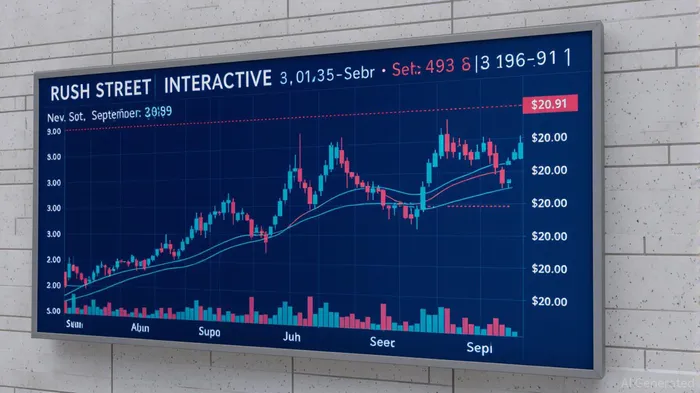
Insider selling at Rush StreetRSI-- Interactive (RSI) has sparked debate among investors, with CEO Richard Todd Schwartz and CIO Einar Roosileht offloading significant stakes in early September 2025. While some view such transactions as cautionary signals, others argue they reflect strategic diversification under regulatory-compliant frameworks. This analysis evaluates the context, implications, and broader market reactions to these sales.
The Mechanics of the Sales
Schwartz sold 193,905 shares of Class A common stock under a pre-established 10b5-1 trading plan, a structured method that automates transactions to avoid insider trading allegations[2]. The sales occurred on September 8 and 9 at weighted average prices of $20.8764 and $20.8682, respectively[3]. Post-sale, Schwartz retained 1,017,471 Class A shares and 5,546,112 Class V voting shares, the latter of which hold no economic value[3]. Similarly, Roosileht sold 70,000 Class A shares at $21.4734 per share under a 10b5-1 plan[5].
These transactions align with the Amended and Restated Limited Partnership Agreement, which outlines contractual mechanics for such dispositions[3]. The use of pre-planned sales suggests a focus on compliance rather than short-term market timing, a common practice among executives to manage personal financial planning or tax obligations.
Financial Performance and Analyst Optimism
Despite the insider sales, RSI's Q2 2025 results underscore robust growth. The company reported a net income of $28.8 million, a dramatic turnaround from a $0.3 million loss in Q2 2024, and adjusted EBITDA of $33.2 million—nearly double Q1 2024's figure[2]. Revenue surged to $269 million, exceeding expectations, driven by 61% year-over-year growth in Monthly Active Users (MAUs) in North America and Latin America[5].
Analysts have responded positively. Benchmark raised its price target from $20 to $24, maintaining a “Buy” rating, citing disciplined marketing spend (under 14% of revenue) and record first-time depositors[3]. Needham also elevated its target to $21 from $17[3]. These upgrades reflect confidence in RSI's operational efficiency and market expansion, including its pending entry into Alberta's iGaming market by 2026[5].
Investor Sentiment and Stock Price Reactions
The insider sales coincided with mixed investor sentiment. While the 10b5-1 plans mitigate concerns about market manipulation, the sheer volume of shares sold—particularly by the CEO—could signal uncertainty about short-term volatility. Following the sales, RSI's stock closed at $20.91 on September 9, a slight decline from pre-sale levels[4]. However, broader technical indicators suggest a bullish outlook: a 65.69% projected increase over three months, with resistance at $21.37 and support at $19.26[4].
The stock also rallied 2.75% in after-hours trading following Q2 earnings, which beat revenue and EPS forecasts[5]. This resilience indicates that the insider sales may not have dented investor confidence, particularly given RSI's strong fundamentals and strategic initiatives, such as the appointment of Shubham Tyagi as CTO[2].
Strategic vs. Pessimistic Interpretations
The key distinction lies in the intent behind the sales. A 10b5-1 plan, by design, removes discretion from the sale process, making it a neutral event rather than a signal of insider pessimism[2]. For Schwartz, who holds substantial voting power via Class V shares, the transaction appears more aligned with personal financial planning than a lack of faith in RSI's prospects.
However, critics may argue that selling during a period of strong earnings could reflect a desire to lock in gains ahead of potential regulatory or market risks, such as Alberta's uncertain iGaming timeline[5]. Yet, given RSI's consistent performance and analyst optimism, such risks seem overstated.
Conclusion
Insider selling at RSI should be viewed through the lens of regulatory compliance and strategic diversification rather than as a red flag. The company's financial strength, coupled with analyst upgrades and a clear growth trajectory, suggests that the sales are part of a broader, well-planned strategy. Investors should focus on RSI's operational execution and market expansion rather than overreacting to structured transactions. As the stock approaches key resistance levels, the coming months will test whether the insider sales were a prudent move or a missed opportunity to capitalize on a rising tide.





Comentarios
Aún no hay comentarios