
Insider Selling at Roblox: Implications for Investor Confidence and Share Price Stability
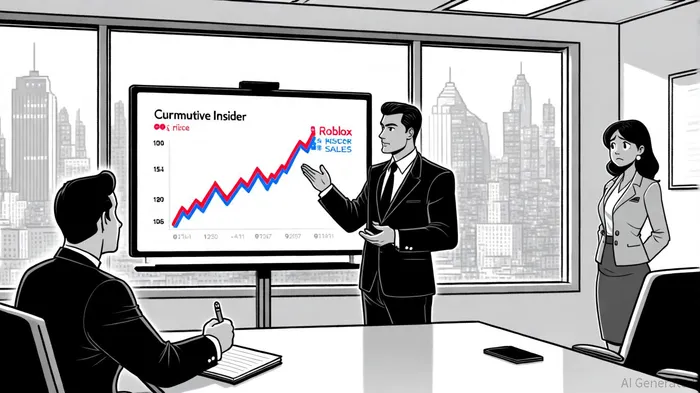
In the volatile landscape of high-growth tech stocks, insider transactions often serve as a barometer for investor sentiment and corporate health. Roblox CorporationRBLX-- (RBLX) has drawn significant attention in 2025 due to a surge in insider selling, with executives and directors collectively offloading over $16 million in shares during Q3 alone[1]. This activity, while partially attributed to tax obligations and pre-established Rule 10b5-1 trading plans, raises critical questions about leadership confidence and market perception.
Roblox's Insider Transactions: A Closer Look
The most notable sales came from CEO David Baszucki, who liquidated 288,654 shares in June 2025 under a Rule 10b5-1 plan, netting $30 million at an average price of $105.13[2]. Despite retaining a substantial stake (211,559 shares directly and 138,044 through the Baszucki Family Foundation), the timing of these sales—occurring as the stock approached a 52-week high of $145.45—has sparked speculation about valuation concerns[3]. Similarly, Lead Independent Director Anthony P. Lee sold $8.1 million in shares on September 2, 2025, at $122.74 per share[1], a price below the stock's current level of $135. These transactions, combined with the absence of insider purchases since 2023, suggest a lack of alignment with investor optimism[3].
Contextualizing Insider Behavior: Strategic or Signal of Weakness?
Insider selling is not inherently bearish. A 2025 Virginia Tech study reveals that executives often time trades around spikes in investor attention, particularly in speculative stocks[1]. For instance, insiders at Palantir and MicroStrategy executed large sales in July 2025, leveraging market enthusiasm for AI and data analytics[4]. However, the absence of repurchase activity—a key indicator of confidence—distinguishes Roblox's pattern. As noted by a report from EdgarIndex, RobloxRBLX-- insiders have sold nearly $1.96 billion in shares in 2025, with no matching purchases[3]. This unidirectional activity contrasts with companies like Unity Software, where executives reinvest in their platforms[3], and may signal a more cautious outlook.
Investor Confidence and Share Price Stability
The psychological impact of insider selling cannot be overstated. A study from ScienceDirect links insider purchases to future innovation and patent quality, with firms experiencing a 21% increase in top-tier patents following two consecutive years of insider buying[3]. Conversely, Roblox's lack of insider purchases, coupled with its 12% year-over-year revenue growth and ongoing net losses, raises concerns about leadership's long-term vision[3]. While the company boasts strong cash flow and a robust metaverse platform (97.8 million daily active users in Q1 2025[4]), the perception of overvaluation—exacerbated by a forward price-to-sales ratio of 11.34x[3]—could pressure the stock further.
Strategic Positioning for Investors
For investors, the key lies in balancing these signals with broader market dynamics. Roblox's strategic focus on advertising (targeting $2 billion in ad revenue by 2026[4]) and AI-driven platform enhancements suggests long-term potential. However, the intensity of insider selling and regulatory scrutiny (including an SEC investigation into financial reporting[3]) warrant caution. Analysts project a consensus price target of $83.52[4], but diverging views highlight the stock's volatility.
In conclusion, while insider selling at Roblox reflects a mix of liquidity needs and strategic planning, the absence of repurchase activity and the scale of transactions underscore a nuanced risk profile. Investors should monitor not only the company's financial metrics but also the evolving narrative around leadership confidence and market sentiment.





Comentarios
Aún no hay comentarios