
Insider Selling at Radian Group: A Window into Market Sentiment and Valuation Dynamics
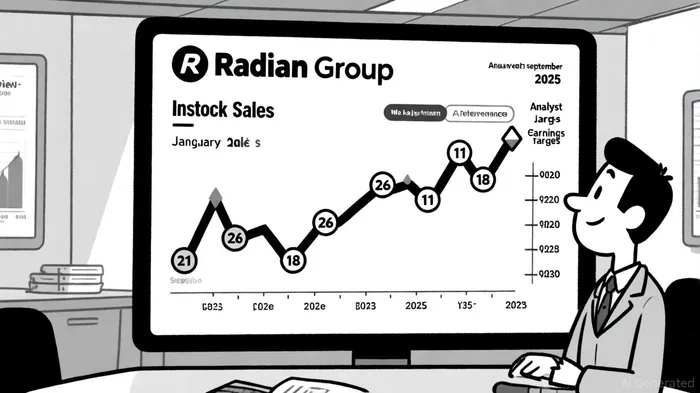
In the intricate dance of capital markets, insider transactions often serve as both signals and noise. At Radian Group Inc.RDN-- (RDN), a series of insider sales in late 2025 has sparked debate about what these moves reveal—or obscure—about the company's prospects. Edward J. Hoffman, the senior executive and general counsel, sold 10,000 shares for $370,000 on September 18, 2025, under a 10b5-1 trading plan[4]. Separately, Derek Brummer, another insider, proposed the sale of 72,519 shares through Fidelity Brokerage Services, with an aggregate value of $2.6 million[1]. These transactions, while legally routine, raise questions about market sentiment and valuation dynamics in a company with mixed financial performance.
The Context: A Mixed Earnings Picture
Radian's second-quarter results underscore this ambiguity. Revenue stagnated at $318 million, missing estimates by 1.9%, while adjusted EPS of $1.01 exceeded forecasts by 3.6%[4]. The operating margin, however, contracted to 55% from 58.6% in the prior year, reflecting increased expenses and volatility in its Conduit business[4]. Analysts have responded with cautious optimism, assigning an average 12-month price target of $36.80, ranging from $35 to $38[2]. Yet only one of five recent ratings was bullish, with three analysts adopting an indifferent stance[2]. This divergence highlights the challenge of parsing Radian's value proposition in a market prone to behavioral biases.
Behavioral Finance and the Insider Signal
Academic research underscores that insider transactions can act as a barometer for investor psychology. Cognitive biases such as anchoring and herding often distort market reactions to such sales[3]. For instance, investors may overreact to large insider sales, assuming they signal private pessimism, even when the transactions are part of pre-arranged plans. At RadianRDN--, the fact that Hoffman's and Brummer's sales were executed under 10b5-1 plans—a legal framework designed to mitigate insider trading risks—suggests these moves were premeditated and not driven by sudden negative information[1][4]. This nuance is critical: as one study notes, “trading plans reduce the informational content of insider transactions, yet retail investors often ignore this distinction”[3].
Valuation Implications: Sentiment vs. Fundamentals
The interplay between insider selling and valuation is further complicated by Radian's capital structure. The recent sales represent a small fraction of outstanding shares, limiting their immediate impact on liquidity[1]. However, behavioral finance principles warn that even minor insider activity can amplify market sentiment. For example, if investors perceive these sales as a “herding” opportunity, they may exacerbate short-term volatility, creating mispricing opportunities for contrarian investors. Conversely, Radian's management has demonstrated disciplined capital allocation, with its adjusted operating income of $173.2 million in Q2 indicating operational resilience[4]. This duality—between behavioral overreactions and underlying fundamentals—defines the current valuation debate.
Conclusion: A Signal, Not a Verdict
Insider selling at Radian GroupRDN-- is neither a definitive warning nor a green light. The pre-arranged nature of these transactions, combined with the company's mixed earnings performance, suggests a more neutral interpretation. Yet behavioral biases ensure that these sales will continue to shape investor sentiment, for better or worse. As markets grapple with the tension between algorithmic trading and human psychology, Radian's case serves as a reminder: the most astute investors distinguish between noise and signal by grounding their analysis in both quantitative rigor and an understanding of cognitive frailty.





Comentarios
Aún no hay comentarios