
Insider Selling at Ferguson Enterprises: A Strategic Analysis for Investors
In the world of investing, insider transactions often serve as a barometer for corporate health and executive sentiment. Recent activity at Ferguson EnterprisesFERG-- Inc. (FERG) has drawn attention, particularly a $699,969 insider sale reported on October 13, 2025, by William Brundage, the company's Chief Financial Officer (CFO). This transaction, involving 1,000 shares at $233.32 per share, raises questions about its implications for shareholders and the broader market.
Contextualizing the Sale
The sale by Brundage occurred amid a series of equity-related transactions by Ferguson's leadership. On the same day, the Chief Digital and Information Officer executed an open-market sale of 3,000 shares at a volume-weighted average price of $233.5163, while the Senior Vice President of Strategic Development sold 3,000 shares at a similar price range, according to a Form 4 filing. These moves, coupled with tax-withholding disposals and restricted stock unit (RSU) grants, suggest a coordinated approach to managing personal tax liabilities and diversifying holdings-a common practice among executives.
Ferguson's recent financial performance provides critical context. The company reported Q4 revenue of $7.9 billion, a 1.4% year-over-year increase, with an adjusted operating profit of $857 million and $2.98 in adjusted diluted earnings per share, according to an Investing.com article. For fiscal 2025, total revenue reached $29.6 billion, and operating cash flow hit $1.9 billion, underscoring resilience despite broader market headwinds. Analysts remain cautiously optimistic, with Citi and RBC Capital Markets raising price targets to $221 and $219, respectively, while maintaining "outperform" or "neutral" ratings, per that article.
Market Implications and Investor Considerations
Insider selling is not inherently bearish. Executives often liquidate shares to meet tax obligations, fund personal needs, or rebalance portfolios-actions that may lack direct correlation to corporate strategy. However, the timing and magnitude of sales can signal underlying concerns. In Ferguson's case, the October transactions occurred after the company expressed confidence in a second-half recovery for its end-markets, citing improving pricing and volume trends, as noted in that article. This alignment between insider activity and management's public optimism suggests a lack of material non-public information influencing the sales.
For investors, the key lies in contextual analysis. While the $699,969 sale by Brundage represents a modest portion of his holdings (he directly owns 10,995 shares post-transaction, according to his post-transaction Form 4), it coincides with broader insider activity. The Chief Digital Officer's open-market sale of 3,000 shares and the CFO's transaction collectively highlight a trend of executives monetizing vested awards-a routine practice in equity-heavy compensation structures.
Strategic Response for Investors
- Assess the Broader Pattern: A single insider sale should not drive investment decisions. Instead, investors should evaluate cumulative insider activity over time. At FergusonFERG--, recent filings show a mix of sales and new equity grants, indicating a balanced approach to compensation and liquidity.
- Focus on Fundamentals: Ferguson's Q4 results and cash flow generation demonstrate operational strength. With analysts raising price targets and the company navigating a challenging market with confidence, fundamentals remain a stronger determinant of long-term value than isolated insider transactions.
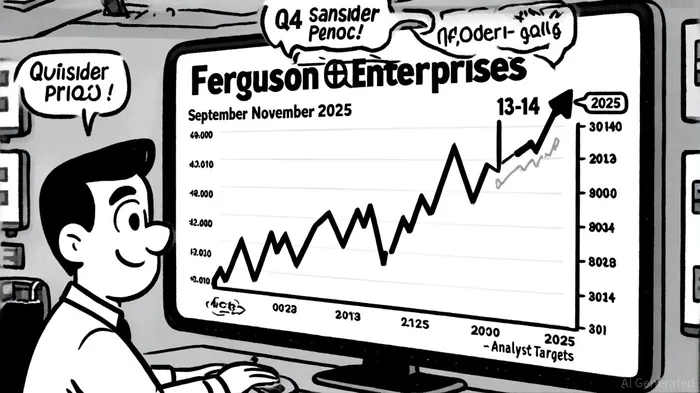
- Monitor Market Sentiment: The stock's performance around October 13–14 will provide insights into how the market interprets these sales. A sharp post-sale decline could signal investor skepticism, while stability or gains would suggest the activity is viewed as routine, as reflected on the Insider Screener page.
Conclusion
The $699,969 insider sale at Ferguson Enterprises, while notable, must be viewed through the lens of tax planning, compensation structures, and the company's robust financial performance. For investors, the transaction underscores the importance of distinguishing between routine executive behavior and material corporate developments. As Ferguson navigates a recovering market, strategic focus should remain on its operational execution, cash flow resilience, and alignment with analyst expectations.





Comentarios
Aún no hay comentarios